Every October, the Delhi government criticises Punjab’s farmers for poisoning the air. But few dwell on the temperature inversion which traps Delhi’s pollution from October to mid-February, and fewer still consider the data that shows that it is the Capital’s internally-generated sources that create air pollution for most of the year. This includes burning biomass fuels.
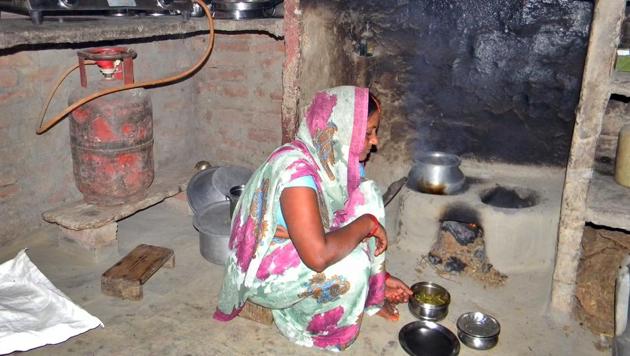
The poor burn biomass for cooking and heating. In Delhi, one of the world’s most polluted cities, 1.7 million people, or about 330,000 households, live in slums. Studies suggest only half use Liquified Petroleum Gas (LPG). The experience of the urban poor with cooking fuels has not been studied enough, although this can have a significant impact on the city’s air pollution and the health of those who use these fuels.
If the poor were to shift to a clean fuel like LPG, would air pollution reduce? In August, the non-governmental organisation (NGO), Chintan, studied the responses of two groups of women from 118 households in two slums — 61 to whom Chintan had provided free LPG cylinders, and 57 who did not own these cylinders. The criterion to receive a cylinder was that the household should have a girl in school.
We asked if any recipients had sold their cylinders. Not a single household had done so. In fact, 69% pointed out that this was the only fuel source they were using. Households were also willing to continue using LPG. Almost 80% of respondents were planning to refill their cylinders. Those who were not cited lack of money as the main reason. We found that most respondents knew that LPG was a clean fuel that did not adversely impact environmental and personal health. Interestingly, their understanding of the health and environmental benefits of fuel was conditioned by their experience of using different fuel types: The more people got used to LPG, the more they were able to understand its beneficial health and environmental impact. This could also have been because 85% of respondents used only biomass fuels (wood, coal, charcoal, kerosene, and cow-dung cakes) earlier. Thus, they had been regularly exposed to high-levels of indoor air pollution. The clear preference for LPG was driven primarily by convenience and concern for health.
{{/usCountry}}We asked if any recipients had sold their cylinders. Not a single household had done so. In fact, 69% pointed out that this was the only fuel source they were using. Households were also willing to continue using LPG. Almost 80% of respondents were planning to refill their cylinders. Those who were not cited lack of money as the main reason. We found that most respondents knew that LPG was a clean fuel that did not adversely impact environmental and personal health. Interestingly, their understanding of the health and environmental benefits of fuel was conditioned by their experience of using different fuel types: The more people got used to LPG, the more they were able to understand its beneficial health and environmental impact. This could also have been because 85% of respondents used only biomass fuels (wood, coal, charcoal, kerosene, and cow-dung cakes) earlier. Thus, they had been regularly exposed to high-levels of indoor air pollution. The clear preference for LPG was driven primarily by convenience and concern for health.
{{/usCountry}}How can this willingness to make a shift be leveraged to safeguard the health of the poor, particularly children, in slums as well as other Delhi residents? One in four children in Delhi has irreversible lung damage.
The Delhi government should ensure that every family with a child of 18 and below, attending a government school, is able to get a gas cylinder at ₹400 or less every month. This is the maximum the respondents were able to pay for any fuel. This must be accompanied by awareness. Multiple sources of money exist for this, from fines for environmental non-compliance to Corporate Social Responsibility (CSR) funds. By doing this, the Delhi government will help us all breathe cleaner air all year round.
India has dozens of comparably polluted cities. To deal with this problem, the Centre must roll-out a new phase of the Ujjwala scheme, with a focus on urban and industrial India. This time, lessons from previous experience, including price-points and the design of subsidies, should be part of the strategy. The 15th Finance Commission has allocated around ₹4,400 crore to cities with 42 million-plus population to combat air pollution this financial year. These cities — Delhi is not on that list — should lose no time in using part of these funds to ensure that clean fuel is available to the poor.
Poor urban women and children are among India’s most vulnerable. Enabling clean air inside their homes will not only ensure the right to breathe safely, it will provide Delhi with real solutions grounded in evidence instead of unfounded accusations.