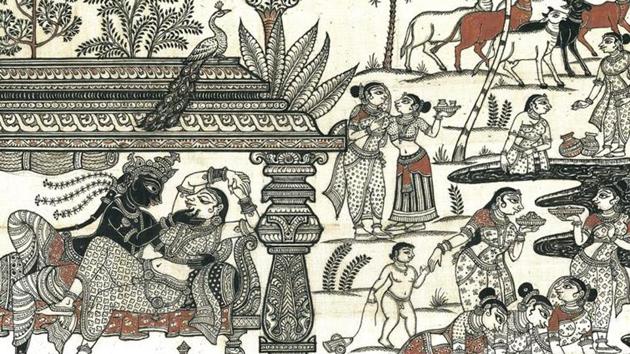
A series of Pattachitra paintings depict Radha and Krishna during the passage of seasons. But it’s the charming backdrops that get your attention. One painting shows a farmer ploughing the fields in the monsoon, while lovers walk arm-in-arm. In autumn, the gopis are shown celebrating the harvest, while in spring, they spray each other with colours.
These textile paintings are part of Bhubaneshwar-based artist Bijay Parida’s (59) first solo exhibition in Mumbai, The Dancing Line. While most of the paintings are based on Gita Govinda — the 12th century poem by Jayadeva which narrates tales of Radha and Krishna — there are also images of Jagannatha, and tales from the Ramayana.
The process involves making an outline with a metal stylus or lokoni on tussar silk and cotton cloth, and painting it with natural colours.
Parida started training at the age of 14, and learned under artist Gokul Bihari Pattnaik. “I have taken reference to the original palm leaf Odisha Pattachitra paintings which were minimal and have embellished the backdrops,” says the National Award-winning artist.
{{/usCountry}}Parida started training at the age of 14, and learned under artist Gokul Bihari Pattnaik. “I have taken reference to the original palm leaf Odisha Pattachitra paintings which were minimal and have embellished the backdrops,” says the National Award-winning artist.
{{/usCountry}}According to scholars, the origins of Odisha Pattachitra date back to the 2nd century BC, to the murals made inside the Khandagiri and Udayagiri caves of Odisha. Made on palm leaves (patta), it developed as a form to illustrate literature, poetry and horoscopes.
Unlike the Pattachitra art form from West Bengal, Parida’s art highlights the genre that originated in Odisha. “There are slight differences in technique. The main difference is that Bengal Pattachitra is made on paper, while we make paintings on fabric,” he says.
Apart from textile art, Parida has also kept wooden dowry boxes (house-shaped boxes used to store wedding gifts), as well as a palm leaf fan, depicting the stories of Radha-Krishna. The show also features an illustration of Chausathi Kala or 64 arts described in the Kamasutra during the 4th century AD. The illustrations depict common professions in those times, including that of the horse trainer and sorcerer.
It takes Parida three days to make a series of six paintings. “It takes more time to make the colours from scratch — the colour white is extracted from conch shells, black from lamp soot, and red from cinnabar,” says Parida.
The exhibition includes the Oriya motif of the Nabhagunjara — a mythical beast that is a combination of nine animals. Its origins were in a version of the Mahabharata, written by 15th century Oriya poet and author, Sarala Das.
Apart from that, there are hardly any paintings of the Mahabharata in Parida’s exhibition. “People seldom like to buy paintings on the Mahabharata; many believe that it may lead to conflicts at home,” explains Parida.
The Dancing Line is on display till April 8, 11am to 7pm At ARTISANS’, Dr VB Gandhi Marg, Kala GhodaCall 8879336068