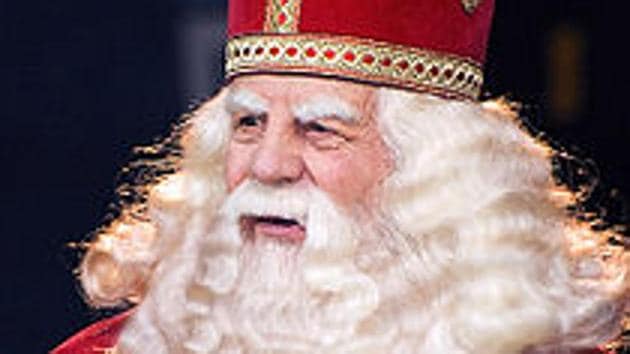
St Nicholas aka Santa Claus is believed to have lived around 300 AD in Patara, in modern-day Turkey (then considered part of ancient Greece). He was the Bishop of Myra, famous for his good work among the poor, his love of children, and his giving of gifts to the needy.
He is typically depicted as a slim figure clad in the red and gold robes of his religious office. Pictures show him adorned by the traditional halo used to represent good deeds, carrying a staff or a Bible or both.
So how did this rather staid image transform into jolly Christmas Eve figure we know now? Here’s a look at the evolution of Santa Claus from charitable icon to saint to North Pole legend.
13th century: Nicholas the Bishop of Myra was cannonised or declared a saint in the first millennium. By the 13th century, the Dutch were celebrating a tradition in his honour of putting coins in tattered shoes left outside the homes of the poor. St Nicholas did it, they would say. Over time, St Nicholas became Sinterklaas. To this day, the official Sinterklaas of The Netherlands is a rather trim, bishop-ly figure in a white robe, red cloak and bishop’s mitre, with almost-regal long white hair and beard. He travels, incidentally, by white horse.
16th century: St Nicholas is now popular across Europe. The Dutch Sinterklaas has, in many regions, become Santa Claus. Every year, the feast of St Nicholas or Santa Claus is celebrated on December 6, widely believed to be the death anniversary of the original Bishop of Myra (no one seems certain of the year, but the date is not in dispute).
{{/usCountry}}16th century: St Nicholas is now popular across Europe. The Dutch Sinterklaas has, in many regions, become Santa Claus. Every year, the feast of St Nicholas or Santa Claus is celebrated on December 6, widely believed to be the death anniversary of the original Bishop of Myra (no one seems certain of the year, but the date is not in dispute).
{{/usCountry}}17th century: Nicholas’s name and image take a turn. He is now called Old Father Christmas, or Lord Christmas, and the legend of the generous bishop in the long beard and robes begins to overlap with that of an older man in similar attire — the Old English chief god Woden, known in Norse legend as Odin. Old Father Christmas acquires his long, flowing beard and hair, and his large build. The Reformation of the 16th century has somewhat erased the Feast of Saint Nicholas; he now begins to represent the spirit of good cheer at Christmas.
1809: St Nicholas makes his way to America via Washington Irving—best known for his short story, Rip Van Winkle. It was in his first book — A History of New York — a satire on history and politics, that he described Santa Claus as a “portly, bearded man who smokes a pipe”. It was Irving who made Santa slide down the chimney too.
1810: John Pintard, an antiquarian and founder of the New York Historical Society, commissions artist Alexander Anderson to sketch the saint. Anderson sketches a trim, somewhat saintly figure in long robes and halo. More importantly, the sketch is accompanied by Christmas scenes familiar today — a smiling child next to a crying and pouting one; a fireplace with stockings hung on either side. An accompanying poem describes Saint Nicholas as a giver of gifts… on request.
1822: Clement Clarke Moore, a writer and professor at the General Theological Seminary of the Protestant Episcopal Church, writes a Christmas poem for his daughters ‘An Account of a Visit from St Nicholas’ which becomes popular as The Night before Christmas. He immortalises this version of the legend—a St Nicholas with a merry laugh, a twinkle in the eye, and a sleigh drawn by reindeer.
1863: The poem inspires political cartoonist Thomas Nast’s illustration, ‘A Christmas Furlough’, which appears in Harper’s Weekly. It shows an almost-familiar Santa, in beard, hat and coat. In later years, Nast would add a North Pole workshop for toys as well as a list of children both naughty and nice. Prints from this time feature shades of tan, and a basic sled (not a sleigh).
1864: Moore’s poem gets a range of illustrations, featuring Santas in yellow suits with yellow sack, others show Santa in blue coats, or green.
1868: Sugar Plums, an American confectionary brand, creates an advertisement that shows an elf-like Santa in a red jacket, red-and-green hat and white bloomers, riding a little green sleigh being pulled by vari-coloured reindeer (above).
1881: Nast finally debuts Santa Claus as a round-cheeked, cheerful man with a long white beard, gold stopwatch, bag full of toys, slender pipe — and a red coat. He is also wearing a delicate crown of mistletoe. He is named ‘Merry Old Santa Claus’.
1920s: It’s American artist Norman Rockwell who creates the image of Santa still used in almost every Santa mask. Some of his Santas — he created many sketches — look sad, tired, or confused. The jolly ones are the ones that stick.
1931: Coca-Cola decides to use Santa Claus in its special print ads for Christmas. Their Santa is very like Rockwell’s, except he’s in the Coke colours — red and white. The ads print across The New Yorker, Saturday Evening Post and National Geographic and become so iconic that versions are reprinted every year after. From 1931 to 1964, the Coca-Cola version of Santa is shown delivering toys, enjoying cola, visiting children and even appearing alongside American soldiers in WW2. Interestingly, Rockwell submitted paintings of his Santa Claus to Coke, but they stuck with their artist, Haddon Sundblom, who created a Santa that would look, for all eternity, a lot like him!