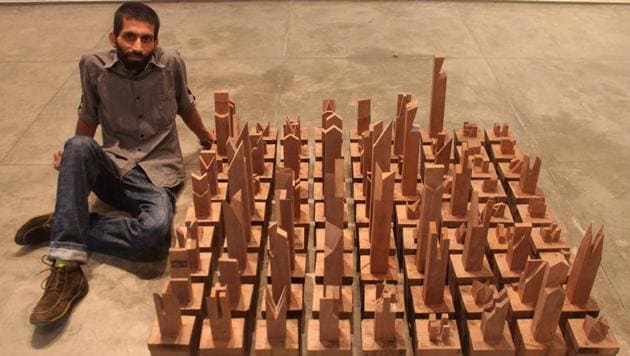
In Hindu philosophy, specifically in the Vedanta school, the physical world is described as an illusion. This existentialist concept, which is called, Maya, is one of the themes that Panvel-based artist Bhuvanesh Gowda explores in his upcoming exhibition, Ōtah Prōtah, which opens in the city on December 7.
Gowda, ironically, works predominantly with wood for his sculptures, a medium that is considered a durable, long-lasting material that is not an ‘illusion’. However, having worked with the medium for over 10 years, he feels wood can best address his questions about the universe and how we — as humans — fit in.
“While growing up, we often think about who we are, and how [we are here]. In the concept of Maya, which is also discussed in Taoism (Chinese philosophy), I read about the emptiness [within physical objects]; and everything is an illusion. But that was difficult for me to understand. So, I started reading books on Indian mythology and Eastern philosophy, and began looking for their parallels in the Western science,” he says.
The artist wanted to find empirical support for Eastern philosophical ideas. Even his exhibition’s title, which means ‘sewn lengthwise and crosswise’, is an ancient Sanskrit verse from the Vedas. It signifies that everything in our world follows a universal pattern and is interrelated.
{{/usCountry}}The artist wanted to find empirical support for Eastern philosophical ideas. Even his exhibition’s title, which means ‘sewn lengthwise and crosswise’, is an ancient Sanskrit verse from the Vedas. It signifies that everything in our world follows a universal pattern and is interrelated.
{{/usCountry}}Gowda’s research led him to Dr Fritjof Capra’s book The Tao of Physics. “According to Capra’s book, the solid portion in our body is of the size of a pin’s head. It also says that 99% of the atom is empty,” he says, talking about how the surface of a seemingly solid object — even the human body — is constantly in motion, and, consequently, an illusion.
Into the wood
Gowda’s artwork treads along the theme of interrelation, though it is also open to interpretation. One of the pieces at his show, titled Capra’s Garden, is a tribute to Capra’s book. It features a group of wooden pots with spiky wooden plants (reminiscent of skyscrapers). Each pot can be interlocked — like pieces of breakdown furniture — with another pot to make a single sculpture.
There are numerous oval-shaped pieces on show, which comprise different types of interlocked wooden bits — such as teak and jack wood. Also on display are abstract relief works, and an installation consisting of a long, antler-like piece of wood that has been carved out from a plank.
Gowda sourced all the pieces of wood over a period of two years. While his friends in his hometown Mangalore sent him some, others have been bought from stores that sell old wood from dismantled houses. At a time when artists are exploring newer mediums, we wonder if Gowda ever feels a little outdated.
“Other artists may be using new mediums, but it doesn’t always mean their thinking process is new. My medium isn’t new, but the thought process is,” he says. And, why don’t more artists use wood? “Maybe it’s because the process of creating wood works is time-consuming. Artists have the freedom to use other mediums as well,” says Gowda.
Finding a balance
According to Gowda, the show takes inspiration from magical realism, Hindu mythology and atomic physics, and blends science, and broadly, ‘the arts’. It’s the artist’s attempt to unite, or at least bring closer, the varying perspectives that people choose to believe regarding who they are and why they exist.
But because he doesn’t have the answers, his works also exude a sense of incompleteness. The oval-shaped pieces, for instance, could represent “missiles, wombs, eggs or the universe”. The artwork, in effect, has the ability to shape-shift in the viewer’s mind, once again hinting at its illusory nature.
Gowda calls this ‘energy’. “Maya is also energy. Even the Nataraja, for example, symbolises movement. At the Large Hadron Collider (at CERN, Switzerland), they have kept a statue of Nataraja. It signifies creation and destruction. So, you see, everything is connected. Everything is energy,” he says.