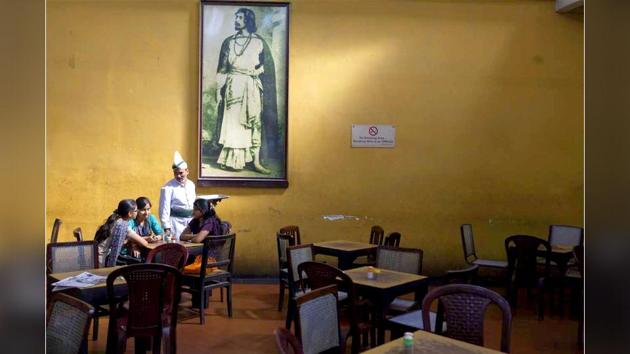
Inside the noisy Mohan Singh Place in central Delhi—a building that houses several tailors, cloth stores and some travel agency offices -- runs a stairway up to the Indian Coffee House (ICH) on the third floor. The ICH opens out to a large terrace, the first welcome being by monkeys of all sizes running around the parapet and swinging by the large tree that overlooks the terrace. Established in 1957, the modest establishment smells more of conversation and less of coffee. This is where photographer and journalist Stuart Freedman is sitting at ease, over a cup of coffee at his preferred “family section” to talk about his work, ‘The Palaces of Memory,’ a photographic ode to 20 years of visiting coffee houses across India. Tasveer in collaboration with Dauble has put together an exhibition of 40 photographs by Freedman at Bikaner House, Delhi until March 15, 2018.
Dressed in a light blue cotton shirt and a pair of jeans, Freedman knows the Indian Coffee House like his backyard. He has an old-fashioned mobile phone, on which his wife calls to tell him about the dense snow in Europe. “She knows where I am. She can recognise the sounds of the coffee house in the background,” he says. Freedman first came to India on work in 1994 and on his first visit to the coffee house, he was reminded of old English cafes and their post-war austerity. During their rule in India, the British set up the Indian Coffee Expansion Board in 1942. The idea was to have English coffee and snacks available to the servicemen posted here. In the capital, American servicemen sampled these delights in Lutyens’ Delhi—a new orderly district in the planned city.
Freedman, thankfully, isn’t one of those photographers charmed by India and its “exoticism.” “I’m from Hackney—when it was Hackney,” he says. Before its gentrification, Hackney was a rough East London suburb, known for its large-scale manufacturing units, scrap dealers and cheap warehousing. “India isn’t romantic for me. I see a lot of similarities between London and Delhi, especially in the underbelly of both cities,” adds Freedman. His photographs of the 35-odd coffee houses across India are a very personal memoir. The melancholy of the built structures as well as the nostalgia that brews in the cups of coffee are symbolic of Freedman’s years spent growing up in a grim tower block in Hackney. “The coffee house reminded me of the places from which I knew I had to escape and explore the world,” he says. His photographs employ longing and escape meticulously, especially in their depiction of empty chairs and tables, portraits of people staring into nothing while sipping on their coffee as well as the dreariness of torn sofas that have seen thousands of people come and go.
{{/usCountry}}Freedman, thankfully, isn’t one of those photographers charmed by India and its “exoticism.” “I’m from Hackney—when it was Hackney,” he says. Before its gentrification, Hackney was a rough East London suburb, known for its large-scale manufacturing units, scrap dealers and cheap warehousing. “India isn’t romantic for me. I see a lot of similarities between London and Delhi, especially in the underbelly of both cities,” adds Freedman. His photographs of the 35-odd coffee houses across India are a very personal memoir. The melancholy of the built structures as well as the nostalgia that brews in the cups of coffee are symbolic of Freedman’s years spent growing up in a grim tower block in Hackney. “The coffee house reminded me of the places from which I knew I had to escape and explore the world,” he says. His photographs employ longing and escape meticulously, especially in their depiction of empty chairs and tables, portraits of people staring into nothing while sipping on their coffee as well as the dreariness of torn sofas that have seen thousands of people come and go.
{{/usCountry}}One also notices the subtle homage to India’s Nehruvian era. Paintings and photographs of Jawaharlal Nehru, Indira Gandhi and Mahatma Gandhi feature high up on the walls of some of the coffee houses and the architecture in question is modernist, even brutalist. Freedman spends equal time sipping coffee in the houses as he does in their environs. There are several photographs of the staff, the social life in the kitchens, the terrace where they take a break and a view of the cities from the roofs of the coffee houses. Every image is a window to a social truth and a relic of a time that stands still within the walls of the coffee house.
Women, though, are conspicuous in their absence as staff members in the coffee houses. The staff, in their government-uniform like attire, present a humbling portrait of the working class, but not without showing how patriarchy runs deep in India, across economic and social classes. Freedman is aware of the absence of women and hopes that his work is able to convey those absent through those who are not. “I studied politics. And my politics is about people. There’s no artifice in my work,” he says.
Freedman’s photographs move swiftly between buildings and the portraits of people who frequent these buildings. The social divide between those who serve and those who sip coffee is evident, but not uncomfortable. This has perhaps to do with a lack of inhibition that most people feel while visiting coffee houses in India. There’s no pressure to look a certain way or have a fat wallet. The plastic chairs, bare wooden tables and high ceilings are all signs of a faded modernism, but the simplicity is also warm and inviting. Heated conversations on politics, art and culture are like old, stubborn paint on the walls. The private conversation is always part of the public discourse in the coffee house.
There’s a photograph of two men across a table at Delhi’s coffee house, as a monkey waltzes past outside, seen through the glass window. It’s a witty visual of ordinary people hanging out in a city that’s uncivil and yet home to conflicting histories. And even though many coffee houses, like the one in Delhi, face regular threats of closure, Freedman is unbothered. “If this one shuts, the space will mushroom somewhere else.” After all, the lure of a good, strong coffee is hard to resist.
WHAT: Photo exhibition The Palaces of Memory — Tales from the Indian Coffee House
WHEN: Till March 15
WHERE: Bikaner House, Pandara Road, India Gate.
NEAREST METRO STATION: Central secretariat