They are the most derided generation. Millennials (those born between the 1980s and the beginning of the 21st century) are routinely accused of being fickle, selfish, lazy, and irresponsible. They “settle down” less and later than their parents and grandparents, fritter away vast amounts of time on social media, and save money at the lowest levels ever recorded.
All this becomes worrisome when you realise that the fate of the world nonetheless rests in their hands. In India alone, millennials comprise the largest generation any nation has ever produced, which will burgeon to 500 million by 2020. Here, these young citizens already earn over 70% of the average household’s income, and constitute half the national workforce.
To be sure, along with the negative trends, there are also notably impressive aspects to the collective millennial character. It is the best-educated generation ever, and the most politically engaged. They are also highly idealistic.
The US-based Millennial Impact Project describes a “much more caring generation than generally believed, one that is complex in their depth of passion toward causes and, at the same time, straightforward in their desire for authentic interactions with them”.
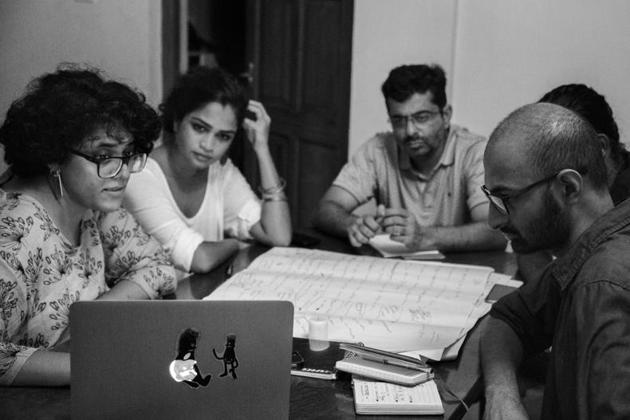
That description strikes bullseye for Jaya Ramchandani (born in 1982), Shrinivas Ananthnarayanan (1985), and Shaira Sequeira Shetty, Deshna Mehta, Akshay Roongta and Rahul Gudipudi (all born in 1987), whose collaborative efforts as the General Circle administering The Story Of Foundation have created an interdisciplinary, informal learning project to “explore and create learning opportunities across science, philosophy, art and culture, with the wider benefit of making interdependence visible”.
{{/usCountry}}That description strikes bullseye for Jaya Ramchandani (born in 1982), Shrinivas Ananthnarayanan (1985), and Shaira Sequeira Shetty, Deshna Mehta, Akshay Roongta and Rahul Gudipudi (all born in 1987), whose collaborative efforts as the General Circle administering The Story Of Foundation have created an interdisciplinary, informal learning project to “explore and create learning opportunities across science, philosophy, art and culture, with the wider benefit of making interdependence visible”.
{{/usCountry}}Next month, this infectiously enthusiastic team, drawn from across the country, will host the free, wildly ambitious The Story of Space festival in Goa, “a unique opportunity to learn about and experience space from a number of perspectives”.
Artists, scientists, researchers, educators, and philosophers from across India and around the world will turn Panaji into a “learning playground” for 10 days.
A total of 72 projects across multiple locations will include interactive installations, a film programme, workshops, talks, and panels, all planned with the aim of engaging audiences of all ages.
The story behind The Story Of is itself rather remarkable. Ramchandani, who studied physics and astronomy in Mumbai and the Netherlands, spent the 2013 New Year holiday in Goa with her good friend, the talented graphic designer Nash Paul D’Souza.
Just for kicks, they mocked up his house as a virtual digestive system, so that you could “see what happens to a pao when you eat it”. The result was a big hit with the neighbours.
In 2014, they dreamed on a much bigger scale and conjured up The Story of Light festival to “unravel the mysteries of light” on the heritage waterfront of Panaji. It was an unqualified art-meets-science triumph, as city residents like my three sons and their friends were enthralled by a range of interactive exhibits including the world’s largest cyanotype (a kind of photographic print), and a life-sized camera obscura.
Soon afterwards, D’Souza migrated to Canada and Ramchandani moved to China, where she developed “a very strong desire to make interdependence visible”. The idea is common to both Western and Eastern philosophy, she says, and is beautifully illustrated by the sciences — physics, ecology, systems biology. “It gives us mindful insight into the impact we have on others and our environment, and acts as a guide to our future decisions.”
This concept became the bedrock of her foundation’s aspirations, and its modus operandi.
The team of six young principal organisers set out purposefully bringing together scholars, scientists, artists, and thinkers from disparate disciplines, into free-ranging and intense conversations that sparked off unconventional and beautiful ideas related to The Story of Space.
The architect Manuel Scotichini and theoretical particle physicist Giuseppe Bozzi (both Italians) joined with Sanskrit scholar S Bhuvaneshwari to build interactive installations that depict different theories about the void, from ancient theology to contemporary science.
Renowned photographer and filmmaker Johnny Miller of South Africa decided to bring his acclaimed Unequal Scenes aerial documentary project of inequality to Goa, where he will use drone photography to capture stark juxtapositions between poverty and affluence.
UK-based astrophysicist Megan Argo and artist Nick Sayers joined together to map out a 4.5-km cycle ride along the Mandovi riverside to lay out the solar system at a scale of 1:1,000,000,000, to help visitors get a “scale of the planets in the context of the urban environment; gain a better understanding of their nearby neighbourhood in space; and discuss the politics and philosophy of space travel”.
Many other Story Of Space projects, installations and presentations similarly straddle the faultlines between arts, science and ethics, in a way that is singularly unique. Shaira Sequeira Shetty has worked with other arts projects, and agrees “the Story Of foundation and all its initiatives are profound and rare from every perspective you choose to look at them.”
They also take the idea of safe and mutually supportive working environment extremely seriously. Shetty says, “The General Circle is a position of accountability, where building mutual trust and keeping energy levels high is essential in creating a work environment that is fair, ethical and protective to our team. So, they evaluate constantly, aiming high at every turn.”
The aspirations extend to the festival budget, which packs immense punch despite capping out at less than Rs 45 lakh. Ramchandani says their model is “freeconomics” based on lessons from the previous edition, where “we learnt early on the secret behind successful collaborations — dialogue and emergence of common objectives.”
While a good portion of the funds came via a crowdfunding campaign and a handful of sponsors, non-cash exchanges power a significant part of The Story of Space, including collaborations with state and national government (for both funds and venues), educational institutions (which lent materials) and foreign embassies (who have been willing to fly in participants).
The absence of a big name sponsor suits the thinking of Deshna Mehta, whose Mumbai-based design studio Anugraha “would be delighted to design for anything except luxury brands and things that promote consumerism in general”. She says, “I value the pool of people and community this festival has attracted. Each interaction has offered a different perspective and helped me to get to know myself better. It would be appropriate for me to say that the journey has clearly been the destination.”
All that high-blown rhetoric seems almost fanciful until you spend some time with this upbeat team, and realise they are committed to their principles.
Akshay Roongta, who handles foundation strategy, says, “It really works because everybody has so much empathy for each other’s situations”, while Shrinivas Ananthanarayanan (who manages communications) says he’s learned “an invigorating and astounding lesson about what the power of a community-driven project can truly achieve.” Lead fundraiser Rahul Gudipudi says the festival proves that “people are able to do more than they believe they can”.
Over the years, those of us who live in pleasant little Panaji have seen it improbably explode into a cultural hub of international significance [see box] with large-scale cultural events lined up back-to-back from November to February each year.
I co-founded and curate one myself, along with eminent Konkani writer Damodar Mauzo. The Goa Arts + Literature Festival is in its eighth year. But even in this crowded, exceptional field, what Ramchandani and friends are doing, and how they are setting about achieving their goals, stands out as particularly inspirational. And that bodes very well for the millennial-moulded future.