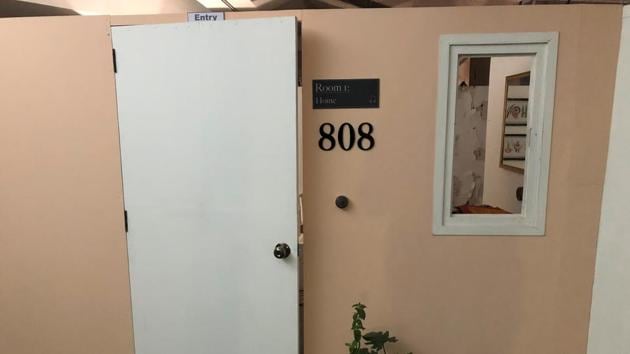
It’s reported that war, violence and persecution have forced more than 65 million people the world over to leave their homes. Over one-third of this population is refugee. To bring home the hardships of a refugee life, an ongoing exhibition in Delhi, titled Passage to Asylum: The Journey of a Million Refugees, features a series of six contiguous installations or rooms, depicting a refugee’s journey from home to conflict and an asylum.
The art show, organised by Migration & Asylum Project, makes a visitor feel invited to negotiate a space that has been created through an interplay of objects and light in each room. In some places, the visitors are driven to navigate through the installation just like how asylum-seekers are bound to navigate the perils of their journey. In other sections, visitors become part of the installation as they venture through it.
The structure of installations, as well as their order, and the objects they contain, have been carefully chosen to illustrate the lived experience of an asylum-seeker, literally as well as through metaphor.
Artist Kalyani Nedungadi, who has conceptualised the show, says, “I had already been working on digital stories that document the refugees and their interactions with the legal bodies. Last February, we had discussions to do a series of six art installations as a kind of immersive experience. In September, we started working on them and created something for people who are not used to speaking about this topic, so that they can come and walk through.”
{{/usCountry}}Artist Kalyani Nedungadi, who has conceptualised the show, says, “I had already been working on digital stories that document the refugees and their interactions with the legal bodies. Last February, we had discussions to do a series of six art installations as a kind of immersive experience. In September, we started working on them and created something for people who are not used to speaking about this topic, so that they can come and walk through.”
{{/usCountry}}There’s an audio guide in each room to help the visitors navigate. “A visitor can pick any four refugees profiles in the form of cards at the beginning of each room. The experiences that refugees go through are varied, but the upheaval is common. And, all these are based on real cases,” adds Nedungadi.
The artist collaborated with architect Maya Gupta to come up with these installations and the two used the emotions of distress as their primary reference. And, having crossed through the installations, if you don’t go to the asylum, you will reach the ‘Deportation corridor’, which will definitely make you wonder the plight of a refugee.
Follow more stories on Facebook and Twitter