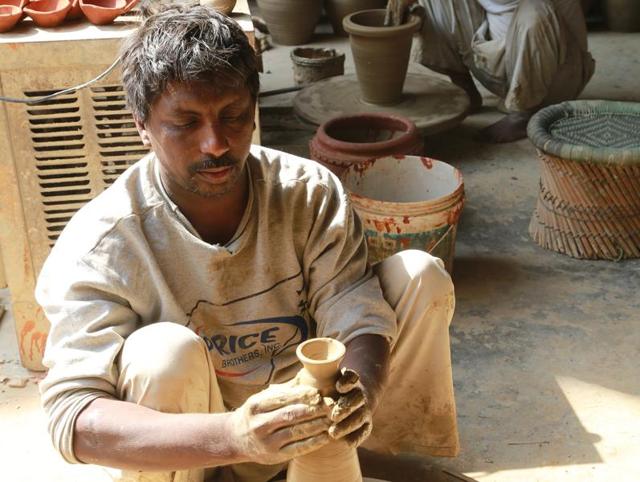
Before you start rummaging through markets for attractive, pocket-friendly and Make in India Diwali decorations, explore the heaven of pottery in West Delhi — Kumhar Colony.
Located in Uttam Nagar, the place is a hub of potters who create intricate patterns in pottery, for Diwali artefacts. Working since several generations, these kumhars (potters) use clay to bring to life to diyas, idols of deities and other festive decorations.
Jagmohan, a third generation potter, rues that the progress in technology haven’t touched the lives of potters. “Even in the digital era, there has been hardly any progress in our community. We’ve only one electronic device — the wheel,” he says, perfecting the round of a diya.
Twelve potters residing in this colony are national awardees, yet most are unable to make profit. “We sell a diya for Rs 2 to the shopkeepers who further sell it for Rs 10. If we had a proper platform, we could have earned a better price for our creations,” says Sunita Kumari, a fourth generation potter.
She adds, “Buyers do pay a good price for the pottery products that we make, but the profits never reach us.” Their concern arises from the hard work that they put in, to bring the mud from Jhajjar (Haryana) and the red soil from Rajasthan. “The red soil is used for adding colour,” says Jagmohan.
Another artisan, Chameli Rani, whose family has been making clay artifacts for more than 100 years, says, “Our work is popular among wholesalers but I wish that locals also get to know about us. That way, we can avoid the middlemen and earn more.”
{{/usCountry}}Another artisan, Chameli Rani, whose family has been making clay artifacts for more than 100 years, says, “Our work is popular among wholesalers but I wish that locals also get to know about us. That way, we can avoid the middlemen and earn more.”
{{/usCountry}}The process
1. The potters sieve the soil and mix it with water to make it dough-like.
2. The dough is placed on an electric wheel to mould it into desired shapes. Various instruments are used to add details. Once carved, the pottery is left out in the sun to dry.
3. When dried, the potters add finishing touches to them and dip the artifacts in red soil. Paints are also used, to make them appear colourful.
Get to know them
The Kumhar Colony has 12 potters who have been awarded by the state. One of them, Harkishan, was honoured with the national award in 1990 and the Shilp Guru award in 2012. Other artists, who have been awarded, include Giriraj Angoori Devi — who was felicitated with Shilp Guru award in 2006 and national award (1987), and Giriraj Prasad — who was also honoured with a national award (2013).