The love of Radha and Krishna is immortalised in temples, Pahari art, classical music and dance, and through the festival of colours - Holi. But while there are several references to Radha in popular culture, she makes fleeting appearances in scriptures.
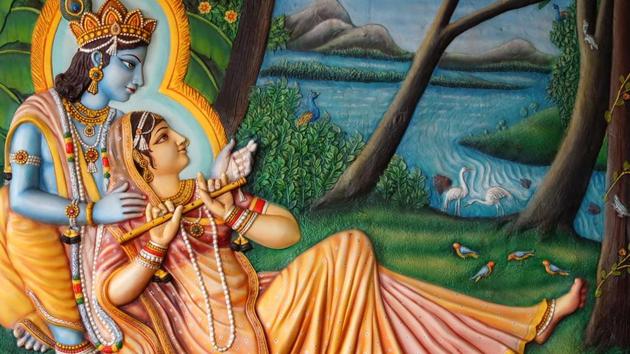
Radha is referred to as a special gopi in Jayadeva’s poetic composition Gita Govinda, as Krishna’s consort in the Sursagar composed by poet Surdas, and as a goddess in the Gaudiya (Bengal school) of Vaishnavism. And while she isn’t seen in the temple Srinathji Ki Haveli in Nathdwara, Rajasthan, she is symbolised by the flute in his hands. But who was Radha really?
Radhayan, a recently released book by scholar Harsha V Dehejia, explores the many stories that feature Radha. The central protagonists in the book are modern-day students Jay and Padma (reincarnations of poet Jayadeva, who wrote Gita Govinda and his dancer wife Padmavati), who embark on a cross-country journey to learn more about the mythical Radha. Their quest takes them to Odisha, Bengal, ancient Mithila, Indore, and Nathdwara, among other places.
Dehejia, a practising physician as well as a Professor of Indian Studies at Carleton University, Canada, found Radha fascinating because of her enigmatic nature — she is depicted in myriad ways and plays divergent roles in mythology. He spent over two years researching and writing this book. For reference, he studied the Bhagavata Purana, Gita Govinda, Maithili poetry by Vidyapati, Chaitanya Mahaprabhu’s life, and modern Hindi poetry, among other works.
{{/usCountry}}Dehejia, a practising physician as well as a Professor of Indian Studies at Carleton University, Canada, found Radha fascinating because of her enigmatic nature — she is depicted in myriad ways and plays divergent roles in mythology. He spent over two years researching and writing this book. For reference, he studied the Bhagavata Purana, Gita Govinda, Maithili poetry by Vidyapati, Chaitanya Mahaprabhu’s life, and modern Hindi poetry, among other works.
{{/usCountry}}Dehejia’s research showed that Radha has a rich and robust presence in Sanskrit and Brajbhasha that dates back to the 12th century. “Radha is essentially kavyamaya — born in and celebrated in poetry and song. She is best understood in the folk songs of women in various regions of India. As a goddess, she is present mostly in the north west of India. Maharashtra and the southern states do not recognise her, but even there, she appears in song and dance,” says Dehejia.
Radha also occupies a special place in Indian arts and aesthetics, and is celebrated through poetry, songs and art. “Miniature paintings, from the 16th century onwards (in Rajasthan and the Pahari regions), celebrate the presence of Radha. Folk arts such as the Chamba rumal embroidery or Sanjhi paper craft in Mathura, terracotta art in Bengal, and the paintings of Madhuban in Bihar, celebrate the love of Radha and Krishna,” adds Dehejia.
Radha continues to evoke mixed reactions from people, and remains unconventional and multi-faceted. ”The ethically minded might call her an adulteress, feminists may find her coy and demure, but lovers and devotees find her devotion to Krishna inspiring,” sums up Dehejia.
Radhayan – The Story of Radha through Myth, History and Fiction by author Harsha V Dehejia, is priced at Rs 1,195. Publisher: DK Printworld. Available at amazon.com
Follow @htlifeandstyle for more