
 E-Paper



Edward TG Anderson: “Hindutva is now a significant feature of diasporic identity”
The author of Hindu Nationalism in the Indian Diaspora talks about the impact of Hindutva on the diasporic community and the role of the Internet in its rise

 Prefer HTon Google


How has Hindutva ideology over the years become an important aspect of Indian diasporic identity, especially in Britain?

Hindutva in the diaspora is not a new phenomenon. It is quite widely known that Savarkar himself spent time abroad (albeit before he authored the seminal, eponymous work on Hindutva). But it is perhaps less well known that RSS shakhas have operated outside India since the 1940s. Things have developed quite rapidly over the past couple of decades – as of course they have in India – and Hindutva is now a fairly significant feature of diasporic identity for many members of the Indian diaspora. It influences the way people engage with the homeland – its history, culture and politics. But it also helps people to navigate life in a multicultural context in places where Hindus are a relatively small minority. It provides people with a sense of community, pride, assertiveness and tools to negotiate identity and politics.
One important point to note though, is that it almost certainly does not represent the perspectives of all people of Indian origin and Indians overseas. Probably not even a majority, although the received wisdom can sometimes suggest otherwise. There is a rich liberal, progressive and radical tradition amongst Indians overseas – both historically and today – and they are often at loggerheads with those whose Indianness is defined by Hindutva.
What were some of the most revealing findings during your research on the impact of Hindutva ideology on diaspora communities, particularly in the British context?
It’s hard to single out one aspect of the research. Part of what I’m trying to do is to understand transnational Hindutva with nuance and in all its complexity. But one thing I found fascinating was that for second and third generations, or those who moved to Britain as children, their understanding of India and Hindu culture was sometimes mediated through Hindutva. Diasporic Hindutva has often played an educational role, with groups including the Sangh and the VHP functioning as a way through which parents can convey culture, values, heritage, national myth, and so on, to children. This is one way in which we might think about global Hindutva as providing certain ‘services’ or ‘functions’ to a diasporic audience.
I am also very interested in the extent to which Hindutva overseas is ‘coordinated’ – a kind of export from India – or if it develops organically, and evolves and shifts in new directions. The reality is somewhere in between. For instance, some aspects of a shakha overseas would be very familiar to an RSS swayamsevak in India, but other things would feel very different indeed. And, clearly, Hindutva functions differently for those who are part of a majority community in one country (India), compared to for those who are a fairly small minority elsewhere around the world. Of course the ultimate goal of transforming society has to be readjusted.
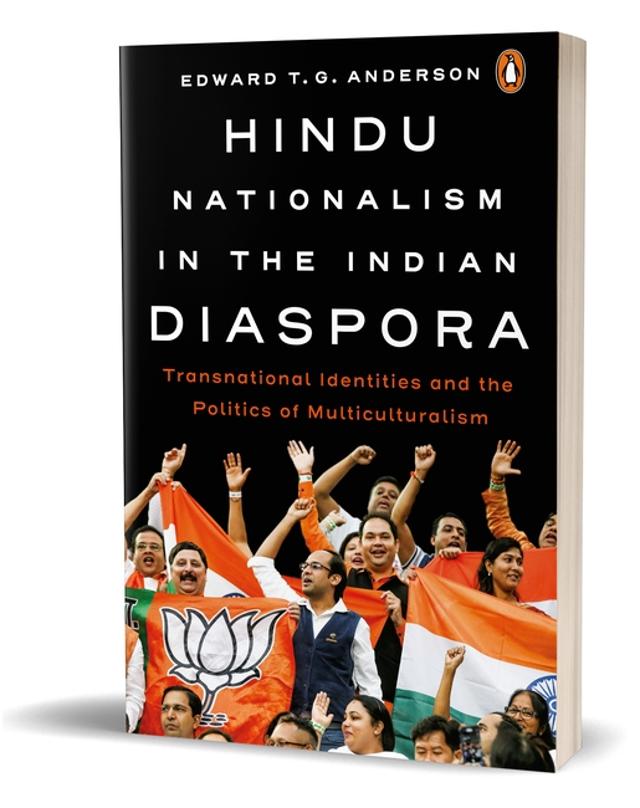
What has been the impact of the rise of Hindutva nationalism in the diasporic community in the UK and US on multiculturalism and interfaith relations? And how does it influence community relations especially when it comes to minorities, including the diasporic Muslim communities?
Hindutva plays an interesting role in relation to multiculturalism and interfaith relations – things that require community representatives to come forward (often in a self-selecting way) as the individuals and groups which ‘speak for’ large, often very diverse, communities of people. Various groups vie for these roles, and it is often the case that groups which embody certain forms of Hindutva ideology have been keen to speak for an ostensibly monolithic Hindu community. Through these positions, some have attempted to police representations of Hinduism, resisted proposed legislation that would outlaw caste, and participated in Islamophobic discourse. Some groups also enthusiastically advocate for certain factions in India, and lobby for certain kinds of politics and policies which they espouse.
Do you also look at similarities with nationalism of other diasporas such as Chinese, Jewish, African immigrants etc compared to Hindu nationalism and how it shapes the transnational identities?
My work isn’t particularly comparative in nature, although there are certainly plenty of parallels and comparisons to be drawn with other diasporic communities and different forms of so-called ‘long distance nationalism’. I do consider in the book, in a few places, ways in which Jewish groups – and to some extent transnational advocacy for Israel and Zionism more broadly – have served as an inspiration for many in the (diasporic) Hindu nationalist movement. This is also an area that has been a specific focus for Azad Essa, in his recent book Hostile Homelands.
You write in the book that important and influential expressions of Hindutva can be found in much less known groups or even organizations that do not explicitly espouse Hindu nationalism. Can you elaborate on this and how these groups and organizations have shaped Hindutva nationalism in Britain and America?
This is a significant trend that seems to have developed and grown quite markedly in recent years. There has been a kind of ‘saffronisation’ of a large swathe of the landscape of Hindu and Indian communities overseas, particularly over the past decade. Previously one might expect to find Hindutva primarily emanating from groups that are connected to, or formally part of, the Sangh’s extended ‘family’. But in the twenty-first century it seems as though a lot of groups, which are framed as mainstream or representative Hindu groups, covering a wide range of different constituencies and remits, are de facto exponents of Hindutva ideology. It is often not well understood by wider publics in Britain, America and elsewhere. And so sometimes these groups are able to enter spaces that might be harder for explicitly Hindu nationalist groups to access. This trend is something I’ve tried to understand through the paradigm of ‘neo-Hindutva’, and it seems to be an important and evolving phenomenon.
That were some of the diverse materials and Hindutva literature disseminated among the diasporic Indian community over the past decades, which you were able to access, and what has been its potential impact?
Hindutva literature has been circulated globally for many decades. Historically, this has largely been in the form of pamphlets, newspapers, magazines and books. The RSS publishes much of this material ‘in house’. Some of it is specifically directed at the diaspora, such as the interestingly-titled 1990 booklet, Hindus Abroad - Dilemma: Dollar or Dharma? The circulation of texts like these are important on many levels – they provide a form of connection between people spread across the entire world, and enable a controlled and consistent set of ideas and practices to be shared widely. As for the question of impact, this is very hard to ascertain and measure, although certain ideas spread through texts definitely seem to be influential and significant for much of their audience.
But it’s also the case that Hindutva literature doesn’t just originate from the ‘homeland’ – much is produced and circulated within the diaspora. An example of this is Sangh Sandesh, the official newsletter/magazine of the Hindu Swayamsevak Sangh (which is the name of the RSS’s equivalent outside India). This was first produced just after the Emergency in the 1970s. During this period, Indira Gandhi banned the RSS along with many other groups, and Indians overseas (including those affiliated with Hindu nationalist groups), were involved in anti-Emergency activism.
More recently, the Internet has transformed the circulation of ideas, which has almost totally superseded printed texts as a medium by which Hindutva is consumed.
What role has the internet and social media played in the rise of the Hindu nationalism among the Indian diaspora in countries like Britain and the US? You write in the book that it is more prominent in India and the diaspora given its “legions of fanatical keyboard warriors” than anywhere else.
Indians abroad were early adopters of online technologies to share ideas, using a range of pioneering platforms and spaces. Global Hindutva and the internet have also gone hand-in-hand for a very long time.
The Internet has transformed the way in which diaspora communities remain connected to their homelands: people have access to news and other online content on a constant basis. But it isn’t just a case of consuming content – social media and messaging platforms enable interactions and influence to flow in all directions. This connectivity has been enormously important and impactful for members of diaspora communities in numerous ways: it could be a means of interacting with extended family and friendship networks, consuming culture, or participating in political discourse and processes.
Lots of people have shown how the Internet has also been particularly significant for nationalist, populist and communal politics around the world. Ideas - and very often disinformation and rumour - spread rapidly around the world with the help of online activists or so-called ‘keyboard warriors’. I’m not necessarily suggesting that online spaces are inherently damaging or toxic. Technology has enabled people, often separated by considerable distance, to cultivate a sense of community and belonging. But it has also amplified chauvinism, intolerance and falsehoods in new and concerning ways.
Majid Maqbool is an independent journalist based in Kashmir.
----


