Please talk about your experience of translating Salma’s book, The Dark Hours of the Night?
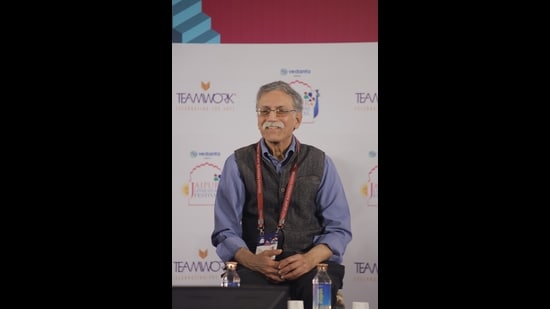
Mine is a second translation. It was first translated by Lakshmi Holmström nearly 15 years ago. When Salma and her Tamil publisher, Kannan Sundaram, asked me whether I’d like to translate it, I said, ‘But hasn’t this one already been translated?’ To which they replied that they wanted a new one. Salma said that the book is now forgotten and needed a new translation
Please talk about your experience of translating Salma’s book, The Dark Hours of the Night?
Mine is a second translation. It was first translated by Lakshmi Holmström nearly 15 years ago. When Salma and her Tamil publisher, Kannan Sundaram, asked me whether I’d like to translate it, I said, ‘But hasn’t this one already been translated?’ To which they replied that they wanted a new one. Salma said that the book is now forgotten and needed a new translation for this generation.
The question I had, as a translator, was how would I know if my translation ended up being similar to Lakshmi’s. She is one of my favourite translators. Some of my methodology comes from what Lakshmi used to say about her own translation process. But we differed on one aspect: language. She was very British, and I’m very Indian. I asked Kannan and Salma, ‘Do you realise, you’re moving from someone who has translated for the world to an Indian translator?’ That’s what’s missing, said Salma. For her, the earlier translation sounded too foreign. Lakshmi would try to render phrases and slang in British English to suit her English audience. She was a great translator, who would read everything by the writer or around the novel published over the last 15-20 years, but she was a translator of Tamil for the English, and I’m for Indians.
What a language means to one person may be different for another. In my own family, my mother uses Hindi that people around her find hard to understand.
That’s what I mean when I say that, in your own language, there are words that have a peculiar meaning only for your family. They won’t have the same resonance for others, but you’d understand the meaning immediately. It’s like a private joke. Despite the worlds of reference being different for each one of us, don’t we manage to communicate? That’s why I say that each one of us is a translator, but we don’t know it.
There’s no such thing as Hindi monolingualism. Hindi is 50 languages, and the same goes for Tamil. There are varieties of it. For example, Imayam’s Tamil is different from Salma’s, and Ambai’s is different from others; hers is pollinated by Marathi, Gujarati, and Kannada. And each of theirs is rooted in their context, locality, community, and culture, and my job as a translator is not to be apologetic in using the Indian terms that help communicate the culture if the resonance is preserved. I render words in English equivalents only where there’s an assumption that others will get it, because with this assumption, we move into another kind of hegemony, that Hindi is widely understood across India more than, say, Tamil.
The use of scientific terms, in particular when it comes to translation, is interesting. As an engineer, I can’t help but notice this similarity. You used ‘pollination’ and ‘resonance’.
I did engineering for two years, and I usually come from science when I talk about translation, to show what it is not.
A translation is an object being taken across space and time in a manner that, at the end, the molecules of the object are in the same relationship with each other as they were in the beginning. That’s physics mostly, but people expect the exact same in literary translation.
When you say you’ve read Márquez, you’ve read the English translation. You’ve read the translator’s text, not Márquez’s. That’s what I tell all my translation students: don’t expect that the text you produce should have the same constituent parts, in exact ratio, a replica of the original text. It won’t be.
While translating, your fidelity or loyalty should be to your own feelings. When you read something, you create this picture of the novel, that’s what you translate: your reading experience. And your reading experience should become your reader’s reading experience, because a translation can never be the same; it’s always similar. People talk about ‘lost in translation’; isn’t there loss in writing, too? Despite what you intended, don’t readers infer a different meaning from what you wanted to say?
If a writer is willingly describing a few things to avoid any confusion, they’re often labelled as translating for the ‘West’, as if everyone in India understands the idiosyncrasies of languages other than those they read and write in.
That’s the problem — people don’t use the same term for the same thing across India. Sometimes, if you say something very common to you, in your region, in the next region, they’ll wonder what you’re talking about.
You edited the anthology India in Translation, Translation in India. It has been a while since that book came out. What do you make of the changes in publishing about translation?
The book still has great relevance. Now, to think of India as always in translation and to think of English as a language in translation, I’d say that there’s an increased acceptance of translation in the Indian market. Earlier, people used to say there isn’t a translation market, which is true to an extent even now, but what they essentially were talking about was reach, if there are translators or readers of works in translations. There aren’t enough translators. It isn’t a big market yet, and given what India is, there should’ve been a huge market for translation.
The problem, however, is that Indians who want to translate want to translate into English. Or they want themselves to be translated into English, to show the world, so, I think, they’re not thinking of India as the world. That’s what I’ve been saying: ‘Think of India as the World’. Then, you’ll not only want to be translated in English but also in languages other than English.
What do you think is a good translation?
Translation is an impossible task. Because one feels certain things won’t have the same impact as the reference frames aren’t the same. You’ve got people saying that they didn’t like a particular thing. I’d say, if you can make it better, do it. Good luck to you.
Sometimes I feel, in India, people nitpick. Tamilians or Bengalis will read something in English translation only to nitpick. As Salma said to her friends who told her that something wasn’t well done, ‘Okay, you do it.’ But they don’t want to do it.
Because it requires time, effort, and labour.
Certainly. But the point I’m making is that very often a translation is an interpretation. My reading of a book informs my translation, and I don’t emphasise certain things that weren’t important in my interpretation, which may be important for someone else. So, any other translation is just a different reading.
After having translated Salma’s book, I read Lakshmi’s version, which I hadn’t read before to avoid being influenced by her, and I found that it was a very good translation, but different from mine. Many would say they liked hers over mine, and vice versa. And that’s fair.
But isn’t it the same case while reading a book written in English? If you read Salman Rushdie’s Midnight’s Children, you’ll find passages that are so boring, and then there are passages you get stuck with. Because it takes an effort to read, you tend to go back to the page that interests you. Imagine it’s a major book, it’s a major writer, yet not every passage works for you. The same is the case with Arundhati Roy’s The God of Small Things. So, there are certain things that you can do in English and certain things you can do in other Indian languages, which can’t be done in English, and if you try to do that, it’ll read odd.
For example, if you read early pioneers of Indian writing in English, say, Raja Rao, you’ll find the usage of ‘sala’ peculiar. There’s a text that reads: ‘Come here, you brother-in-law.’ And there’s one, because sala is also used as an insult: ‘Don’t call me brother-in-law. You can’t insult me like this’. And connotations of sala have evolved ever since: it was used to question the honour of your family earlier; it was a deadly insult. Over time, it has become a term of affection. So, one pondered on the use of sala when it was translated. Because, within your culture, when you’re reading, you’re taking everything for granted.
Saurabh Sharma (they) is a nonbinary, queer writer, essayist, and culture critic. On X: @writerly_life; Instagram: @writerlylife.
One Subscription.
Get 360° coverage—from daily headlines
to 100 year archives.
Archives
HT App & Website