Stories the Fire Could Not Burn, a part memoir about the loss of home, chronicles the Kuki-Zo tragedies in the ethnic conflict between the majority Meitei and the minority Kuk-Zo community in the violence in Manipur between 2023 and 2025. How did you balance the personal with the collective narrative?
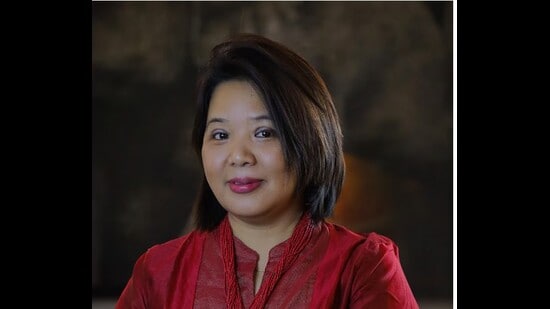
I write what I know and what impacts me personally, and about the most horrifying humanitarian crisis that has happened in my lifetime. I’ve seen successive governments come and go. Manipur was never at peace anyway, but not to this extent. There has never been such animosity between communities because we’ve always held it together by some force or the other. Manipur is like a little India. Imagine about 29 different tribes living together. And it was an unspoken truth that we all knew: that the Meiteis were like big brothers. We would never pick a fight with them. How did it even happen? I was searching for answers as to how could something of this magnitude happen, and how it could be allowed to go on festering. I centered the book around home because home is supposed to be the safest place, and when the safest place is removed, destroyed, burned, there’s really nothing left to say.
I had to contextualize it through my own lived experience. But it’s not really about me or my family. In fact, at times when I read it, I feel a little apologetic — who will want to read my story? Who am I? But then it was very necessary to route it through a story that is lived and experienced.
{{/usCountry}}I had to contextualize it through my own lived experience. But it’s not really about me or my family. In fact, at times when I read it, I feel a little apologetic — who will want to read my story? Who am I? But then it was very necessary to route it through a story that is lived and experienced.
{{/usCountry}}People were killed, homes burned, and thousands displaced. The state has been segregated — all Kuki-Zo people were forced to leave the Meitei-dominated Imphal valley and all Meiteis the Kuki-Zo dominated hill areas like Churachandpur. You write about the terrifying circumstances in which your family escaped. Tell us about your family’s relationship with Imphal.
Home was Imphal for us. My grandfather was one of the early settlers from the hills who came there. Ethnically, I belong to Churachandpur. But I was born in Imphal. Home was Imphal for us. Now my parents are in Guwahati. Now, when they think of home, they’re only reminded of that night. So, they’d rather not think about it. I left home when I was 13. I went to a boarding school in Kohima. Gradually, it was like testing the waters — further to Shillong, and finally Delhi. We had to leave. We left because Manipur was so unstable.
What was it like growing up in the shadow of violence?
Sometimes in school, there’d be sudden bandhs. The bell would ring and we would rush out. We would wait for somebody to come and pick us up...
Or if you’d hear a gunshot — an encounter just behind a house or behind a lane, and we would run up the terrace to see. My sister and I would go out looking for it. One morning, I remember people running behind the house, and my sister and I also just ran along. One man was shot at night and his body lying next to a fish pond. We went looking out for things like that. Can you imagine how dreadful it is that we went chasing for all of this?
There really was no concept of eating out. The year restaurants and cafes started opening, people who had left Manipur began returning — signs that things are being repaired. But it was all very superficial when you think about it because it never addressed the simmering root cause that the hill tribes forever felt neglected and that Imphal did not want them.
You write of always being cognizant of the differences between Meiteis and Kukis — that the communities coexisted in Imphal but there was no cultural assimilation.
Meiteis are Imphal centric. They don’t know how to pronounce our names and can’t speak our dialects. We know everything about Meitei culture. We speak their language because obviously Meiteilon is a common language. There are different tribes — Paite, Vaiphei, Mizo, Hmar... — we all speak different dialects. Meiteis’ know very little about the hill tribes. We were very careful because we felt that perhaps they don’t like us; that they thought, ‘How can these people, these minorities actually get where they have?’ My community, the Kukis, are very progressive. Meiteis have art, they have music, they have culture. Meitei society is very well-equipped, very self-sufficient. Therefore, they could pursue art, literature, culture. The government is theirs; everything is theirs. It was very convenient for them to think that the dynamics will not change. But relationships were always very cordial. People who gave shelter to my parents are Meiteis. And it was also a Meitei who saved Jamngaihkim Gangte. Even now, from Imphal, Meitei friends send me packets of dried fish. There are old ties. They would call my mother, but my mother is too hurt. Some of my closest Meitei friends have not spoken to me, I have not spoken to them. It’s just very uneasy. It’s made it very uncomfortable for people to look each other in the eye.
The book, you state quite explicitly at the onset, is not seeking to be neutral. Later, even while engaging with trolls on social media, you write about trying to understand things from their side as well. What was that process of reconciliation?
I said I could not be impartial because I’m not telling their story. I’m telling my story. When I look at the trolls — nameless, faceless, they’re doing what they’re supposed to do. Or they’re also very helpless and if they say one negative thing against me, they feel, okay, I’ve done my duty. I get that.
But then, though the frustration level is the same, the magnitude can never be the same. The Meiteis who went from Churachandpur, they were sheltered in Imphal. The government took care of them. The Kuki-Zo people — nobody took care of them. Even relief materials took very long to reach Churachandpur. The quantum of suffering can never be the same because we had no state backing.
At the same time, I know where they’re coming from. I get it. They are a product of a broken system. I am also, to an extent.
You were in Gurgaon while it all unfolded. While you didn’t experience the violence firsthand, you tried to call for help, terrified for your family, for your community. Your husband is Punjabi, so there’s, I would imagine, a loneliness in your everyday grief. Tell us about that.
I wept and wept and wept. I took therapy and the psychologist said the grief that you feel is the same as somebody losing a loved one.
I’m very protective of my husband and son, and I don’t want them to know what I’m going through. I want them to be strong. I want them to be there to pick me up, but I don’t want to pull them in my sorrow, because they’re the only safe reserve that I have. If they felt that loss so deeply, who will pull us up?
Saudamini Jain is an independent journalist. She lives in New Delhi.