
 E-Paper



HT Picks: The most interesting books of the week
Books on the religio-political space in Pakistan, the internment of the Chinese-Indians, and a biography of VP Menon feature on this week’s reading list

 Prefer HTon Google


SOUL RIVALS; STATE, MILITANT AND POP SUFISM IN PAKISTAN BY NADEEM FAROOQ PARACHA
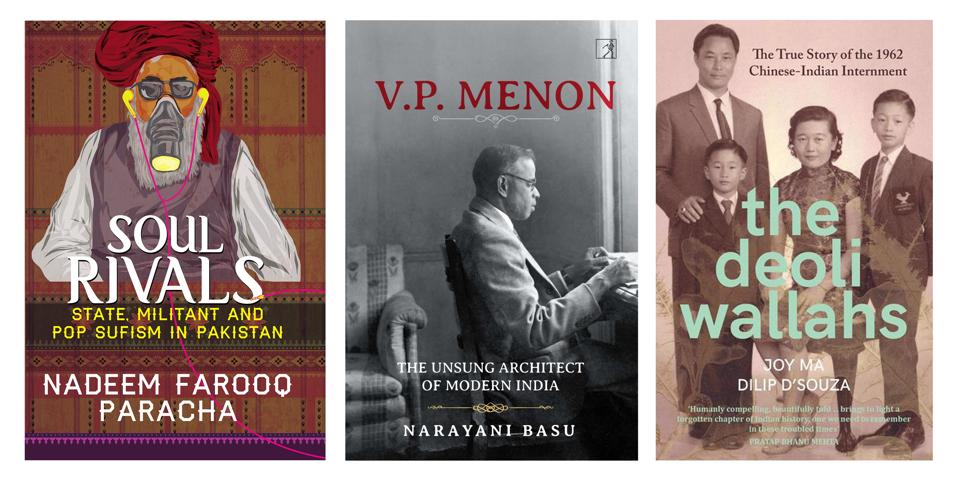
Sufism has always been a contested space in Pakistan. Successive governments, political parties and religious organizations have attempted to co-opt it or reject it to suit their own political agendas. Since the turn of the millennium, however, the Pakistani government has made a conscious effort to recast Pakistan as a Sufi country – a whitewashing endeavour.
In the past few decades, Pakistan’s image has taken a severe beating, ravaged as the country is by the rise of religious extremism. A focus on the syncretic culture of Sufism was seen as a way to reverse this damage without the need to explore more secular narratives and alternatives as almost every attempt at genuine reform has triggered extreme reactions from the politico-religious segments of the society that were empowered through various controversial constitutional amendments and laws between 1974 and the late 1980s.
Soul Rivals discusses the many strands of Sufism (State, Pop and Militant) that have emerged in the course of the country’s attempts to reimagine Sufism. In this close look at the religio-political space in Pakistan, Nadeem Farooq Paracha is as insightful as he is entertaining.*
THE DEOLIWALLAHS BY JOY MA AND DILIP D’SOUZA
Just after the Sino-Indian War of 1962, about 3000 Chinese-Indians were sent to languish in a disused World War II POW camp in Deoli, Rajasthan, marking the beginning of a painful five-year-long internment without resolution. At a time of war with China, these ‘Chinese-looking’ people had fallen prey to government suspicion and paranoia which soon seeped into the public consciousness. This is a page of Indian history that comes wrapped in prejudice and fear, and is today largely forgotten. But over five decades on, survivors of the internment are finally starting to tell their stories.
As several Indian communities are once again faced with discrimination, The Deoliwallahs records these untold stories through extensive interviews with seven survivors of the Deoli internment. Though these accounts, the book not only recovers a crucial chapter in our history, but also documents for the first time how the Chinese came to be in India, how they made this country their home and became a significant community, until the war of 1962 brought on a terrible incarceration, displacement and tragedy.*
VP MENON; THE UNSUNG ARCHITECT OF MODERN INDIA BY NARAYANI BASU
With his initial plans for an independent India in tatters, a desperate Viceroy, Lord Mountbatten, turned to his senior-most Indian civil servant, Vappala Pangunni Menon – or VP – giving him a single night to devise an alternative, coherent and workable plan for independence. Menon met his stringent deadline, presenting the Menon Plan, which would play midwife to India’s birth as a free nation.
As Reforms Commissioner to India’s last three Viceroys - Linlithgow, Wavell and Mountbatten and then as Secretary, States Ministry, VP used his enormous intellect, diligence and powers of persuasion, to integrate 565 states into the Indian union. These include Junagadh, Hyderabad and Kashmir – the big three with a history of dissent.
As Sardar’s right-hand man, VP Menon was unarguably the architect of the modern Indian state. Yet, startlingly little is known about this bureaucrat, patriot and visionary. In this definitive biography, Menon’s great-granddaughter, Narayani Basu, explores the man behind the public figure – his unconventional persona life; his determination to give women the right to vote; to his strategy, at once ruthless and subtle, to get the princely states to accede to India.
Through letters, diaries and files long forgotten, the author looks into the world of a deeply flawed, intensely private, fiercely ambitious man. With unprecedented access to Menon’s papers and his taped off-the-record and explosively frank interviews in India and the United Kingdom – VP Menon: The Unsung Architect of Modern India not only covers the life and times of a man unjustly consigned to the footnotes of history but also changes our perception of how India, as we know it, came into being. Equally, the book candidly explores the man behind the public figure – his unconventional personal life and his private conflicts, which made him channel his energy into public service.
Narayani Basu, a historian and academic, marries rigorous research with a flair for storytelling, to provide riveting portraits of the personalities of the Indian independence movement, including stalwarts like Gandhi, Jinnah, Nehru, Patel and Mountbatten, to bring fresh perspectives and insights into a period that continues to capture the imagination of every Indian citizen.*
*All copy from book flap.


