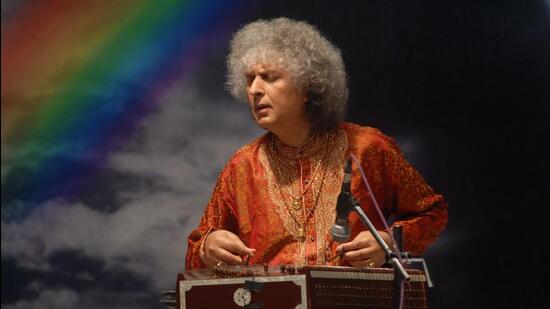
With the death of Pt Shivkumar Sharma, we have lost one of our greatest classical musicians. These days, a nicely packaged recital is a must. Virtuosity is high but the emotional content is low and the audience is often starved of hearty hues in the music, which has become mostly predictable. In contrast, rare artistes like Pt Shivkumar Sharma, who displayed supreme control coupled with majestic artistry in exploring the unknown, preferred soulful sophistication to impulsive virtuosity.
Listening to his
With the death of Pt Shivkumar Sharma, we have lost one of our greatest classical musicians. These days, a nicely packaged recital is a must. Virtuosity is high but the emotional content is low and the audience is often starved of hearty hues in the music, which has become mostly predictable. In contrast, rare artistes like Pt Shivkumar Sharma, who displayed supreme control coupled with majestic artistry in exploring the unknown, preferred soulful sophistication to impulsive virtuosity.
Listening to his music one wondered about the kind of tapas, saadhana or diligence that must have gone into making him the maestro he was. I was fortunate to have an immersive conversation with him during his last visit to the capital in 2019. During the course of our talk, he revealed that his family did not have a musical legacy going back many generations. His grandfather was the raj-purohit of Kashmir. The Maharaja of Kashmir was a great connoisseur of music and reputed musicians performed at his court. This exposure influenced Pt Shivkumar Sharma’s father, Pt Uma Dutt Sharma, to learn the tabla. He then grew interested in vocal music and went to Benaras where he became a disciple of Bade Ramdasji. After his return, he trained his son in vocals and tabla. The boy soon became a sought after tabla player and accompanied stars like Ravi Shankar, Bhimsen Joshi, Hira Bai Badodkar and Begum Akhtar.
It was at this juncture that his father decided that the young Shivkumar should become a santoor player. Shivji remembers that at that point, he had not even seen the santoor, just heard it, and was not enamoured by its sound. Still, he accepted his father’s decision and tirelessly worked on the structure and tuning of the Kashmiri folk instrument and lifted it into the classical realm.
Some excerpts from our conversation:
Your name has become synonymous with the santoor. Please tell us about the instrument and its journey to its current classical status with you.
(Laughs) You may call it destiny. My father, Pt Uma Dutt Sharma, the raj pandit of Raja Pratap Singh of Jammu, was a vocalist of the Benaras gharana and a disciple of Bade Ramdasji. He initiated me into vocal music and tabla from an early age. He was a music supervisor at the All India Radio (AIR) and got transferred to Srinagar for two-three years. There, he came in contact with great Sufi singers like Mohammed Tibet Baqal, who played this folk instrument called the santoor for their Sufiana mausiqi (Sufi music). My father recognized the potential of classical music in this unknown folk instrument of Kashmir. He did intensive research, developed it, and encouraged me to learn and play it, and to establish it as a classical musical instrument. I call it a “Daivi ghatna”, an ordained incident, because it was just by chance that my father was transferred to Srinagar and got acquainted and deeply involved with this instrument, which was hardly seen then even by people in Kashmir, not to mention the rest of India and the world.
In Kashmir, this folk instrument was played with Sufiana mausiqi but the fact is that this is an ancient instrument that was known as the shat tantri veena in the olden days. As you know, in those days, all string instruments were called veena, so the name referred to an instrument with hundred strings. Santoor is played not only in India, but you will find it in different parts of the world with different names.
Weren’t you were already an AIR broadcaster and a tabla player in great demand by the age of 13?
Yes, but my father had worked hard, doing extensive research and developing this instrument for classical music. He dreamt of his son becoming the first musician to play Indian classical music on it. I took it upon myself to fulfill his dream. I started a new journey with this instrument and was committed to it with full dedication and determination. I still remember my father’s friends, the great musicians and ustads of those times advising me, in good faith, to leave this. “You are a hardworking intelligent boy with good training. Take up another instrument like the sitar or sarod and you will shoot up to the skies of popularity in no time,” they said. But I pursued the santoor wholeheartedly and after a few years, those very people praised me and said, “Never leave this instrument, you shall reach the top!”
When did you give your first public performance?
It was at the Swami Haridas Sangeet Sammelan, Mumbai, in 1955. Soon after, I was invited to perform at the All India Music Conference, Kolkata, in 1956 and started performing all over the country. Pt Ravi Shankar took me along for the Festival of India in 1968, and I gave solo concerts in 40 cities in the US and Canada and people started recognizing this instrument across the globe.
My first solo album was released in 1960. In 1976 came the concept album, Çall of the Valley – on it I teamed up with Pt Hari Prasad Chaurasia on the flute and Pt Brij Bhushan Kabra on the guitar – which broke all records of popularity. The album turned out to be one of the greatest hits in Indian classical music and the rest is history.
Your most significant contribution is popularising this instrument. You have also made it one of the most riveting classical instruments with a superb tonal quality that suits your aesthetic expression. Tell us something about that.
It was not a cakewalk. I carried out experiments with the santoor for many years to make it more suitable for my classical technique. The modified santoor, which I now play, has 31 bridges with a total of 91 strings. It has a range of full three octaves with a chromatic tuning. I also created a technique for smoother gliding between music notes in order to get the quality of the human voice and improvised a new technique of playing that could sustain notes and maintain sound continuity.
Your 100 per cent accurate shruti-shuddha (tunefulness) with perfect shades of the swaras for the chosen raga, has always mesmerized me. But I have also admired the lovely laya-kari of your compositions. Has this come about because of your earlier association with the tabla? It feels as if there is an internal pulse like an antah-salila or an undercurrent of laya in your music. What is your notion of the laya or rhythm?
It is not necessary that a person who has learnt tabla would have a better sense of rhythm or understanding of it. Laya or rhythm is not just mathematics. It also carries emotion or bhava. Think of the thumri, Piya ke milan ki aas (hums the thumri immortalised by Ud Abdul Karim Khan, and then sings the same line at a faster pace to show how the whole rasa-bhava vanishes at a faster speed). Laya ek ehsaas hai. Like the musical or tuneful voice, a real feel for laya (rhythm) is also God’s gift.
You have been performing for more than seven decades but you are also a devoted guru, who does not charge a single penny for vidya-daan. When did you start teaching? Please share your experiences as a teacher.
I have been teaching for more than 40 years now. I never said no to anyone who came to me for learning the santoor because I wanted to popularise the instrument. I have taught numerous students. Here I want to say that I am just a medium destined by some divine power to spread this vidya. My disciples fall into four categories: First are those who have studied under me and are playing my music; the second category is not playing my music because they could not understand it; the third type includes those who touch my feet and address me as Guruji. When I tell them that I do not remember meeting them before, they acknowledge that they have learnt by listening to my music. The fourth category is of those who have learnt and play my music but don’t confess to it and say, “This is my own gharana.” I bless them also to do well.
How do you feel at this juncture of your life after winning many awards and so much love from your audiences of both classical and film music. You have also composed for blockbusters like Silsila, Chandani, Faasle and Darr.
These days, I am trying to educate classical listeners because I realise that it is our responsibility. We should not tamper or dilute our music according to their taste and musical level. There are performers who take claps to be the criterion of a successful concert but I tell my audience not to clap because it disturbs my concentration.
I have started a new campaign, “Ḿusic Beyond Entertainment”, both at home and abroad. When I start playing, I tell my audience to forget about Shiv Kumar Sharma or the santoor. Just close your eyes and concentrate on the sound. When your attention moves astray, try to bring it back to the sound. This is our age-old technique of meditation.
Have you tried this with your foreign audiences also?
There is a popular music festival in the US called Womad started by famous pop star Peter Gabriel. It is held in a big park with a variety of musical styles offered. At one place, you can listen to fusion music, at another, rock, pop or jazz. I did this experiment there with people who had come to my recital after listening to pop or rock. They confessed that my music gave them solace and a real feeling of bliss.
In a concert hall, 95 percent of the people do not understand raga-tala. Nobody would know if I announced Bageshri and played Malkauns. Of course, I do tell them the name of the raga and the tala, but now I want to connect them with the spiritual aspect of music. I tell them not to think in terms of being entertained or being bored. This is something beyond that. Music has been called rooh ki ghiza, food for the soul. I’m trying through my music to reach their soul.
Just like there were four stages of life marked in the olden days - brahmcharya, grihasth, vanprasth and sanyas, we artistes also pass through different stages. There was a time when I loved claps but after having too much of them, I have now reached the stage where I look for peace and tranquillity in my music and want to communicate the same to my listeners.
Manjari Sinha is a senior music journalist. She lives in New Delhi.
One Subscription.
Get 360° coverage—from daily headlines
to 100 year archives.
Archives
HT App & Website