You advocate for trust in a post truth world. How is trust an integral part of how Wikipedia was envisioned and continues to function?
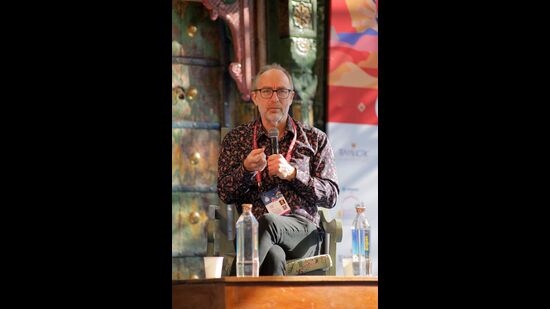
Wikipedia is all about the community, people coming together from different backgrounds, trying to work together, and we have to build trust with each other in the community, to find ways to compromise and ways to work together effectively. The book is a result of reflecting on the things that you need to do to build trust; things like transparency and openness and having a good purpose is actually a big part of it.
The far Right in the United States has called out biases within Wikipedia. What are your comments about this?
Whenever there’s any kind of criticism, what we need to do is to be transparent, grapple with the criticism, take it seriously. Say, ‘Okay, well, look, come and help us. What are things we could improve? How do we make things better?’ In some cases, you look and say, well, actually, the criticism isn’t founded, and so this is just not fair. In other cases, you say, oh, okay, actually, we could improve in this area. I think you always have to take things seriously, because if you lose that spirit of intellectual curiosity and wanting to make things better, then you’re lost.
What motivated you to write this book?
{{/usCountry}}What motivated you to write this book?
{{/usCountry}}I was watching the Edelman Trust Barometer survey for many years, and seeing this enormous decline in trust in journalism and politics and business and all kinds of institutions and reflecting that, oh, well, Wikipedia used to be considered kind of a joke by most people, to being one of the few things people trust. So, I think I have some lessons that maybe the world will find interesting and helpful.
How does Wikipedia embody the ethics you espouse in the book?
Wikipedia is very transparent. When we think about the seven rules of trust, all of them has a Wikipedia component. I’d say one of the most important is having a good purpose. So that good purpose of a free encyclopedia for everyone is very exciting for volunteers, but it also gives us a way to focus our energy. If we were just writing random blah, blah, then there’s no way to get sort of serious and focus. And that focus then helps to build trust. The public knows what to expect from us, all of those things become more stable, and that’s really reassuring.
Tell us about your experience as an author navigating the global publishing landscape.
Because I’m newly an author, it’s been fascinating. One of the things that I found interesting as an author is how slow book publishing is, because I’m used to hitting Save and then it’s public immediately. But that’s also a positive thing -- the level of review and fact checking, spell checking. It’s been fun. And we’ve sold the book in 18 languages around the world. I’m planning to spend this year travelling a lot, and I’m very excited, because I love coming to India.
In an interview, you said that Wikipedia enables a healthy discursive environment where two opposing factions can still contribute to the same topic on the platform. Please elaborate.
At Wikipedia, we’re trying to write an encyclopedia article, and an encyclopedia article shouldn’t take sides, it should present the major viewpoints. It turns out, people are actually quite good at this. Obviously, journalism has a big piece of this. For most news reporting, you shouldn’t take one side or the other. You’re just trying to explain to the public what a debate is about and what are the different sides saying, and we just take that sort of old value system to say, like, actually, if we’re trying to be fact based, then we have to be fair to all the sides. Even if we maybe agree with one side more than the other, that is irrelevant.
You mentioned how facts can be threatening. Please explain.
If people are uncomfortable with some things in history, or some things that have happened, then that may be awkward or embarrassing, and for some authoritarian governments, that can be a problem. But in open societies, we accept that there are a lot of different views out there, and we have to grapple with them, and we should be fair about it. Facts aren’t actually threatening even if some people may feel they are.
How do you think literary festivals like JLF can contribute in terms of offering a collaborative space for the ‘culture wars’ that we are currently experiencing?
Literary festivals draw an audience of people who love to read, and they love to read all kinds of different things, and that’s really wonderful. This festival seems very open and easily accessible by students. This is hugely important, because I think one of the things that’s exciting for me is, despite all of the negative talk about young people, they love Wikipedia. They’re very passionate about it. They are the number one audience for long form podcasts, right? They love to binge watch huge, complicated TV shows, right? And they also like short form Tiktok videos that are silly, and that’s okay, right? So, I think for literary festivals, we should be thinking about bringing in students. Let’s bring in the next generation to open the world of knowledge to everyone.
In the times of AI, how do you see Wikipedia evolving?
One of the important things about Wikipedia is that it’s very human; we’re very human-centric human knowledge. One of the things we know as Wikipedians is how hard it is to do good quality reference work. There’s a lot to debate about the details and the obscure facts and what are the quality sources and all of this. So far, the natural thing AI can do is produce large volumes of very casual text that may not be accurate, and that’s really not good enough. We think that the human component is really necessary. The reason why all of the AI models train on Wikipedia is because that human curated knowledge is incredibly important.
Has writing become a part of your everyday routine?
Becoming the author of a book was a different experience. One of the reasons I felt that I could do it is because I spend my whole life writing. I’m always writing emails and I’m writing on wiki and I’m talking to people and, you know And so I thought, oh, yeah, well, I just have to write a book. This should be easy. Well, it turns out it’s not that easy. But I really enjoyed the process. And so, it’s all very exciting.
Please share a bit about the process?
In the beginning, I worked with my agent to shape the idea. We had a lot of conversations to narrow it down and to figure out the exact focus. Then I started writing, and that part was the fun part. The easy part was I just started writing all of my stories and the things I’ve learned and so on. Then I got to a certain point and I’m like, ‘Oh, now what?’ I don’t know how to turn this into a book. So, I brought in a collaborator, Dan Gardner. He was fantastic. He came in not as a ghost writer, but as a collaborator, and really helped me shape the book. He was like, ‘Oh, this is really great. Got all your great material, but we really need other stories and other people’. I’m a very shy person. You wouldn’t think so, seeing me on stage and all that, but I am. He said you know all these amazing people; why don’t you just ask them for an interview? So we brought in all these great interviews of academics and business leaders to talk about their stories of trust, things that have gone wrong, and how they corrected them, what are the lessons learned, and all of that. Once Dan came in, it got fun again because it felt like, ‘Oh, I see the path forward’.
Much of the book is on the human condition. Which authors inspired you to pen down your thoughts?
There are many author friends who were inspiring. I’m a big fan of Tom Friedman. I really like to read his books, and I don’t always agree, but I always feel like he’s serious, and you have to sort of grapple with it, and that’s what I enjoy. I enjoy ideas, even if I maybe agree with some and I don’t agree on others. That’s okay, because I’m learning anyway.
Simar Bhasin is a literary critic and research scholar who lives in Delhi. Her essay ‘A Qissa of Resistance: Desire and Dissent in Selma Dabbagh’s Short Fiction’ was awarded ‘Highly Commended’ by the Wasafiri Essay Prize 2024.