
“When I was younger, I thought writing should be the struggle with what you are. Now I think it’s the struggle to find out who you were.” M John Harrison, who has made history as the oldest writer to win the Booker Prize, makes this admission at the beginning of Wish I Was Here (2023), his discursive anti-memoir, in which he looks back on his life while questioning how much of it he can truly remember. Memories arrive in fragments. He revisits the frozen puddles from childhood, his father’s death when he was 13, the angry teenager who played truant, the young man who went to London without quite knowing what he wanted from it.
He writes about notebooks filled with observations, places revisited only to find that they have changed beyond recognition, and an elusive alter ego called Map Boy, who seems to possess all the freedom and certainty Harrison himself could never claim. He remembers, doubts his memory, questions what he has written and occasionally makes fun of the whole enterprise. There is something disarmingly candid about a writer who, after six decades of putting words together, remains unsure of the person who wrote them. Most memoirists attempt to explain how they became who they are. Harrison wonders whether that person ever existed quite as remembered.
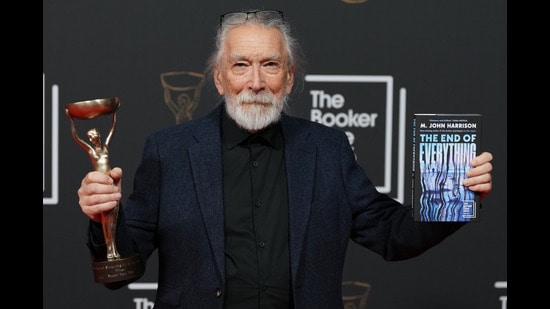
Which makes his latest achievement all the more deliciously ironic. At 81, when most writers might reasonably be expected to rest on their laurels, Harrison has won the coveted prize for his thirteenth novel, The End of Everything. He is also the first Booker winner to have emerged from the science-fiction tradition, a literary territory whose ambitions have often been underestimated. For a writer who has spent much of his career questioning the conventions of fiction and making a nuisance of himself at the borders of literary respectability, it is a remarkable turn of events. The literary establishment has finally picked someone who has never been particularly interested in belonging to it.
{{/usCountry}}Which makes his latest achievement all the more deliciously ironic. At 81, when most writers might reasonably be expected to rest on their laurels, Harrison has won the coveted prize for his thirteenth novel, The End of Everything. He is also the first Booker winner to have emerged from the science-fiction tradition, a literary territory whose ambitions have often been underestimated. For a writer who has spent much of his career questioning the conventions of fiction and making a nuisance of himself at the borders of literary respectability, it is a remarkable turn of events. The literary establishment has finally picked someone who has never been particularly interested in belonging to it.
{{/usCountry}}The award will undoubtedly introduce Harrison to readers unfamiliar with his work, including those who have never ventured into science fiction. They may be surprised by what they encounter. His worlds are unsettling, his characters frequently bewildered, and his novels seldom offer the reassurances that readers have come to expect. It is difficult to imagine that the Booker will make him any more accommodating.
The End of Everything (Serpent’s Tail/Hachette India), at just 198 pages the shortest novel on this year’s Booker shortlist, is a darkly comic account of a society living through a catastrophe whose origins remain obscure. In a near-future England, government barely functions, Europe has somehow become inaccessible, and mysterious entities called the iGhetti have appeared. Phillip Tennent, its protagonist, makes a living collecting strange objects washed up along the Kent coastline. One of his discoveries, a jelly-like object, begins to grow, speak and issue instructions. His elderly aunt, Marnie, an artist who is suffering from dementia, is armed and bewildered. They inhabit a society that appears to have passed through disaster and arrived not at the other side but somewhere in its interminable middle. People still drink coffee, attend parties and go about their business. The apocalypse, inconveniently, has failed to cancel everyday life.
This is Harrison’s great joke, and an uncomfortable one. We have been conditioned by cinema and popular fiction to expect catastrophes to announce themselves spectacularly, preferably with collapsing skyscrapers and a sufficiently resourceful hero. There must be an identifiable enemy, a battle and, if the budget permits, a sequel. Harrison suspects that real disasters are far less obliging. Social breakdown, ecological damage and political irrationality can accumulate over years, until people cease to recognise them as exceptional and begin treating them as ordinary life.
Harrison has said that current affairs supplied the novel’s themes and satire, particularly the question of how people continue to live when their expectations and explanations of the world have themselves become part of the disaster. The iGhetti might invite comparisons with artificial intelligence, capitalism or the bewildering political upheavals of our time, but Harrison leaves their significance unresolved. There is also tenderness beneath the novel’s disorientation, an acknowledgment that people continue to need one another even when their understanding of the world, and of each other, begins to fail.
Born in Rugby, Warwickshire, in 1945, Harrison spent long hours in public libraries, where he discovered writers ranging from JG Ballard to the French experimental novelist Alain Robbe-Grillet. His first short story, Marina, appeared in Science Fantasy in February 1966, when he was 20. In 1968, he joined New Worlds, the influential British magazine edited by Michael Moorcock, as its literary editor. This was the period when British science fiction was becoming more adventurous, politically alert and formally experimental. Even among writers intent on challenging convention, Harrison appeared particularly suspicious of convention. Technological marvels of imaginary worlds were not his things. He was drawn to the psychological unease of people confronted with experiences they could neither understand nor explain.
His debut novel, The Committed Men, published in 1971, marked the beginning of a career that would repeatedly challenge the boundaries between science fiction and literary fiction. His Viriconium sequence, comprising the novels The Pastel City (1971), A Storm of Wings (1980) and In Viriconium (1982), along with the stories collected in Viriconium Nights (1984), took his experiments further. Its imagined city refuses to remain fixed: its history and identity seem to alter with each telling. In his hands, fantasy became a means of questioning the very desire for imaginary worlds that appear more coherent than our own. Readers looking for the familiar comforts of heroic fantasy might feel cheated. Harrison would probably consider that a promising beginning.
Harrison’s 1989 novel Climbers remains one of his finest achievements. Drawing on his experience of rock climbing in northern England, it is ostensibly about people seeking difficult routes up rock faces. Read closely, it’s a searching account of obsession, disappointment, companionship and the peculiar human need to escape ordinary life by placing oneself in dangerous situations. If The Course of the Heart (1992) explores the damage fantasy can inflict on ordinary lives, Signs of Life (1997) examines bodily transformation and anxiety over environmental degradation.
His best-known Kefahuchi Tract trilogy — Light (2002), Nova Swing (2006) and Empty Space (2012) — returned him to science fiction with extraordinary imaginative freedom. There is a delightful anecdote about his friend Iain Banks taking him drinking in Soho and suggesting that he needed to have more fun with his writing. Harrison took the advice seriously enough to begin Light, though naturally he responded by producing something considerably stranger than the usual space opera Banks had apparently hoped for. His later fiction brought that same unease closer to home. The Sunken Land Begins to Rise Again, which won the Goldsmiths Prize in 2020, draws on failed relationships, conspiracy theories and seemingly ordinary surroundings. The uncanny does not erupt into everyday life so much as seep through its neglected corners.
By its closing pages, Wish I Was Here becomes a fierce, often wickedly funny examination of the writing life itself. Harrison’s reflections on what he calls his late style amount to a declaration of independence. He urges himself to break structures, deny conventional endings and, above all, “Keep saying no.” It is the advice of a writer who has spent a lifetime resisting the pressure to become more accessible, more marketable or simply more like somebody else.
In the epilogue he makes the startling assertion: “I don’t believe we’re in the Anthropocene. I believe we’re in the Age of Fantasy.” He is not dismissing environmental catastrophe but questioning a culture increasingly dependent on seductive stories, manufactured realities and narratives that make complex problems seem reassuringly manageable. For Harrison, the immersive worlds of commercial fiction have uncomfortable parallels with advertising, political rhetoric and the fantasies through which societies evade difficult truths. The irony is not lost on him: he is a novelist questioning the imaginative seductions on which his own profession depends.
In the anti-memoir, a remarkably personal reckoning with age and mortality, Harrison worries about leaving behind a library of books nobody wants, acknowledges his fear of death and describes the physical and psychological exhaustion of finishing a manuscript. Beneath the literary provocations is a man confronting the prospect of loss, including the loss of the identities he has constructed for himself over the years.
That concern with what remains when familiar certainties disappear connects Wish I Was Here to The End of Everything. Mary Beard, who chaired the Booker jury, found a surprising “twinge of optimism” in the winning novel. Perhaps it lies in the determination of its inhabitants to carry on, making choices and improvising their lives despite the collapse of the systems they once trusted. The anti-memoir begins with a writer asking who he used to be; his Booker-winning novel extends that uncertainty to an entire society, asking what people become when the world that shaped them is no longer recognisable. The Booker has given Harrison an extraordinary moment of public recognition. But the question he posed at the beginning of his memoir remains unanswered. And one suspects he would rather keep it that way.
Olivia Laing once described Harrison as “the missing evolutionary link between William Burroughs and Virginia Woolf,” a wonderfully apt description of a writer who combines the former’s unruly imagination with the latter’s extraordinary sensitivity to the workings of consciousness. The Booker has finally given Harrison his place in literary history. Whether it brings him any closer to finding the man behind the writing is another matter altogether. In other words, the award may have found M John Harrison at last, but perhaps the finest thing about him is that he has never stopped looking for himself.
Nawaid Anjum is an independent journalist, translator and poet. He lives in New Delhi.