Kelly Dorji dressed in the traditional gho looks as dashing as ever, the people of Bhutan are as polite, hospitable and cheerful as ever, and the 10th edition of the Mountain Echoes Festival of Arts, Literature and Culture held from 22 to 25 August this year was as interesting as ever. Thankfully, some things never change.
You’ve attended the event thrice, drawn each time by the lure of the nation, the only one among our neighbours that seems to actually like Indians at the people-to-people level (in itself a pleasant shock), and by the chance to listen to worthies from across the world talk about everything: Padmalakshmi on cooking and endometriosis, a monk on The Divine Madman, Lam Drukpa Kunley, one of Bhutan’s most fascinating religious figures, Pico Iyer on, what else, cultivating silence, and Witi Ihimaera on Maori culture and writing in New Zealand.
In between all that you imbibed ample quantities of the excellent K5 Bhutanese whisky, gaped at the magnificent gigantic Buddha Dordenma statue that watches over Thimphu, swayed to the excellent local bands playing at the Mojo bar, ridden off to Punakha to be blessed with a giant wooden phallus by a little monk at the Chimmi Lakhang temple thronged alike by those who seek blessings for their progeny and by those who yearn to have children, and hung around the, to Indian eyes, surprisingly clean market. You’ve developed a taste for crunchy fiddlehead ferns, ema datshi (a delicious spicy cheesy stew that is the national dish of Bhutan), and the bamboo shoot and fiery Tsirang Valley dry fish pickles available at the excellent Farm Stores on Norzim Lam. You even have a local bike-hire guy, the cheerful Tashi Tenzing, whose well kept no-fuss Enfields are perfect for cruising down the country’s smooth roads. Riding in Bhutan in therapeutic – the land is beautiful, people follow traffic rules and don’t honk belligerently at you, and the chances of being mowed down by a drunk truck driver after dark are as rare as sharing a table with a talking takin in one of the cafes off Thimphu’s Clocktower Square.
Bhutan’s national animal, which looks like a curious cross between a goat and a cow and whose origin is credited to the Divine Madman, had a session devoted to it at the festival. Other sessions on our threatened natural world in the Anthropocene included one on the golden mahseer, on water habitats, wetlands and riverine systems, and on the ruddy shelduck (the Brahmini duck). Historian Sudipta Sen and economist Sanjeev Sanyal came to a discussion on the Ganga from different political spaces, Tony Joseph, author of Early Indians: The Story of Our Ancestors and Where We Came From spoke of the many genetic layers that make up the Indian population today, and poet Arundhati Subramaniam and Pavan Varma, author of Adi Shankaracharya, Hinduism’s Greatest Thinker spoke about the man from Kalady who re-energised Hinduism in the 8th century CE. At a session entitled Novelist in the Newsroom, Raj Kamal Jha, chief editor of the Indian Express and author of The City and the Sea spoke about gender violence, of using magic realism to explore the events of December 16 2012, and about dealing with the juvenile perpetrator with a rare degree of empathy. There were sessions on the folk music of Bhutan, on Yashodhara, Buddha’s wife (she who is permanently recalled in the Amar Chitra Katha-frame-inspired mind as asleep with the infant Rahul at her side even as a stricken Gautam steals away in search of Truth) and on AI. A delicious one on food featured Marryam H Reshii, author of The Flavour of Spice, and an informative one on the history of Indian magic had John Zubrzycki, author of Jadoowallahs, Jugglers and Jinns, in conversation with the young high-energy mentalist Karan Singh. Karma ‘Lhari’ Wangchuk, Bhutan’s first fashion blogger, whose refreshing work rejects homogeneity to feature real people who embody coolth regardless of body shape, economic status or age, spoke of being inspired by his rural Bhutanese mother and her “badass friends”. No literature festival on the subcontinent is complete without a film celebrity and the feisty and intelligent Richa Chadha ably represented Bollywood in Bhutan.
{{/usCountry}}Bhutan’s national animal, which looks like a curious cross between a goat and a cow and whose origin is credited to the Divine Madman, had a session devoted to it at the festival. Other sessions on our threatened natural world in the Anthropocene included one on the golden mahseer, on water habitats, wetlands and riverine systems, and on the ruddy shelduck (the Brahmini duck). Historian Sudipta Sen and economist Sanjeev Sanyal came to a discussion on the Ganga from different political spaces, Tony Joseph, author of Early Indians: The Story of Our Ancestors and Where We Came From spoke of the many genetic layers that make up the Indian population today, and poet Arundhati Subramaniam and Pavan Varma, author of Adi Shankaracharya, Hinduism’s Greatest Thinker spoke about the man from Kalady who re-energised Hinduism in the 8th century CE. At a session entitled Novelist in the Newsroom, Raj Kamal Jha, chief editor of the Indian Express and author of The City and the Sea spoke about gender violence, of using magic realism to explore the events of December 16 2012, and about dealing with the juvenile perpetrator with a rare degree of empathy. There were sessions on the folk music of Bhutan, on Yashodhara, Buddha’s wife (she who is permanently recalled in the Amar Chitra Katha-frame-inspired mind as asleep with the infant Rahul at her side even as a stricken Gautam steals away in search of Truth) and on AI. A delicious one on food featured Marryam H Reshii, author of The Flavour of Spice, and an informative one on the history of Indian magic had John Zubrzycki, author of Jadoowallahs, Jugglers and Jinns, in conversation with the young high-energy mentalist Karan Singh. Karma ‘Lhari’ Wangchuk, Bhutan’s first fashion blogger, whose refreshing work rejects homogeneity to feature real people who embody coolth regardless of body shape, economic status or age, spoke of being inspired by his rural Bhutanese mother and her “badass friends”. No literature festival on the subcontinent is complete without a film celebrity and the feisty and intelligent Richa Chadha ably represented Bollywood in Bhutan.
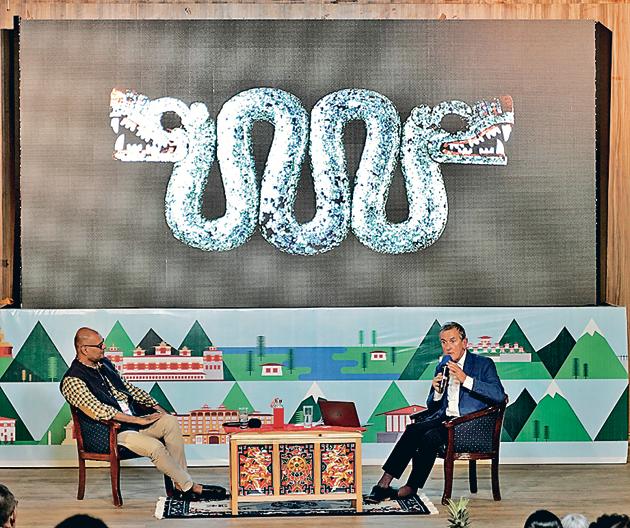
{{/usCountry}}Even if the festival had featured only a talk by Neil MacGregor, former director of the British Museum and author of A History of the World in 100 Objects, you would still have been satisfied. An African drum mislabelled for decades as a native American one and the history of slavery that it reveals, the Aztec double-headed snake in the British Museum and what it tells us of the Incas, colonialism and its aftermath, the many claimants of the Kohinoor, and the ethics of exhibiting objects plundered in the colonial era in First World museums were all part of his wide-ranging conversation on the significance of objects with Pramod Kumar KG.
Literary festivals are to a Books Editor what sales conferences are to marketing professionals. You attend them, despite the danger of being stabbed by that unhappy author, who will never forget the bad review you wrote in 1999, because it is part of your job. Sometimes these jamborees are torture. Mountain Echoes is different. It is difficult to be unhappy in Bhutan. This time, your perennially curmudgeon self was further softened by the discovery of superb Bhutanese rice beer.
Really, you have no reservations in pronouncing the 10th edition of Mountain Echoes a great success.
Follow more stories on Facebook and Twitter