Dusk was setting on the streets of Imphal. An elderly woman, holding a bag in her hand and her grandchild in the other was talking angrily to a vegetable vendor. My friend explained that the lady was annoyed with the constant frisking by the security forces that takes place in her hometown. “This is my land. I grew up here. I should be asking them to show their identity cards to me. I should be frisking them,” she was heard saying. What could be more real and poignant than that! These words of the grandmother reverberated in my mind whenever I thought of Imphal, the capital of Manipur.
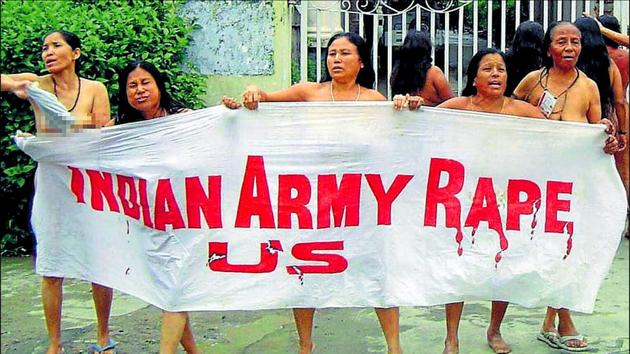
For me, Manipur is more than just another dot on the map. I have reported on myriad issues from the state. Whenever I went there, walking on the streets and in the marketplaces of Imphal, I tried to soak myself in the life and times of contemporary Manipur. Every time I spoke to the women, I imbibed something new. Among the many incidents that touched me was the furious nude protest by 12 elderly women, mothers, in front of the Kangla Fort in Imphal on July 15, 2004. They were protesting the death of 32-year-old Thangjam Manorama, an alleged militant. Manorama was picked up from her house on July 11 and later shot dead by 17 Assam Rifles personnel amidst claims and counter claims.
I wanted to dig deeper. I was eager to know more about these 12 women and I embarked on my journey. It was a surprisingly fulfilling one with me often sitting with these grandmothers near their kitchen hearths, in their courtyards, or in their small shops as they told me their stories -- of trials, laughter, fears, aspirations -- accompanied by warm hugs. I made an extra effort to meet them during my reporting assignments to Manipur. Like typical grandmothers, they showered me with love and affection, made me feel at home, cooked for me, and laughed with me. It was like talking to my elderly aunts and grand aunts at a family gathering. They were wise. They had seen the world. There were many things I could learn from them. They were ready to bare their hearts to me.
{{/usCountry}}I wanted to dig deeper. I was eager to know more about these 12 women and I embarked on my journey. It was a surprisingly fulfilling one with me often sitting with these grandmothers near their kitchen hearths, in their courtyards, or in their small shops as they told me their stories -- of trials, laughter, fears, aspirations -- accompanied by warm hugs. I made an extra effort to meet them during my reporting assignments to Manipur. Like typical grandmothers, they showered me with love and affection, made me feel at home, cooked for me, and laughed with me. It was like talking to my elderly aunts and grand aunts at a family gathering. They were wise. They had seen the world. There were many things I could learn from them. They were ready to bare their hearts to me.
{{/usCountry}}Some of them were surprised that I was looking for them and that I wanted to unearth their stories. One of them told me that nobody had ever bothered to meet her or ask her what she wanted. Some of them are resentful and are always ready to speak up for a cause. They are also intelligent homemakers, sane mothers to their children and lovable grandmothers with bagfuls of stories to tell to their grandchildren. After talking to them I always felt a sense of catharsis; a sense that there is hope beyond the conflict. For peace. I had their stories of extraordinary resilience buried deep in my notebooks and in my heart.
Years and seasons passed by. The nude protest settled down as a hazy memory in Manipur’s consciousness. I waited for someone to write about these 12 stellar women. One day, I got the news that one of the mothers had died. That was the day I felt that perhaps I should be the one to tell their stories. These were stories that I had always wanted to tell the world. I strongly feel that to understand a conflict, we need to listen to the voices of the people. It is important that these stories be told without being judgemental. The words and wisdom of these women will lead us to a better understanding of the way conflict affects the lives of people.
This book is not merely a collection of the biographies of these women. I have tried to weave in many other tales – history, legends, anecdotes and stories of contemporary Manipur. I have tried to look beyond the headlines with my understanding of the trouble-torn state. The book is also my trek as a journalist into the state whose name literally means, ‘a land of jewels’. Singer Akhu Chingangbam startles me with the irony of his words: “There are guns pointed at you all the time. I feel life is too short not to sing all that I see. I want to be contemporary and talk about my generation.”
For me, writing this book has been an agonising, exhilarating, inspiring and most importantly, a cathartic experience. These are living stories of the thinness of present times and will hopefully help future generations to learn, understand, and cherish. These stories have immense possibilities. I wrote this book also in the hope that these stories will open many more windows and will lead us to a better understanding of gender and conflict in the region.