The gospel of Christianity first came to the hill tribes of present day north east India in the late 19th century. Within a few decades, their world was transformed. It is a miracle that a group of peoples whose culture prescribed revenge against enemies came to embrace, in such short order, a belief system that advocates turning the other cheek. However, after a hundred years of Christianity, doubts have returned. Not about Christianity itself but about how the faith was received, interpreted, and applied vis-a-vis traditional cultural practices. Social decay in the form of substance abuse and addiction among the youth, the greed and corruption that characterize politics, and the decline in moral standards and social cohesion have led many to look back longingly at the pre-Christian past. Many also fear that the customary wisdom and norms handed down orally through generations will be lost with the imminent passing of the pre-World War II village generation.
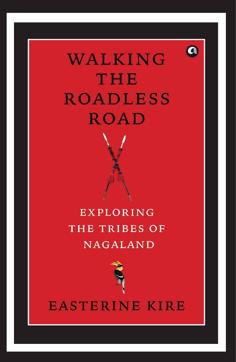
It is this fear that prompted Easterine Kire to write Walking the Roadless Road: Exploring the Tribes of Nagaland. The book claims to be “a comprehensive history of the Naga tribes who live within the borders of Nagaland.” That the study has been limited to the 16 Nagaland tribes means prominent Naga tribes like Tangkhul and Mao (they are concentrated in Manipur’s Ukhrul and Senapati districts) are excluded while non-Naga tribes like Kuki and Dimasa Kachari are included. The book ambitiously attempts to trace the evolution of the tribes from their origin in antiquity to the 21st century. However, more than half is devoted to the nature and culture of Naga society before the arrival of Christianity. The tone is descriptive rather than argumentative. The near absence of chronology gives the stories a feel of timelessness. In a way, this puts a question mark over the book’s claim to be a historical study.
Nevertheless, this is a timely book that tries to encapsulate the tribal story and looks at everything from origin myths, village structure, and institutions like the morung and the Feast of Merit to the spiritual world, clan systems, festivals, rituals relating to birth, marriage and funerals, and the customary law practices and social taboos of each tribe. The centrality of land to the Naga identity is also beautifully laid out.
{{/usCountry}}Nevertheless, this is a timely book that tries to encapsulate the tribal story and looks at everything from origin myths, village structure, and institutions like the morung and the Feast of Merit to the spiritual world, clan systems, festivals, rituals relating to birth, marriage and funerals, and the customary law practices and social taboos of each tribe. The centrality of land to the Naga identity is also beautifully laid out.
{{/usCountry}}Non-tribal people imagine tribal life to be primitive and lawless. The term ‘head-hunters’ is often invoked as evidence. No one knows exactly why the tribes practised head-hunting, and Kire says the stated reasons “vary from tribe to tribe”. Some believed the human head contains soul matter, which fertilized the land and brought prosperity to the head-hunter and his village. It is known that head hunting enhanced a warrior’s reputation, boosted his prospects for marriage, and deterred enemy tribes. It was a ritual necessity and not some mindless blood sport.
These stories also bring out the extent to which cultural practices cut across tribal boundaries and show just how connected various tribal groups are. Instead of serving as evidence of the Nagas’ ‘uniqueness’, they exhibit just how connected the various tribal groups are, at least in terms of cultural norms and practices. Take the example of the institution of the morung. Each Naga tribe has its own name for it. The Zomi called it zawlbuk or haam. A big dormitory hall, the morung acts as “the centre for attitude formation of young people where the young men received semi-military training and taught war tactics”. Here, “they performed difficult initiation rituals… received training in various cultural, arts and craft skills. Naga oral traditions were kept alive in the Morung and passed on from one generation to the next in the form of folk songs, dances and folk tales.” The morung played the role that the church plays in society today.
The principles of the morung or sobaliba (an Ao-Naga term that refers to ‘an ethics of living with regard to society, culture, tradition, environment and nature) governed behaviour. These included extending help to the needy, sharing one’s belongings, respecting elders, selflessness, truthfulness, honesty, adherence to customs and tradition, and altruism. The tribes lived by Christianity’s best teachings even before they knew the faith. Perhaps that is why they adapted so easily to the new religion.
The tribes all prefer hilltops as village sites, and have broadly similar migration stories, ghost stories and tales about apotia (unnatural) deaths. As a young Paite boy, I too heard slightly different versions of the tales mentioned in the book from village elders.
Today, Christianity has transformed personal and social life in Nagaland and elsewhere; villages have become towns; tribal norms have been replaced with state laws; altruism has given way to competition, and written texts have replaced oral dissemination. Crime is also increasing and Christianity with its ideals of turning the other cheek seems impotent against violence and bloodshed. There is concern that by discarding in toto the old ways in favour of western Christianity, along with the attendant changes in lifestyle, we may have thrown out the baby with the bathwater. Sadly, this aspect of the debate – the question of indigenizing Christianity – is not adequately discussed in the book.
Read more: Review: Understanding India’s Northeast: A Reporter’s Journal by Rupa Chinai
But Kire is not worried. She sees Naga culture kept alive in how inter-village disputes are settled, role and status assigned to family members, marriage rules dictated, and in the way stories are transmitted to the young every time they come upon monoliths in the Naga areas.
I am optimistic too, though for a slightly different reason. This book tells me that if we listen deeply, not only to specific communities and tribes, but across them, we will realize that the things that tie us together are stronger than those that pull us apart. We are all closer to each other than we thought.
Thangkhanlal Ngaihte teaches political science at Churachandpur College, Lamka, Manipur