Towards the end of Chapal Rani, the Last Queen of Bengal: The Life and Times of a Female Impersonator, in an interlude titled The Drag Queen, the narrator reflects: “If he said that to Moira’s gender studies class, I think they would all spontaneously implode. I mean, where do you fit Chapal Rani in queer theory where we are always talking about the intersection of identity, gender and sexuality?”
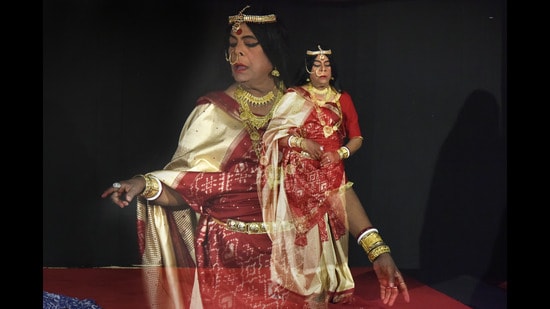
Here, the narrator is referencing a hypothetical conversation about Chapal Rani’s relationship with a married man:
Narrator: “Don’t you get jealous about his wife?”
Chapal Rani: “Why should I? She could give him children. I couldn’t. I could satisfy him in every way except that.”
This is a pivotal interlude in this book about the iconic jatra performer for two reasons: firstly, because Chapal Rani eludes the academic vocabulary that attempts to pin down the vast spectrum of an individual’s sexuality; and secondly, because it shows that sexuality is not the only measure of a life.
{{/usCountry}}This is a pivotal interlude in this book about the iconic jatra performer for two reasons: firstly, because Chapal Rani eludes the academic vocabulary that attempts to pin down the vast spectrum of an individual’s sexuality; and secondly, because it shows that sexuality is not the only measure of a life.
{{/usCountry}}These two things, when considered together, help the reader understand what Chapal Rani continued to do his whole life — he played a part. He wasn’t a part apart from the whole. He was integrated in being a figure who has baffled and continues to do so. His life is a testimony to a refusal to conform.
Divided into 13 chapters, with 12 interludes (11 of which are imagined recreations), Chapal Rani, the Last Queen of Bengal, a work of creative non-fiction, is not only a celebration of the performer but also a brief historical overview of the Bengali jatra form in the 20th century, especially in the liminal era when women were beginning to perform on stage.
Sandip Roy presents this remarkable life story in a way that recalls a moving jatra with many acts, and in doing so, induces in the reader a “critical intimacy” with Chapal’s story. By way of introduction, Roy writes, “The first time I saw Chapal Rani, he did not look like a queen after all.” This makes the reader curious: what qualifies someone to be called a queen? What if that person intends to be a queen only on stage, and in the minds of his viewers, but assumes an “ordinary” life once the make-up is off?
“Some people are born queer. Some have queerness thrust upon them. I felt Chapal was very much the latter,” Roy writes adding that the young LGBTQ+ movement in India that’s hungry for a queer history seems to have “seized on Chapal Bhaduri to be its fairy godmother.” It is this godmother image – a beautiful woman who could almost pass for Kirron Kher from Sanjay Leela Bhansali’s Devdas (2002) – that appears on the book’s cover. It’s clear, though, that the performer himself does not identify with gentrified Anglophone pronoun-centric LGBTQIA+ discourse.
Page by page, Roy unveils Chapal’s story from his days as the beloved youngest son of star actress Prabha Devi and his interactions with his extended family in their shared home, to the dark period after his mother’s early death. What stung the young Chapal most was the humiliation of seeing “Father’s name: Unknown” in a court summons. After a brief stint labouring with the railways, he went on to find purpose in the world of Bengali jatra, which drew huge crowds but was viewed as inferior by Calcutta’s bhadralok. Chapal joined jatra in the 1950s when women were still rare on stage, and excelled in playing epic female characters.
“The love of an audience has a hypnotic power of its own. It’s an addiction of sorts,” Roy writes in Chapal’s voice as he knits conversations with his subject and others with imagined conversations – like the one with an emerging female actor of the era -- to create this biography that’s also a cultural document of a time. Particularly moving is the section about the audience’s cruel and very vocal public rejection of Chapal and his art.
On 29 July, this year, Chapal turned 88. He now lives in an old-age home in Kolkata. Is he the same person who appears at the beginning of this book? The interlude titled The Ghost of Putulbari provides some clues. The narrator here thinks to himself that he had heard Chapal’s voice emerging from “a bespectacled old man with thinning hair who had trouble walking”. Surely, he says, this can’t be Chapal. “The old man’s voice was high and sweet, but… Chapal Bhaduri had the waist of a dancer. His hair was long and thick. This shuffling old man with a belly pushing out of his kurta was no Chapal Bhaduri. You can’t fool me that easily. I knew Chapal Bhaduri. Once I was his guardian angel.”
Only an imaginary character could have stated with as much conviction that he knew Chapal Bhaduri. The real ones would have demurred. Interestingly, even this narrator did not say he knew Chapal Rani. Perhaps Chapal, who says “half of me is still Chapal Bhaduri but the other half has become Chapal Rani” cannot claim such knowledge of his selves either.
If publisher Naveen Kishore’s documentary Performing the Goddess (1999) pulled Chapal Rani back into the spotlight, Roy’s superb work has contextualised the once and forever queen of the jatra stage.
Saurabh Sharma (they) is a nonbinary, queer writer, essayist, and culture critic. On X: @writerly_life; Instagram: @writerlylife.