There is an unlikely connection between Mary Oliver’s poems and Charulata Chittol, the protagonist of Rahul Bhattacharya’s new novel Railsong. I watched the PBS documentary — Mary Oliver: Saved by the Beauty of the World — about the life and work of the best selling American poet and I found myself reading Oliver’s most famous poems, which offer, often, that moment when a person recognizes a voice that is their own. In The Journey, she wrote about the moment when, “you finally knew what you had to do, and began.” Or the realisation, as she wrote in When Death Comes, “I don’t want to find myself sighing and frightened, / or full of argument.” She wrote about nature, and about answering the quiet inner summons to freedom. “You only have to let the soft animal of your body / love what it loves,” Oliver wrote in Wild Geese, and that:
Whoever you are, no matter how lonely, the world offers itself to your imagination, calls to you like the wild geese, harsh and exciting – over and over announcing your placein the family of things.
Charu seems to live by something similar. She knows, instinctively, the art of leaving. To be an extraordinary person, you have to do just one extraordinary thing, Charu thought as she, aged 16, ran away from home. This was in the mid-1970s and “the game of life was of daring.” She was going to Bombay to “become something” — Railsong is the story of how Charu becomes Miss Chittol, an independent young woman in the big city.
The novel begins in 1961 when Charu is three years old and her family arrives in Bhombalpur, a fictional railway township in Bihar. Her father had found a job in the railways and considered it his national duty. He had discarded his Bengali Brahmin surname for Chittol, the name of the oily fish his wife affectionately called him by. A few pages into the novel, his wife dies, leaving behind three small children. Railsong follows Charu from girlhood to “that late flush of youth where maturity has manifest itself, where the present moment is the very ripening of the past and the future is long.” The decennial census marks the passage of time as she navigates friendship, relationships, grief, work and the railways. The census as a way to mark the decades is a clever even political act, considering the historic six-year delay in the sixteenth census of India, which was due in 2021.
{{/usCountry}}The novel begins in 1961 when Charu is three years old and her family arrives in Bhombalpur, a fictional railway township in Bihar. Her father had found a job in the railways and considered it his national duty. He had discarded his Bengali Brahmin surname for Chittol, the name of the oily fish his wife affectionately called him by. A few pages into the novel, his wife dies, leaving behind three small children. Railsong follows Charu from girlhood to “that late flush of youth where maturity has manifest itself, where the present moment is the very ripening of the past and the future is long.” The decennial census marks the passage of time as she navigates friendship, relationships, grief, work and the railways. The census as a way to mark the decades is a clever even political act, considering the historic six-year delay in the sixteenth census of India, which was due in 2021.
{{/usCountry}}This is the making of the modern Indian woman. And for Charu, it means resisting being trapped — by the confines of a small town, the fate of a spinster relative, a dead-end job or relationships. But she’s not a rebel in the conventional sense. She’s neither flighty nor dramatic. She’s polite, hardworking, considerate, even acquiescent. But throughout the novel, she remains true to her need for autonomy — personally, professionally, ethically, physically, intellectually and ideologically.
About halfway through the novel, she moves into a working women’s hostel where, surrounded by single working women in different stages of life, “She regretted that she was not married, divorced or deserted, for such experiences generated their own propulsion.” For most of this novel, she is guided by something firmly internal.
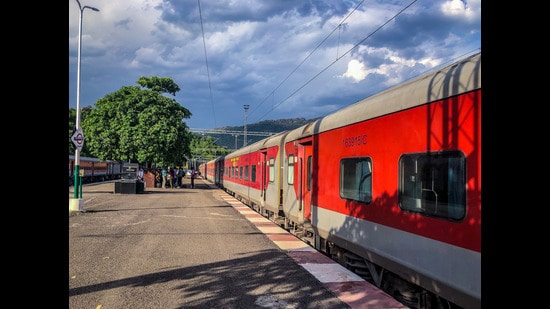
Years after escaping the railway colony, Charu herself becomes a railway woman. She gets a job in personnel, the HR department of the Indian railways managing “the seventeen lakh people who manage the Indian railways.”
The Indian Railways, which carried daily “ten million passengers and half a million tonnes of goods, on a network of seven thousand stations, using eleven thousand locomotives,” her boss tells her, “does not see religion, caste, language, state boundaries, summer, winter, rain. We have to meet the challenges because without Indian Railways this country will not be India.” And she does her job as a welfare inspector with that same neutrality and constancy. She travels to faraway, sometimes dangerous, towns to investigate claims, looking for the rightful next of kin of deceased railway employees to transfer benefits. The bureaucracy of the railways is, as it turns out, fascinating stuff — and in Bhattacharya’s hands, it is sometimes even enjoyable. He also evokes quite vividly the bodily nostalgia of travelling by train in the 20th century – “Over time, like melting ice cubes, people lost volume, wriggling their way into improbable openings.” Or how the Rajdhani with its busyness of soup and ice-cream and bed-linen, had turned, as the joke went, the experience of the railways from “suffer” to safar, that “the Rajdhani did not go to places, places came to it.”
Last year, when David Szalay’s Flesh won the 2025 Booker prize, The Guardian controversially published an editorial declaring that the win put masculinity back at the centre of literary fiction.
Some Indian critics expected Railsong to be on the shortlist this year and saw its absence too glaring an oversight. The novel has its issues. The railway bureaucracy, enjoyable for the most part, is sometimes too tedious. The novel ends too abruptly. There are smaller sections where the narration switches to first person, which seemed kind of pointless. And sometimes, I found it hard to keep track of smaller chunks of time, flipping back and forth wondering if a year had passed or more.
Still, with this novel, Bhattacharya achieves a rare, even singular, thing. The acuity with which he renders Charu’s interiority may have given us the most fully realised woman protagonist written by a male novelist, certainly an Indian male novelist writing in English. I was startled particularly by his understanding of moments of privacy. When Charu discovers masturbation, it is a method perhaps commonly used but so rarely spoken about that even Cosmo, writing about it recently, noted it was still somewhat “underground.”
Flirting in her twenties, Charu knows how to “put on the bright in her eyes, the bright that made another feel: wish I could laugh with that girl.” And during an intimate moment with her boyfriend, as “he began to suck air through his teeth, making a hissing sound… She understood it was meant to be the sound of desire, and suspected he wished her to reciprocate in kind. But how unnatural — how very odd and unnatural indeed!”
And then there’s marriage — the novel deftly, even unexpectedly, moves from independent young woman in 1970s Bombay to the working wife living in a cramped flat with the in-laws in a Gujarati chawl in the 1980s. Bhattacharya captures that stark jump in selfhood that marriage demands of Indian women. “The perfect day of marriage is weightless,” he writes. But that “day upon day of marriage piles up and exerts its weight.” But it’s not the everyday heaviness that he zooms in on. The in-laws, cohabiting in a minuscule Bombay flat, juggling the demands and ambitions of work and expectations of domesticity… all of it fades into the background in the face of the political trappings of marriage. It is the late ’80s and there are drives to collect donations for the construction of a Ram temple in Ayodhya where the Babri Masjid was still standing. And as the Hindutva movement gains momentum and bleeds into the family — and “to have put herself in this position after the long quest for independence felt to her at moments the highest folly.” Charu also wonders quietly whether her husband “under his equanimity and his intimations, a man of common prejudice, of ordinary capacity? The awful thought very briefly raised its head. Was he? What did that say about her? No, no, he is not, perish the thought, banish it at once! And it was banished, beautifully it perished.”
Years earlier, a boy who was studying psychology she had met at a New Year’s Eve party was telling Charu that difficult circumstances were like gravity — that it was possible to escape them, but the energy required to break free would leave one depleted.
For girls, she pointed out to him, “generating energy was not easy, for there was not always a defined hurdle that you could build up speed towards and jump over. Where was the space? Sometimes you were not even aware of the circumstances, you only had a general recognition, a haze, a fog, and you wondered if it was just the climate.”
This is the crux of the novel, and perhaps the core of its protagonist. She may not always see the hurdle, but she recognizes the haze, the fog, adverse climate conditions to avoid – and that itself is a rare extraordinary thing.
Saudamini Jain is an independent journalist. She lives in New Delhi.