
 E-Paper



Review: The Last Time I Saw You by Akhil Katyal
In Akhil Katyal’s new book of poems, which uses playfulness as a technique to deliver an emotional payload, his narrator is an auto-ethnographer, closely analysing the various phrases of love between two men

 Prefer HTon Google


In April 1947, while speaking to a creative writing class at the University of Mississippi, American novelist William Faulkner, who won the Nobel Prize for Literature in 1949, described his contemporary Ernest Hemingway in these words: “He has never been known to use a word that might cause the reader to check with a dictionary to see if it is properly used.” Reputed for his combativeness, Hemingway, who loved boxing and also won the Nobel Prize for Literature in 1954, responded a few months later: “Poor Faulkner. Does he really think big emotions come from big words?”
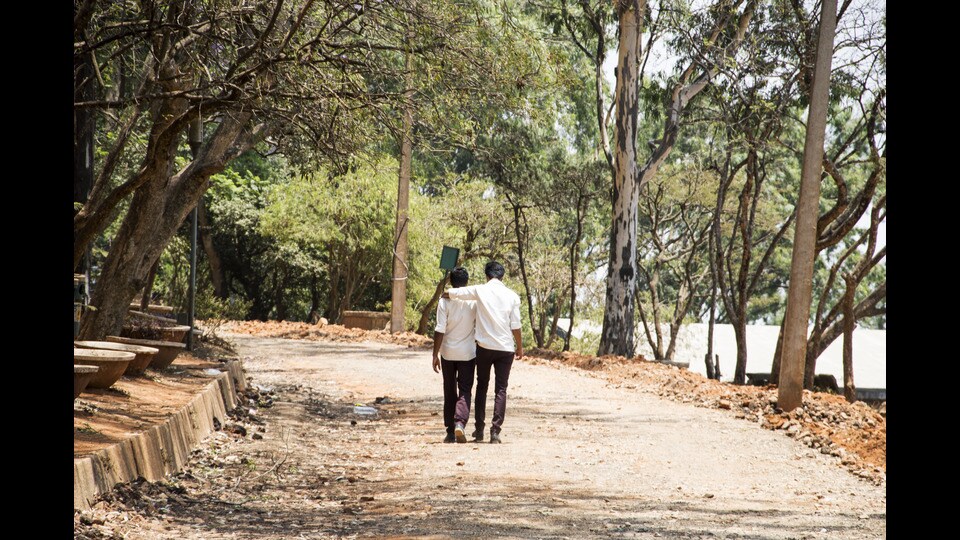
No reader of Akhil Katyal’s new book of poems, The Last Time I Saw You , will probably run to the dictionary — but they will pause often, provoked into feeling big emotions by his consummate craft. Nineteenth-century British Romantic poet Samuel Taylor Coleridge famously described poetic technique as “the best words in the best order”, and Katyal demonstrates a deep self-reflexivity with words. The very first poem in this collection is titled Etymology, where the narrator traces the origins of words — grief (grever), sadness (saed), pain (poena). It is a prose poem about loss, perhaps the end of a relationship, and it ends — “You left and the sentence does not end” — with a drying up of words.
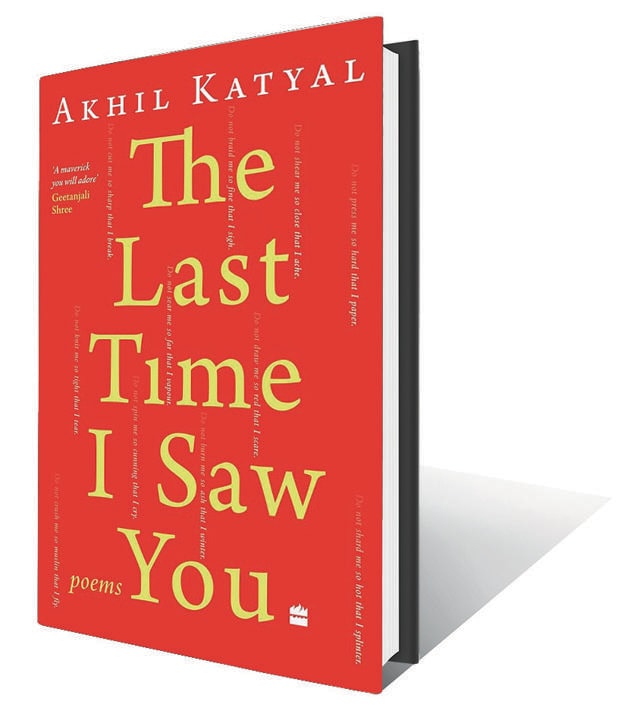
The mood of the collection oscillates between pensive and playfulness. In other poems, there are games involving words, such as Scrabble (Scrabble) and crosswords (Ordinary Things). In Nickname, words are analysed as parts of speech (“Two vowels, / three consonants”), imagined as objects (“I let the sound / hang in the room / like an unexpected / fallen eyelash”), or even as fonts (“In an unexpected argument, one day, / I got caught in the elegant Garamond / of the way you said it”). And in several poems, words from other languages — Hindi, Urdu, Punjabi, Italian, German — seep into the English poems, refusing any assumption of watertight division between them.
In I Translate Your Name Into Nine Languages, the name of a lover is written in Armenian, Hebrew, Malayalam, Uzbek, Somali, Gurmukhi, Odia, and Japanese. Counting on one’s finger, it is evident that these are only eight languages (unless, of course, one also considers English, in which the poem is written.) Though the tone of the poem is playful, it has an obvious lineage in Sufi or Bhakti poetry, where the name of the beloved or the object of devotion is chanted in many different ways. Such techniques have also been used in Hindi film songs. For instance, in the 1993 film Yugandhar, starring Mithun Chakraborty, the song Ayega Krishna, written by Javed Akhtar, uses several names of the Hindu god Krishna in a crescendo.
For Katyal, playfulness is a poetic technique to deliver an emotional payload. For instance, in the poem Eunice De Souza Hears My Agonies, the narrator complains to De Souza, celebrated Indian poet and critic, about the end of a relationship: “He has gone, / I complain.” The poem weaves in a thought about the nature of love and mortality: “At thirty-five, / one asks for certainties, / right?” But De Souza’s response reminds one of her legendary wit: “one prefers / a good bowel movement / over love”. In this poem, wit is an escape from the pains of love, but not so in others.
In I See Reels, the narrator scrolls social media reels where young content-makers “spell out a word / letter by letter, and when / asked to put it together / say something else entirely”. He provides an example: “In one, a girl reads / P, A, R, L, E, G, very, very / confidently, and says ‘biscuit’.” The poem ends:
That night, in my sleep
I spell out W, H, E, R, E
and take your name.
The playfulness of words is not always a protection against pain. The narrator must confront it and allow it to transform the tone of the poem to one of longing.
Though biographical details are anathema to contemporary literary criticism, it is impossible not to refer to the person to whom this book is dedicated — “for G, who might not read this” — and who makes appearances in several of the poems. He casts as much a shadow on Katyal’s collection as the mysterious “Fair Youth” on William Shakespeare’s sonnets. In poem after poem, the narrator speaks to G —
I keep telling G
I will peak at forty.
(A Saint Came to Die in Our Land)
or of him
I was to make a home
in your touch.
I was to make a home
in make-believe.
(First Days)
In many ways G is the prism that refracts the rays of Katyal’s poetry into its constituent colours.
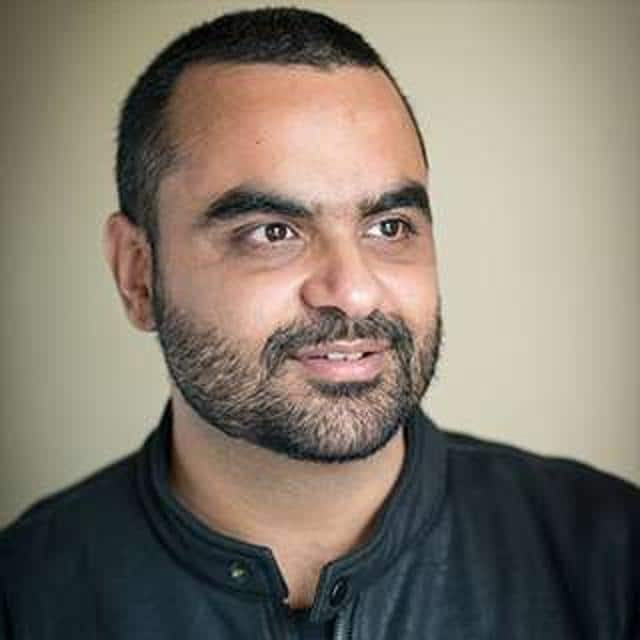
In his popular poems like I Want to 377 You So Bad or He was as arrogant as a Chhattarpur Farm, Katyal had performed a cartography of Delhi through a queer compass. In this book, Katyal’s narrator is an auto-ethnographer, closely analysing the various phrases of love between two men. Though the love ends with hints of estrangement, the poetry it produces is less performative and more reflexive. It is not a process of mellowing — but of maturing.
Uttaran Das Gupta is an independent writer and journalist.


