In the author’s note at the end of Your Utopia, Bora Chung writes: “[W]hen faced with loss, one must mourn, and to remember and mourn loss, one must survive. If I do not remember, then who will remember those we have lost? And if I do not mourn through my actions, then how will I remember these losses?” To a large extent, Chung’s second collection – translated from the Korean by Anton Hur, just like its predecessor, Cursed Bunny – is an act of memorialisation, although she does not go about it in any straightforward way. A running strand across the eight stories is the need for connection, whether it is with one’s own self, others, the planet, the material and the immaterial. Chung’s characters live with hope in a world that dares not dream of it, yet desperately needs it.
The story Maria, Gratia Plena particularly stands out. Set in a world where technology, that can extract and view memories, is used by the justice department to solve cases and prevent future crime, its female protagonist is a technician tasked to work on a comatose woman. Once at the centre of a massive drug-trafficking operation, the woman is now slowly deteriorating towards death after an overdose. While examining her memories, the technician tries to figure out what led her subject down this expressly forbidden path. She reads out passages about space exploration, in particular the Cassini mission, to the woman as she lies unresponsive and develops an unspoken bond that cannot be reciprocated. This depth of feeling isn’t restricted to humans.
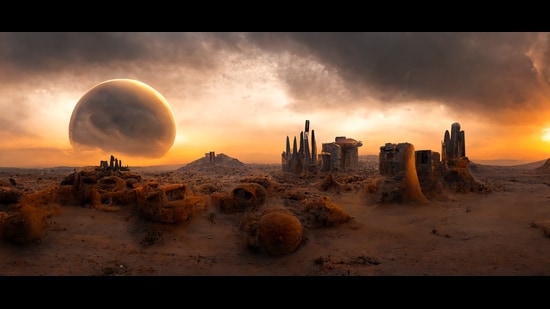
The titular story follows a sentient automobile on an alien planet. Once populated, this wasteland now just hosts the debris of civilisation. Unable to adjust to the planet’s adverse weather conditions and the resulting physiological ailments, humans abandoned it en masse. What remains is the rusting junk of inorganic machines and mutated organic matter. It is this landscape that the automobile traverses daily, in search of a compatible fellow machine while trying to survive on meagre recharges of its battery by a recalcitrant sun. In its back seat is a new found friend, a malfunctioning small robot who constantly asks “Your utopia is… On a scale of one to 10…” While the human dream of paradise did not come to be, the autobot adjusts to life without its creators and tries to find purpose.
{{/usCountry}}The titular story follows a sentient automobile on an alien planet. Once populated, this wasteland now just hosts the debris of civilisation. Unable to adjust to the planet’s adverse weather conditions and the resulting physiological ailments, humans abandoned it en masse. What remains is the rusting junk of inorganic machines and mutated organic matter. It is this landscape that the automobile traverses daily, in search of a compatible fellow machine while trying to survive on meagre recharges of its battery by a recalcitrant sun. In its back seat is a new found friend, a malfunctioning small robot who constantly asks “Your utopia is… On a scale of one to 10…” While the human dream of paradise did not come to be, the autobot adjusts to life without its creators and tries to find purpose.
{{/usCountry}}Your Utopia is not the only story with a robotic/mechanic protagonist. A Song for Sleep unwinds through the point of view of an elevator in a residential high-rise. Artificially intelligent, part of a larger network of connected devices and systems that share information and data with each other in what seems to be an advanced if benevolent form of surveillance, it develops a connection with a 93-year-old woman with Parkinson’s on the 53rd floor. It is the year 2069 and she is not used to the level of technology that permeates daily human life. Most of her sensors and devices are off, there is barely any available personal information shared with the building’s network, and she is an enigma. All of the elevator’s overtures are met with fear and it, used to the constant repairability and apparent permanence of machines, is confused by the life cycle of humans and the need for irreversible death.
Chung switches it up in Seed, another story set in the near future, where it is gradually revealed that a set of characters, identified by the names of trees and who communicate via pollen, are human-plant hybrids. In this dystopian world, every natural resource is owned by one of only two faceless multinational corporations who have deliberately and systematically destabilised the ecology of the planet for the sake of profit. The wildernesses, forced by the advent of extinction, have adapted and evolved to survive. They seeded into humans and took root, becoming one over generations. It’s a symbiotic relationship meant to halt and, one fine day, even reverse the encroachment of industrial destruction. Seeds become a bridge between the human and the vegetal, drawing two different worlds together with the hope of rebirth: “We only need one of those seeds to sprout. Just one. One is enough.” When the seeds they spread return, “dancing on the wind”, the wounds will begin to heal.
While the horror was more pronounced in Cursed Bunny, as the opening pages of its very memorable first story will testify, it is subdued in Your Utopia. This volume relies more on high-concept speculative fiction in a vein similar to Ted Chiang. There might be elements of horror present in most stories, but they are not at the centre. The two notable exceptions are The End of the Voyage and A Very Ordinary Marriage. The former follows a pandemic, dubbed simply as “the Disease”, which turns people into cannibals. They continue functioning normally but get an irrational hankering for human flesh, chomping down matter-of-fact on whoever is nearby. In the latter, a man discovers that his wife is hiding a secret after he catches her making regular calls late at night and speaking in a strange language. But, if they do not keep up appearances as an ordinary couple, the results can be horrific. Overall, this is an excellent second offering from Bora Chung. It makes perfect sense to be excited about her next book – translated by Anton Hur, of course – which comes next year.
Areeb Ahmad is a Delhi-based freelance writer and literary critic. He is @Bankrupt_Bookworm on Instagram.