Before he was born in the home of a junior government official in Baramati, Maharashtra, in 1910, the parents of Nathuram Godse, who killed Mohandas K Gandhi, had lost their three previous sons in infancy. Only one child, a daughter named Mathura, had survived. Taking this as a sign, the parents decided to trick the evil fate that seemed to befall their male children by bringing up the baby boy as a girl. “His nose was pierced and he was made to wear a nose ring” writes Dhirendra K Jha in his book Gandhi’s Assassin. “It was thus that the child came to acquire the name “Nathu” or the one with a pierced nose, and then Nathuram, even though his official name was Ramachandra Vinayak Godse”.
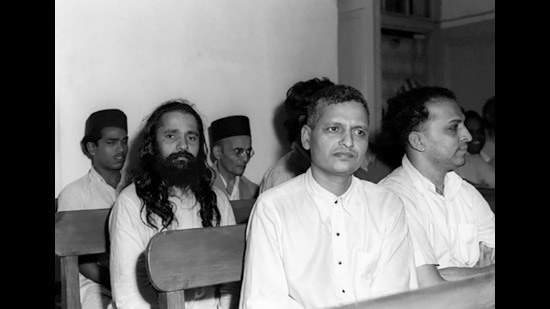
The journey of Nathuram Godse from Baramati to the gallows in Ambala where he was hanged in 1949 for the murder of Gandhi is the subject of this book. It is a life journey whose direction, for the initially effeminate boy, was determined, in Jha’s telling, by the fateful transfer of Godse’s father to the small town of Ratnagiri on the Konkan coast of Maharashtra in 1929. The boy, who was sent to Poona for his education and who returned after failing his matriculation exams, moved with them. As luck would have it, they had a famous neighbour: Vinayak D Savarkar, who had been sent to Ratnagiri by the British after his release from the Cellular Jail in the Andamans. Godse soon fell under his spell.
The first half of the book, titled Ploy, chronicles his growing involvement with Hindu right-wing politics as a member of both, the Hindu Mahasabha and the Rashtriya Swayamsevak Sangh. There were fraternal relations between these two organisations. VD Savarkar’s brother Ganesh Savarkar was among the founders of the RSS. Its chief in Sangli was a man named Kashinath Limaye, who mentored Godse’s entry into the RSS fold. Jha, through interviews and archival work, documents that this man, who later became Maharashtra RSS chief, also doubled as state president of a militia called the Hindu Raksha Dal. Godse and Narayan Apte, his chief co-conspirator in the assassination of Gandhi, were the official founders of that militia. How Godse and Apte met and became collaborators is not known, but Jha points to Savarkar as the common link.
{{/usCountry}}The first half of the book, titled Ploy, chronicles his growing involvement with Hindu right-wing politics as a member of both, the Hindu Mahasabha and the Rashtriya Swayamsevak Sangh. There were fraternal relations between these two organisations. VD Savarkar’s brother Ganesh Savarkar was among the founders of the RSS. Its chief in Sangli was a man named Kashinath Limaye, who mentored Godse’s entry into the RSS fold. Jha, through interviews and archival work, documents that this man, who later became Maharashtra RSS chief, also doubled as state president of a militia called the Hindu Raksha Dal. Godse and Narayan Apte, his chief co-conspirator in the assassination of Gandhi, were the official founders of that militia. How Godse and Apte met and became collaborators is not known, but Jha points to Savarkar as the common link.
{{/usCountry}}The second half of the book, titled Plot, is on the assassination of Gandhi. It is a story whose principal characters are Godse and Apte, but Savarkar is a presence right through. There are also cameos by women, including Apte’s lover Manorama and the actress Shanta Modak, who the two met by chance on a train journey on their way to meet Savarkar on January 14. Modak dropped them off outside Savarkar’s house in her car. They left for Delhi shortly after meeting Savarkar and, upon reaching there, began preparing to kill Gandhi. Their first attempt, on January 20th, was unsuccessful, but they went back on January 30th and finished the job.
The RSS has long denied that Godse was a member of the organisation when he murdered Gandhi, but Jha argues, convincingly, on the basis of archival material such as Godse’s pre-trial statement recorded in Marathi, that he never left the RSS. He was simultaneously a member of both the RSS and Hindu Mahasabha, says Jha. He also asks whether Godse’s final court statement during his trial, made eight months later, which distanced him from both Savarkar and the RSS, can be relied upon. It was a statement that served the useful legal and political purpose of protecting Savarkar, who was facing trial along with him, and the RSS, whose members had faced attacks and ostracism after the assassination of Gandhi. Jha points out that it was a statement in excellent English – a language that the matric-fail Godse could barely speak. The implication is that it was drafted by a barrister.
In its portraiture of Gandhi’s assassin, and in reporting details of the plot, the book does a good job. It is deeply researched, with references that stretch from previous published texts on the subject to interviews by the author and archival work. It is lucidly written and the story itself makes for a page turner. The text, however, meanders repeatedly into amateur psychoanalysis and perhaps overstates the point in trying to relate Godse’s childhood experience of being initially raised as a girl to his final act of killing Gandhi. It is also a bit thin on the larger politics of the times, and the event that finally triggered Gandhi’s assassination – the Partition of India.
Jha points out that Savarkar had espoused the two-nation theory as far back as 1923 and quotes a speech by him 14 years later in which he says, “There are two antagonistic nations living in India… the Hindus and the Muslims”. The Muslim League, he says, picked up the thread later and demanded the Partition of India. While it is certainly true that the League did not officially seek Partition before 1940, the idea of Hindus and Muslims being two antagonistic nations living side by side in India had been around long before Savarkar.
British historian and civil servant Penderel Moon, in his book Divide and Quit, pointed out that “As far back as 1888, Sir Syed Ahmad, the great Muslim leader of the nineteenth century, had laid down the premises which lead naturally, perhaps even necessarily, to the idea of Pakistan”. Ahmad, Moon pointed out, described India as a country inhabited by two nations, the Mohammedan and the Hindu, and predicted that if the English were to leave India, it would be impossible for the two to “sit on the same throne and remain equal in power”.
The idea of Partition was one that had advocates among both Hindus and Muslims long before 1937, when Savarkar became president of the Hindu Mahasabha, or 1940, when the Muslim League adopted the Pakistan resolution.
Samrat Choudhury is an author and journalist.