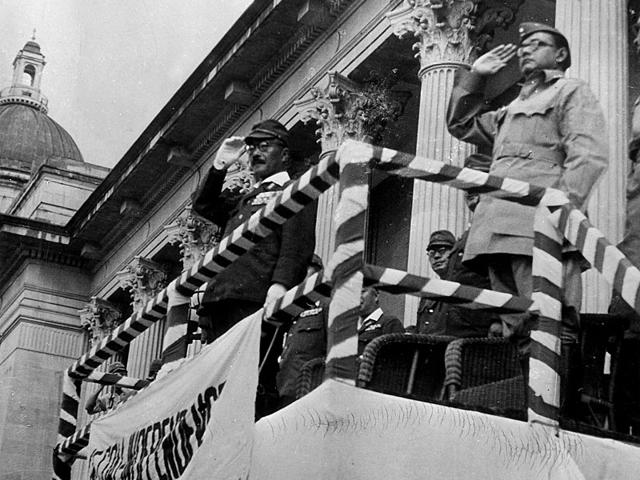
Yasmin Khan writes of how WW II reshaped the subcontinent. This excerpt looks at Subhas Chandra Bose's Indian National Army.In April 1943 Subhash Chandra Bose arrived in Japan, carried by submarine for many weeks through the oceans from Germany to Sumatra, and then finally flown from Singapore to Tokyo. After his public arrival back in Singapore on 2 July 1943, the Indian National Army and the Indian Independence League became his personal vehicles. These organisations, which had been formed in early 1942, struggled under factional strain in South-East Asia, with many becoming sceptical about the ability of the INA to work as an equal partner with the Japanese, who simply liked the propaganda significance of the Indian renegade soldiers. Bose gave his followers the slogan 'Chalo Delhi!' (Advance on Delhi) and like an alchemist was able to turn the volatile situation among Indians in South-East Asia into political gold, by welding together men and women of different religious and linguistic backgrounds and inspiring them to fight under one banner and one leadership. In bold and uncompromising language Bose spoke single-mindedly of victory against the British and of the triumph of Indian nationalism. His speeches relentlessly referred to India's subjugation by Perfidious Albion and the machinations of a ruthless alien empire. Certainly, many of the INA men who joined him in the newly christened 'Azad Hind Fauj' shared this belief and were born again into the movement with a fervour that compelled them to risk everything.
The Raj at War: A People’s History of India’s Second World War by Yasmin Khan. Random House India (Rs 699; PP 416)Shah Nawaz Khan was a tall, gentlemanly officer from a long line of military professionals, and was bitterly disappointed by the surrender of 1942 and by his status as a prisoner of war in Singapore. He was already a member of the INA but held many reservations about it, and remembered his own conversion from scepticism to becoming a fully fledged leader of the Indian National Army: When Netaji [as Bose was known] arrived in Singapore, I watched him very keenly. I had never seen or met him before, and did not know very much about his activities in India. I heard a number of his public speeches, which had a profound effect on me. It will not be wrong to say that I was hypnotized by his personality and his speeches. He placed the true picture of India before us, and for the first time in my life I saw India, through the eyes of an Indian.
Yasmin Khan, author of The Raj at War: A People’s History of India’s Second World War. Shah Nawaz Khan was tried during the Red Fort trial of 1946 and became one of the national heroes of the INA. Women, too, found Bose quite irresistible. In South-East Asia, many women who had been fearful about the future prospects of their community now turned to Bose. The INA's recruitment of women into the famed Rani of Jhansi Regiment was consistent with the transformative changes that were taking place for women across South Asia. Among the local population in South-East Asia, the support of women was vocal and one fervent, anonymous supporter of Bose recorded in her diary: The women's section of the IIL [Indian Independence League] convened a mass meeting of Indian women. It was addressed by Netaji. The audience hung on each syllable as it dropped from the powerful jaws of our beloved leader. Women had walked ten and twelve miles to the meeting place... A Gujarati lady gave away all her jewellery: bangles, rings, necklace that she was wearing, as gift to Netaji for work by women. At a distance and from across the Indian Ocean, the subcontinent could be simplified and idealised as Mother India, and Bose was able to bring co-ordination and security to the shattered South-East Asian community of Indians. 'What is most note-worthy is the way all petty intrigues have been abandoned, all quarrels forgotten', wrote the same woman in her diary. 'Netaji has certainly transformed all of us. We feel different.' She went on to join the Rani of Jhansi Regiment. This was a bracing modern form of nationalism with potentially fascist overtones. But unlike German fascism, it also played heavily on an inclusive vision of Indian identity, wiping aside differences of caste, class, religion and even gender. It inspired visions of revolutionary transformation, though one which Bose grounded on ideas about the will of the people. His rallies, funding drives and public orations during whirlwind tours to Rangoon, Shanghai, Bangkok, Nanking and the Andamans brought out crowds of thousands. In reality, though, in South-East Asia there were far more complex undercurrents... Doubts over Japanese intentions persisted... There was also the need to co-ordinate with the Japanese and to organise everything from food and medical supplies to military tactics, military discipline and regulations. Bose persisted in trying to make his movement a genuinely independent and serious fighting machine... and to imbue the provisional government with autonomy, but ultimately relied on Japanese authority. For instance, in the Andaman Islands, where Bose hoped to formally acquire some control of Indian soil for his provisional government, he was able to rename the islands Shahid and Swaraj Islands and acquired nominal control, but failed to get the Japanese to relinquish any real sovereignty or military power. Despite Bose's lobbying to have his troops integrated into the military assault on India, ultimately only 8,000 of the INA would see action when the Subhas Brigade took part in the Imphal campaign of 1944, leading to death, desertion, capture and appalling struggles for survival for these men and women... But for those on the other side of the Indian Ocean, within India's actual borders, listening to Bose and simply the knowledge of the existence of the Indian National Army (and the establishment of the Provisional Government of Azad Hind (Free India) from October 1943) gave a focal point for nationalism. From the time of his arrival in South-East Asia, Bose's broadcasts intensified in frequency and popularity back in India and were heard by many. The Japanese radio stations in Singapore and Burma directed propaganda towards India from 11 p.m. until 3.30 a.m. and used Hindi, English, Bengali, Marathi, Urdu, Tamil and Punjabi. At least two hours a day were allotted to Bose and his programme and Rash Behari Bose also broadcast directly from Tokyo. People huddled around clandestinely to listen to these addresses...Broadcasts were well informed by conditions in India and dwelt on themes such as the futility of the Cripps Mission, the impact of air raids on South Asia and, from 1943, the famine.50 Significantly, Bose continued to refer to the Mahatma and to pay deference to Congress symbols and history, despite his differences with Gandhi, melding the Indian National Congress with the aims of the INA in the minds of some. Ultimately, the INA lost their military battles but they won the propaganda war, and the myth of Netaji became indefatigable. This would become even more important at the cessation of war when the celebration of the INA heroes would become a national cause célèbre and propel forward the collapse of the Raj.
{{/usCountry}}Yasmin Khan, author of The Raj at War: A People’s History of India’s Second World War. Shah Nawaz Khan was tried during the Red Fort trial of 1946 and became one of the national heroes of the INA. Women, too, found Bose quite irresistible. In South-East Asia, many women who had been fearful about the future prospects of their community now turned to Bose. The INA's recruitment of women into the famed Rani of Jhansi Regiment was consistent with the transformative changes that were taking place for women across South Asia. Among the local population in South-East Asia, the support of women was vocal and one fervent, anonymous supporter of Bose recorded in her diary: The women's section of the IIL [Indian Independence League] convened a mass meeting of Indian women. It was addressed by Netaji. The audience hung on each syllable as it dropped from the powerful jaws of our beloved leader. Women had walked ten and twelve miles to the meeting place... A Gujarati lady gave away all her jewellery: bangles, rings, necklace that she was wearing, as gift to Netaji for work by women. At a distance and from across the Indian Ocean, the subcontinent could be simplified and idealised as Mother India, and Bose was able to bring co-ordination and security to the shattered South-East Asian community of Indians. 'What is most note-worthy is the way all petty intrigues have been abandoned, all quarrels forgotten', wrote the same woman in her diary. 'Netaji has certainly transformed all of us. We feel different.' She went on to join the Rani of Jhansi Regiment. This was a bracing modern form of nationalism with potentially fascist overtones. But unlike German fascism, it also played heavily on an inclusive vision of Indian identity, wiping aside differences of caste, class, religion and even gender. It inspired visions of revolutionary transformation, though one which Bose grounded on ideas about the will of the people. His rallies, funding drives and public orations during whirlwind tours to Rangoon, Shanghai, Bangkok, Nanking and the Andamans brought out crowds of thousands. In reality, though, in South-East Asia there were far more complex undercurrents... Doubts over Japanese intentions persisted... There was also the need to co-ordinate with the Japanese and to organise everything from food and medical supplies to military tactics, military discipline and regulations. Bose persisted in trying to make his movement a genuinely independent and serious fighting machine... and to imbue the provisional government with autonomy, but ultimately relied on Japanese authority. For instance, in the Andaman Islands, where Bose hoped to formally acquire some control of Indian soil for his provisional government, he was able to rename the islands Shahid and Swaraj Islands and acquired nominal control, but failed to get the Japanese to relinquish any real sovereignty or military power. Despite Bose's lobbying to have his troops integrated into the military assault on India, ultimately only 8,000 of the INA would see action when the Subhas Brigade took part in the Imphal campaign of 1944, leading to death, desertion, capture and appalling struggles for survival for these men and women... But for those on the other side of the Indian Ocean, within India's actual borders, listening to Bose and simply the knowledge of the existence of the Indian National Army (and the establishment of the Provisional Government of Azad Hind (Free India) from October 1943) gave a focal point for nationalism. From the time of his arrival in South-East Asia, Bose's broadcasts intensified in frequency and popularity back in India and were heard by many. The Japanese radio stations in Singapore and Burma directed propaganda towards India from 11 p.m. until 3.30 a.m. and used Hindi, English, Bengali, Marathi, Urdu, Tamil and Punjabi. At least two hours a day were allotted to Bose and his programme and Rash Behari Bose also broadcast directly from Tokyo. People huddled around clandestinely to listen to these addresses...Broadcasts were well informed by conditions in India and dwelt on themes such as the futility of the Cripps Mission, the impact of air raids on South Asia and, from 1943, the famine.50 Significantly, Bose continued to refer to the Mahatma and to pay deference to Congress symbols and history, despite his differences with Gandhi, melding the Indian National Congress with the aims of the INA in the minds of some. Ultimately, the INA lost their military battles but they won the propaganda war, and the myth of Netaji became indefatigable. This would become even more important at the cessation of war when the celebration of the INA heroes would become a national cause célèbre and propel forward the collapse of the Raj.
{{/usCountry}}