The capital cities of most Indian states are concrete jungles with an ever-shrinking green cover. That’s thankfully not the case with Bhubaneshwar where the Odisha Craft Odyssey held the OCO Symposium 2026 on September 20. The theme this year was Mapping Transitions: Art, Craft and the Ethnographic Turn with the focus on Chandua, an applique tradition from the state.
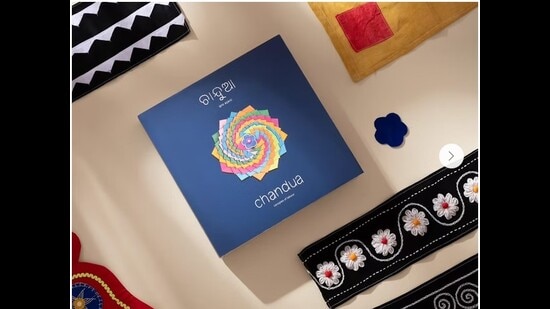
The event began with filmmaker and art curator Premjish Achari detailing the inspiration behind Odisha Craft Odyssey’s Chandua: Canopies of Labour, a bilingual book that he edited with Sibdas Sengupta. “Unfair binaries between art and craft need to be challenged. Everything now is artisanal, but the social background is often ignored,” he said adding that fast fashion, which has taken over the market, has led to the creation of large amounts of waste. At such a juncture, we need to refocus on slowness, which is integral part of art, he said.
Achari went on to moderate the first discussion titled Art as Social Practice: Artists as Ethnographers, Reimagining Local Knowledge Systems with artist and curator Jeebesh Bagchi, Anupam Roy from the Panjeri Aritists’ Union, and poet and educator Bishnu Mohapatra. “Labour is often invisiblized in the art world and contemporary politics definitely shapes the experiences of artisans,” said Roy who explained that the Panjeri Artists’ Union based in North 24 Paraganas has artists from Muslim, Matua and several other communities. For the Matua community, Partition is not a frozen moment in time; it was a continuous process spread across decades. As a result, after Special Intensive Revision, they have chosen not to recall their “desher badi” (homeland) as they don’t want to be categorised as Bangladeshi, he revealed.
{{/usCountry}}Achari went on to moderate the first discussion titled Art as Social Practice: Artists as Ethnographers, Reimagining Local Knowledge Systems with artist and curator Jeebesh Bagchi, Anupam Roy from the Panjeri Aritists’ Union, and poet and educator Bishnu Mohapatra. “Labour is often invisiblized in the art world and contemporary politics definitely shapes the experiences of artisans,” said Roy who explained that the Panjeri Artists’ Union based in North 24 Paraganas has artists from Muslim, Matua and several other communities. For the Matua community, Partition is not a frozen moment in time; it was a continuous process spread across decades. As a result, after Special Intensive Revision, they have chosen not to recall their “desher badi” (homeland) as they don’t want to be categorised as Bangladeshi, he revealed.
{{/usCountry}}“For me, craft and art are not opposed to each other. Instead, they are in tandem,” said Bagchi, who added that it is important for an artist to have an understanding of everything that’s happening around them. Mohapatra took the conversation further: “Ethnography is not simply about visiting an ancient community. It is also about asking, ‘Who am I and what am I trying to do?’” he said. “There are ethical concerns when it comes to researching the other or even oneself. What is emphasized on, what decisions led to it are important.”
The next panel titled The Institutional Bridge: Institution Building between Art, Craft, and Anthropology had cultural policy thinker Charudatta Panigrahi moderating the discussion between Monisha Ahmed, founder of Ladakh Arts and Media Organisation, Richa Agarwal, Chairperson of Kolkata Centre for Creativity, and Siddartha Mohanty, Director of MGM Foundation. Panigrahi spoke about artforms being carried forward from one generation to the next before posing the question: “Is work being done to actually sustain art or is it being done to just feel good in the present?”
The discussion was lively with Mohanty speaking about how corporate social responsibility has changed and how innovative ideas are what create the most impact. Ahmed spoke about her own journey that led her to doing her PhD in Ladakh. “Ladakhis take time to open up and share about their culture and lives. I also consciously decided what to reveal and what not to,” she said, urging people to practice sensitivity. Agarwal stressed that “we all need to give back to the artists”. “While academia is important, we need to sustain art as well,” she said.
The concluding panel on The Applique Artisan Agency, Adaptation and Evolution featured author and master artisan Debi Prasanna Nanda, visual artist and founder, Utsha Foundation for Contemporary Art, Jagannath Panda, and Raj Maurya, archivist fellow with the OCO Fellowship Programme. Curator and editor at OCO, Sibdas Sengupta, who moderated the discussion, explained how applique artists work in clusters all over the state and how their styles were as varied as their geographical locations. “We went through 12 districts and talked to several artisans to understand the minute differences in their work,” said Maurya. Then, Nanda displayed two contrasting images of Chandua work. One was the traditional way while the other, which he had made with his daughter, was more modern. “In the case of handcrafts, when an institution becomes an enterprise, it becomes sustainable,” he said. He ended his piece by pointing out that no applique artisan has as yet been honoured with a national award.
Hopefully programmes like these will change that and put the focus on this intricate art form. The event culminated with the launch of Chandua: Canopies of Labour by guest of honour Rajeev Sethi and chief guest Vishal Kumar Dev.
Chittajit Mitra (he/him) is a queer writer, translator and editor from Allahabad. He is co-founder of RAQS, an organisation working on gender, sexuality and mental health.