Imagine this. You sit down to watch a movie, and minutes into it, you recognise one of your favourite books? A book you’ve read and re- read, loved and lived, many times over. Can you feel the excitement, the almost triumphant thrill of having been let in on a precious secret? The experience is what I like to call ‘delicious serendipity’. I have felt it. Many times.
And it led me to romanticise about these stories as they traversed across time and space and culture. About how, somewhere in a foreign land, sometime during long ago, a story emerged in the mind of an artist and they put it down between pages. And many decades later and many thousand miles away, other artists turned the pages, made the story their own, and translated the book into film. And how, in either avatar, the stories continue to resonate with, and pleasure us.
Kanamarayathu is an adaptation of Daddy-Long-Legs
It began with the 1984 Malayalam film, Kanamarayathu, starring Mammooty, Shobana and Rahman. It is an adaptation of Daddy-Long-legs, the book written by Jean Webster in 1912. If you’ve read the book, you don’t need me to rhapsodize over the powerful portrayal of the young and impudent American orphan, Judy. The story takes us with her as she grows up, gets an education, gathers life experiences, finds herself, and falls in love; all conveyed through the regular letters she writes to her benefactor. Kanamarayathu takes off from the same premise; 15 year old, orphaned Shirley on her way to college, sponsored by a dashing Roy Varghese. And like all movies, it is liberally sprinkled with song and dance, a few extra layers, and some, not strictly necessary, intrigue. But it gets there in the end, so all is well.
Gawahi is based on Night of January 16th
{{/usCountry}}Gawahi is based on Night of January 16th
{{/usCountry}}The next is a movie called Gawaahi, made in 1989. This courtroom drama starring Zeenat Aman, Shekhar Kapur, and Tanuja, is based on Ayn Rand’s book of 1933, Night of January 16th. The film, and the book, trace the murder or apparent suicide of a man. The protagonist is his mistress, on trial for the crime. The victim is an acknowledged and audacious swindler, hedonist, and egotist. He is an eloquent symbol of an unbridled sense of ‘self’. Now all Ayn Rand fans know that in her world, none of these descriptors are, on any count, bad words. What is astonishing though is that, till the end, Gawahi never swerves from the ideals of the book. The philosophy of Ayn Rand and her convictions are faithfully transported into this Hindi film. Through the pagan sexuality and the unapologetic capitalist aspirations, which ostensibly are uncommon in the Indian context, the film perseveres. It is truly a labor of love.
Shubho Muhurat is an adaptation of The Mirror Crack’d
With Shubho Muhurat, Agatha Christie’s thriller of 1962, The Mirror Crack’d from side to side, appeared in Bengali cinema. This Whodunit, made in 2003, corresponds to all things successful cinema should be; controlled performances, excellent screenplay and a stellar star cast. Rakhee essays the role of the canny Ms. Marple with consummate ease. Sharmila Tagore, with her fragile beauty, flows seamlessly into the character of the nervy and tumultuous actress. Soumitro? His mere presence is a treat.
While the book, in Christie’s inimitable style, gradually peeled of the layers and laid before us the murderer in the last chapter, Shubho Muhurat too builds up to the crescendo convincingly. It captures the essence of the book and is a delightful watch at many levels. Agatha Christie would be happy.
Gangoobai is based on Flowers for Mrs. Harris
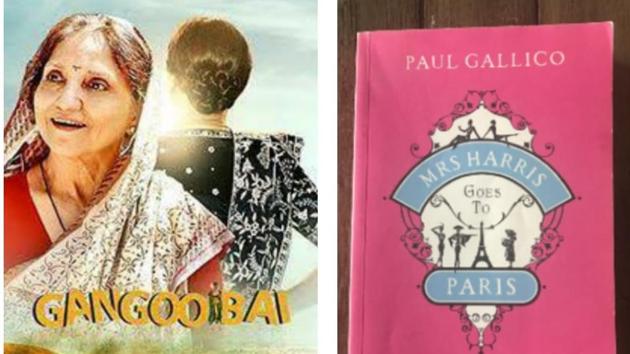
The last in the series is the 2013 Marathi film, Gangoobai. This is based on Paul Galico’s novel, Flowers for Mrs. Harris. Galico wrote the book in 1958, and owing to a chance stroke of luck, I read it in 2006, meeting Mrs. Harris for the first time.
It turned into, and remains, a no-holds-barred love affair. Ada Harris, The quintessential British Char, travels to Paris to buy herself a Dior dress, no less. She scrimps and saves for three years before she can make the trip. Her heartwarming encounters and experiences in Paris comprises the rest of the story. In this deceptively simple jewel of a book, Galico shows us how well he understands women, their dreams, and their unique female-ness.
Gangoobai takes us with her from Matheran to Mumbai to buy herself a hard won Parsi Gara sari. Her desire fuelled journey for the Sari is filled with unstinting hard work, friendships, flowers, and the kindness of strangers. No mean actor, Sarita Joshi plays Gangoobai with quiet dignity and aplomb. And the end is fittingly poetic.
It is deeply satisfying when the personal and popular come together, no?
Disclaimer: The views expression by the author are personal, and not those of the publication.