
 E-Paper



Govt rolls out festive ‘stimulus’
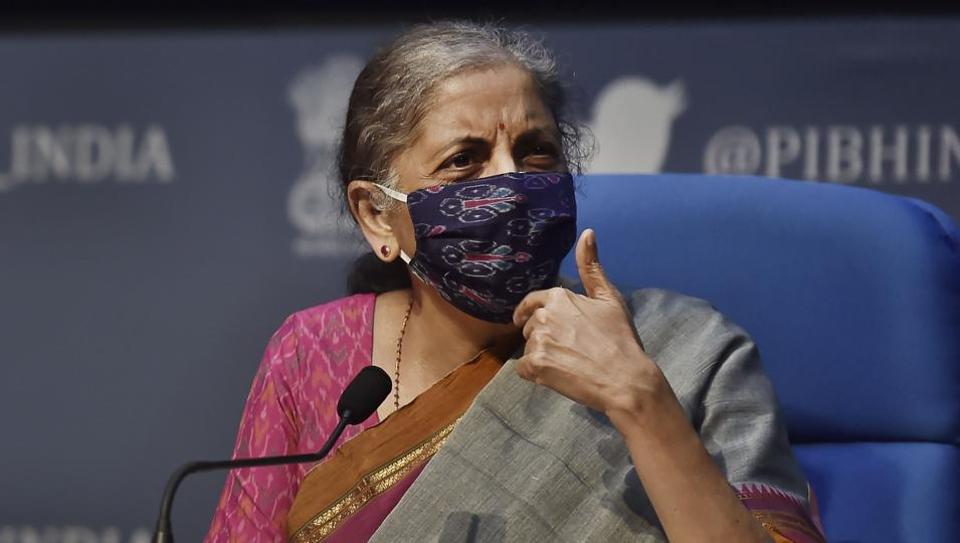
Finance minister Nirmala Sitharaman said the demand stimulus package has two focus areas — consumer spending and capital expenditure.

 Prefer HTon Google


Finance minister Nirmala Sitharaman unveiled a new demand stimulus package on Monday, offering incentives to consumers to spend more ahead of the festive season in an attempt to stir the economy out of stupor.
Sitharaman proposed ₹73,000 crore in public expenditure, including ₹28,000 crore on leave travel concession (LTC) vouchers and encashment by government employees, ₹8,000 crore on pre-paid special festival advances, ₹12,000 crore capital investment by states via 50-year interest-free loans from the Centre, and ₹25,000 crore additional capital spending on infrastructure projects by the Centre in 2020-21.

Announcing what she termed fiscally prudent proposals to stimulate demand in the economy, the finance minister said that if the private sector offered similar LTC benefits to their employees, that would have an additional impact of ₹28,000 crore, which would take the total demand stimulus package to over ₹1 lakh crore. All benefits are available till March 31, 2021.
Sitharaman said the demand stimulus package has two focus areas — consumer spending and capital expenditure. In consumer spending, the package has two components — LTC encashment vouchers plus leave encashment, and special festival advances through pre-paid RuPay cards.
Central government employees get tax free LTC to any destination of their choice once every four years besides leave encashment of 10 days. As travel is difficult during the Covid-19 pandemic, the government has decided to make cash payments for the fares in line with the entitlement of government employees, which is tax-free, she said. The offer is one-time only, she clarified.
The latest offer by the government follows a record 23.9% contraction of the economy in the quarter ended June as the country paid the price for the coronavirus pandemic and the ensuing 68-day hard lockdown that closed factory production and business establishments, confined residents indoors and shut public transport. Gross domestic product is likely to contract this fiscal year by 9.5%, the Reserve Bank of India’s monetary policy committee forecast last week.
To be sure, the offer unveiled by the government on Monday is conditional. Employees taking up the offer will be required to buy goods and services worth three times the fare component of LTC and the equivalent of leave encashment component of LTC before March 31, 2021.The money must be spent on products that attract a Goods and Services Tax (GST) rate of 12% or more from a GST-registered vendor through the digital mode, Sitharaman added. “So, the demand infusion in the economy by Central government and Central government public sector undertakings is estimated to be around ₹19,000 crore... and infusion, even if, just 50% of the states opt to give this facility,... we think, that will bring in about ₹9,000 crore,” she said.
Sitharaman said that if private sector companies offer similar benefits to their employees that can boost demand equal to the Centre and states combined, which is about ₹28,000 crore.
Economic affairs secretary Tarun Bajaj said that the estimate of ₹28,000 crore of demand generation by private sector employees was a conservative estimate; employers would be happy with the tax concessions offered , he said.
Explaining the special festival advance, the second component of the consumer spending measure, Sitharaman said the government proposes to restore the festival advance as a one-time measure for its employees. It plans to give an interest-free advance of ₹10,000 per employee through a pre-paid RuPay card that can be repaid in 10 instalments. The beneficiary has to spend the amount through the digital mode by March 31, 2021. All such advances were abolished by the 7th Pay Commission. For Central government employees, this would entail an expenditure of ₹4,000 crore. If states also join this scheme, conservatively, over ₹4,000 crore of additional consumer demand will be generated, she said.
Speaking about demand generation through capital expenditure, the finance minister said the government has proposed a ₹12,000 crore special interest-free, 50-year loan scheme to states to be spent by March 31, 2021. According to the scheme, ₹200 crore each will be given to eight Northeastern states and ₹450 crore each to Uttarakhand and Himachal Pradesh. While ₹7,500 crore will be available to other states in proportion to their shares determined by the devolution of the Finance Commission, ₹2,000 crore will be given to those states that meet at least three out of four reforms given in the Atmanirbhar fiscal deficit package, she said.
Announcing the last tranche of the package on May 17, Sitharaman said the Centre had also accepted the demand of states to raise their borrowing limit from 3% of their gross state domestic product (GSDP) to 5%; that would give them additional resources of ₹4.28 lakh crore during the Covid-19 crisis. The increased limit was, however, conditional and depended on implementation of reforms by them in four areas — one-nation, one-ration-card, ease of doing business, power distribution and urban local body revenues.
Sitharaman said that the government has decided to provide ₹25,000 crore in additional budget for capital expenditure on projects related to roads, defence infrastructure, water supply, urban development, defence infrastructure and domestically produced capital equipment. “Allocations will be made in forthcoming revised estimate [RE] discussions of the ministry of finance with concerned ministries,” she said. The budget already provides for ₹4.13 lakh crore of capital expenditure in the current financial year.
Referring to the ₹20.97 lakh crore economic stimulus-cum-relief package announced between March 26 and May 17, Sitharaman said that while the needs of the poor and the weaker sections have been addressed in the Atmanirbhar Bharat (Self-Reliant India) package, current proposals are designed to stimulate demand “in a fiscally prudent way” so that “today’s solution should not cause tomorrow’s problem”.
The Congress party hit out at the government, saying the ₹ 12,000 crore to states for capital expenditure is a “no more than a lame joke” on the economy.
In a statement, Congress spokesperson Gourav Vallabh andthe party’s technology and data cell head Praveen Chakravarty said the finance minister had given a new definition of “fiscal stimulus” for a set of measures that she claimed will stimulate demand and investment.
“First, we are glad that the FM has had a belated realisation that consumer demand needs to be stimulated in the economy, something that we and almost every other sensible economist have clamoured for, over the last six months,” they said.
“It was also a clear admission that the much hyped ₹20 lakh crore Atmanirbhar plan announced by Prime Minister Narendra Modi in May is a dismal failure in protecting and reviving India’s ravaged economy,” they alleged.
“But evidently lessons from that experience have not been learnt yet. Just because the PM or the FM call these measures an economic stimulus does not mean the economy will obey and get stimulated. The economy cannot be dictated to or swayed by headlines,” the Congress leaders said.
Economic affairs secretary Bajaj said the package was prepared keeping fiscal prudence in mind and it will not require any additional borrowing in the current financial year. In May, the government had already raised its gross market borrowing target for FY 2021 to ₹12 lakh crore from ₹7.8 lakh crore budgeted in February.
“The much awaited second round of fiscal stimulus, amounting to a little less than 0.4% of the estimated FY21 GDP, is roughly divided equally into boosts to capital expenditure of ₹37,000 crores, and consumption expenditure of ₹36,000 crores,” said DK Srivastava, chief policy adviser at consulting firm EY India.
“Coming ahead of the festive season, this may be considered a limited but welcome fiscal stimulus. These direct expenditure commitments may be supplemented by an increase in private expenditure since government employees have been given an incentive to spend on goods and services bearing a GST rate of 12% or above. This scheme, however, may be beset by excessive conditionalities,” he added.
Nilaya Varma, co-founder and CEO of consulting firm Primus Partners, said: “The government recognises the need to raise demand, and any measure to this regard will help revive the economic measures... The industry is looking forward to the Budget 20-21 to introduce more demand-side measures to revive the economy further.”


