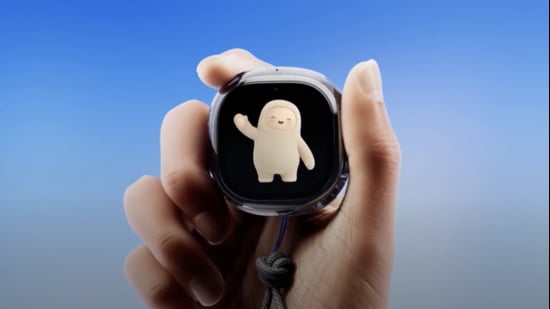
At a recent keynote, when Meta’s Mark Zuckerberg teased an upcoming AI gadget concept, some of you may have been old enough to find more than a passing familiarity with the Tamagotchis. Those pocket-sized digital virtual pets created by Bandai in the late 90s. They launched in Japan before becoming a massive global cultural phenomenon. The relatability to Meta’s Muse Charm concept begins with a form factor, once the alien creature cracked out of its egg. Tamagotchis were small, with a tiny screen and three small buttons, all of which had a specific function—feeding it, cleaning its virtual poop or playing with it.
That, and a question which we may not exactly have an answer for immediately—do we really need another attempt at making AI gadgets? This question becomes a bit more important, since artificial intelligence (AI) companies have already dabbled with the idea of AI gadgets. Remember the Humane AI Pin or the Rabbit R1 which absolutely collapsed under their own weight of expectation. Or even the Google Glass which never really got off the ground. HP later acquired all of Humane’s assets. In my book, the fatal mistake these devices made was that they attempted to replace the smartphone. Users were never going to buy that pitch, because phones already did the same tasks faster and more reliably.
And what does one really say about Meta’s smart glasses, the Ray-Ban Meta family, which are plagued with typically serious privacy issues that had led to a very low level of confidence in anything Meta does. I had also written about my refusal to review and assess the Ray-Ban Meta Gen 2 glasses when they were launched in India last year, due to a greater sense of discomfort with the idea considering Meta’s habits around user data privacy. To be walking around with a camera, isn’t exactly a good idea.
That leads us to something else that Meta is talking about now. And something OpenAI keeps hinting at from time to time. The context here is that AI companies seem to be approaching this hardware element in a different way this time around. First, set the groundwork for them to be useful. And then release them hoping consumers take the bait. Key propositions—Meta Muse and OpenAI Dots.
{{/usCountry}}That leads us to something else that Meta is talking about now. And something OpenAI keeps hinting at from time to time. The context here is that AI companies seem to be approaching this hardware element in a different way this time around. First, set the groundwork for them to be useful. And then release them hoping consumers take the bait. Key propositions—Meta Muse and OpenAI Dots.
{{/usCountry}}Build the assistant, then sell the product
They are both personal agents, with the key element being they’re “always-on” cloud AI agents that run tasks in the background. These can be multi-step tasks too, but you must give them access to your apps and data will be relevant for them working as your assistant. Emails, the calendar, your web browser, and third-party apps that you use. Agents can be set up to find hard-to-get concert tickets, make dinner reservations, compare prices across websites and shop online. They can also sort and clean up a mailbox, coordinate calendars, do research and organise a mess of files and folders.
For more advanced tasks, an agent uses a virtual mouse and keyboard to open desktop apps, move files, copy data between programs and fill in long online forms. It can also link apps that do not work with each other directly: it can download an invoice from an email, rename it and upload it to a specific cloud folder.
Basically, you don’t need to have a Windows AI PC or an Apple Mac mini or a Mac Studio or a cluster of them working together to run an AI agent for you. The compute is all done on a server somewhere, online.
Online services have begun to push back. Amazon blocked Muse from its site on September 20, citing its terms of service. Resy, a restaurant booking platform in the US, has said it does not allow unapproved bots or agents on its service, and it has locked out users whose agents kept checking it for tables. Is this the beginning of a wider pushback? That will determine the utility of these AI agents, and the assistant hardware that is supposedly round the corner.
A pragmatic pivot, and boring winners
The then-ambience that defined positioning as ‘smartphone killers’ in the early days, has moved to something that could possibly be more substantive. The first generation AI gadgets were essentially hardware searching for a reason to exist. Now, smarter from that experience, AI companies are first getting the software in place, which people will make a habit of.
Turns out, the more successful AI hardware isn’t glamorous or flashy, and you may not need to wear it around your neck. AI company Plaud makes voice recorders that transcribe and summarise meetings, and have a more robust AI suite rolling out later this year. Numbers reported over the summer peg its user base at around 2 million users worldwide, and expect more than $500 million worth of sales this year. In my experience, this particular use-case has merit for a dedicated AI device, over a smartphone that does some of the things, but not all.
Meta is building the Muse, and then the Charm arrives on the scene after users have made the always-on agent a habit. And it is targeting consumers first, which is Meta’s stronger base. There will be merit in the argument for a dedicated hardware at that time. OpenAI is trying the same with Dots, which for now are available to ChatGPT Pro, Enterprise and Business Premium users in certain markets, but it is a matter of when and not if, for Dots to roll out to consumers too. For months, it has been rumoured that OpenAI will release a screen-less speaker, perhaps even with a camera. No one knows.
The AI Tamagotchi is quite relevant for the Muse Charm, which is expected at some point. Call it a pendent, call it a puck, call it a keychain, this is expected to have a 2-inch screen, built-in 5G (but no voice calls, that 5G is for AI compute) and will be underlined by the Muse models. Meta aims to ship this device in December, hoping to cash in on the holiday sales, but it may not be so simple. Zuckerberg noted that they’ve “only built a few of these so far”, and getting the right components at the right prices in this time won’t be easy. Pricing has not yet been announced.
The question you must answer is, do we need AI assistants rummaging through our data, so we need better AI assistants and finally, do we need a device that’s akin to adopting a virtual pet? Answers to this three-layered question will define whether you queue a pre-order for the Muse’s Tamagotchi avatar.