This may well be a model of great consequence. Google has released a significantly more capable Gemini 4 Hydrogen artificial intelligence (AI) model, which is one of the lightest models and perhaps the eventual successor to the Gemini 3.8 Flash model. That means, more consumers and enterprises are expected to interact with this model on a regular basis across everyday usage including in Google Search and the Gemini app.
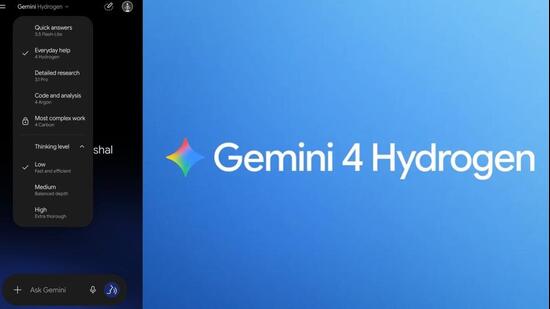
The Gemini 4 Hydrogen model, Google illustrates is better at most AI benchmarks for models of this category, including Anthropic’s Claude Sonnet 5.5 and OpenAI’s GPT-6.1 Terra. In some instances, Hydrogen returns better results than even the frontier model, Argon. That in itself underlines a significant leap for a generally available model that will be widely available to Gemini users, and also at a lower token cost for enterprises.
Also Read: Google Gemini 4 Carbon is now available, but only for top-tier subscribers
Koray Kavukcuoglu, SVP, Google DeepMind and Chief AI Architect, Google confirms that Hydrogen surpasses Argon on the Artificial Analysis Intelligence Index at its default high thinking level (51 vs. 50, and reaching 54 at its highest xhigh thinking setting), while often completing tasks faster than models in its class. Another example: in the Terminal-Bench 4.1 benchmark, Hydrogen scores 57.0%, ahead of Argon which scored 57.4% in Terminal-bench 4.0 at the time of its release.
There are four key areas where this model delivers improvements for a significant demographic of users: better understanding of intent, improved query linking to serve a broader range of helpful links, richer language understanding and more visual responses. Alongside, there are improvements for developer and enterprise workloads including multi-step tasks, deep research, multimodal knowledge work and web development.
{{/usCountry}}There are four key areas where this model delivers improvements for a significant demographic of users: better understanding of intent, improved query linking to serve a broader range of helpful links, richer language understanding and more visual responses. Alongside, there are improvements for developer and enterprise workloads including multi-step tasks, deep research, multimodal knowledge work and web development.
{{/usCountry}}Also Read:Google Gemini 4 Argon is Alphabet’s most advanced model yet
“While our frontier models, Gemini 4 Carbon and Gemini 4 Argon, excel at deep, long-horizon reasoning on your hardest problems, Hydrogen is built for rapid execution across diverse agentic workflows,” says Kavukcuoglu.
A short-term release?
Interestingly, the Google Cloud documentation for the Gemini 4 Hydrogen categorises it as generally available (GA) as a “short-term release”. Could this be because generational model transitions are happening at a much faster pace, as the recent example of the Gemini 4 Argon being followed by the Gemini 4 Carbon illustrated?
The benchmark leap
The competition landscape sees a significant change. In the Agents’ Last Exam v1.1 benchmark for knowledge work, Hydrogen (71.6%) is far ahead of Claude Sonnet 5.5 (60.4%) and GPT-6.1 Terra (69.8%). In the reasoning benchmark called HLE-Diamond, Google notes that Hydrogen scores 58.8% while Claude Sonnet 5.5 (53.3%) and GPT-6.1 Terra (47.3%) follow. The agentic coding benchmark SWE-sweep sees Hydrogen (13.5%) gain a significant lead over Claude Sonnet 5.5 (3.1%) and GPT-6.1 Terra (5.8%).
Also Read: Anthropic’s new Claude Fable and Mythos models deliver momentum ahead of IPO
The bigger generational leap for a model of this size and frugality is more apparent in the Artificial Analysis Intelligence Index leaderboard. Hydrogen scores 54 at the high thinking level. For context, Claude Fable 5.2 leads with a 65 score, followed by Gemini 4 Carbon (high) with a score of 60, while Claude Opus 5.5 scores 59. Meta’s Muse Wonder Full at max thinking scores 50, while Claude Fable 5.1 returns a score of 49. That underlines the leap in capabilities of a smaller, high-efficiency workhorse model.
In fact, Hydrogen’s score is higher than what the Gemini 4 Argon, released a few weeks ago, scored 50 at the high thinking level in this benchmark.
Pricing and availability
“Gemini 4 Hydrogen brings improvements from our latest Gemini 4 safety and security stack to our broadest audience yet, combining built-in training with real-time surface safeguards to help mitigate both misalignment and misuse,” says Kavukcuoglu.
In terms of pricing, Gemini 4 Hydrogen is priced flat across its entire 1 million-token context window at $1.50 per million input tokens and $7.50 per million output tokens. This will be at par with Gemini 3.8 Flash, which will also be priced at $1.50 per million input tokens and $7.50 per million output tokens from January. For now, Gemini 3.8 Flash is priced at $0.75 per million input tokens and $3.75 per million output tokens.
Also Read:Two weeks, a new AI frontier: Google Gemini 4 Carbon marks shorter upgrade cycles
Interestingly, Google is rolling out the Gemini 4 Hydrogen to all users, across developer, consumer and enterprise platforms. For consumers, Hydrogen is available in the Gemini app as well as in Google Search, while Gemini in Google Sheets is currently limited to Google AI Pro and AI Ultra subscribers. If you are on the free tier in the Gemini app, the Hydrogen model is available but it will be auto-selected based on query type. Paid subscribers can manually choose between different models, including 3.1 Pro, Gemini 4 Argon and Gemini 4 Carbon (if you are an AI Ultra subscriber) at different thinking levels.