
 E-Paper





Many fund managers strive to be transparent with their financial disclosures. Others are so obstructive that they might as well be kicking sand in investors’ faces.
How One Big Private-Equity Fund Makes Its Numbers Incomprehensible
Tricks of the trade gain new importance as 401(k) accounts open up to alternative investments.
Updated on: Aug 13, 2025, 15:33:06 IST

WSJ

 Prefer HTon Google
Share via
Copy link

While private equity is synonymous with opacity, the tricks of the trade are taking on greater importance as the industry seeks to broaden its reach among ordinary investors. President Trump last week signed an order seeking to open up Americans’ 401(k) retirement accounts to private equity and other alternative investments. Rep. Elise Stefanik (R., N.Y.) made headlines when she asked the Securities and Exchange Commission in June to investigate the way Harvard is valuing its private-equity holdings.
To date, private equity has generally been the domain of institutions and high-net-worth individuals with long-term investment horizons and a high tolerance for risk and illiquidity. Less wealthy, ordinary investors have traditionally had only limited access. Their ability to participate has been growing, however, as more funds register with securities regulators and publicly disclose their financial reports. The funds may invest directly in other private-equity funds, or purchase stakes in them on the secondary market from existing investors.
Such funds should, at a minimum, allow investors to see how much each private-equity holding originally cost and compare that with its latest carrying value. Some funds are making this exercise difficult. This is particularly problematic in light of recent controversies over some of the industry’s valuation methods.
Among the hottest flashpoints: Some funds have exploited an accounting loophole by buying stakes in other private-equity funds at big discounts on the secondary market and then marking them up immediately to their official net asset values. Sometimes the technique has resulted in gains of 1,000% or more in a single day.
At many funds, such markups are at least easy to spot. The funds include clear, user-friendly tables in their financial reports that show each investment’s cost, the latest fair value and the acquisition date. These data points are required disclosures under federal securities rules. Showing them alongside one another makes comparisons simple.
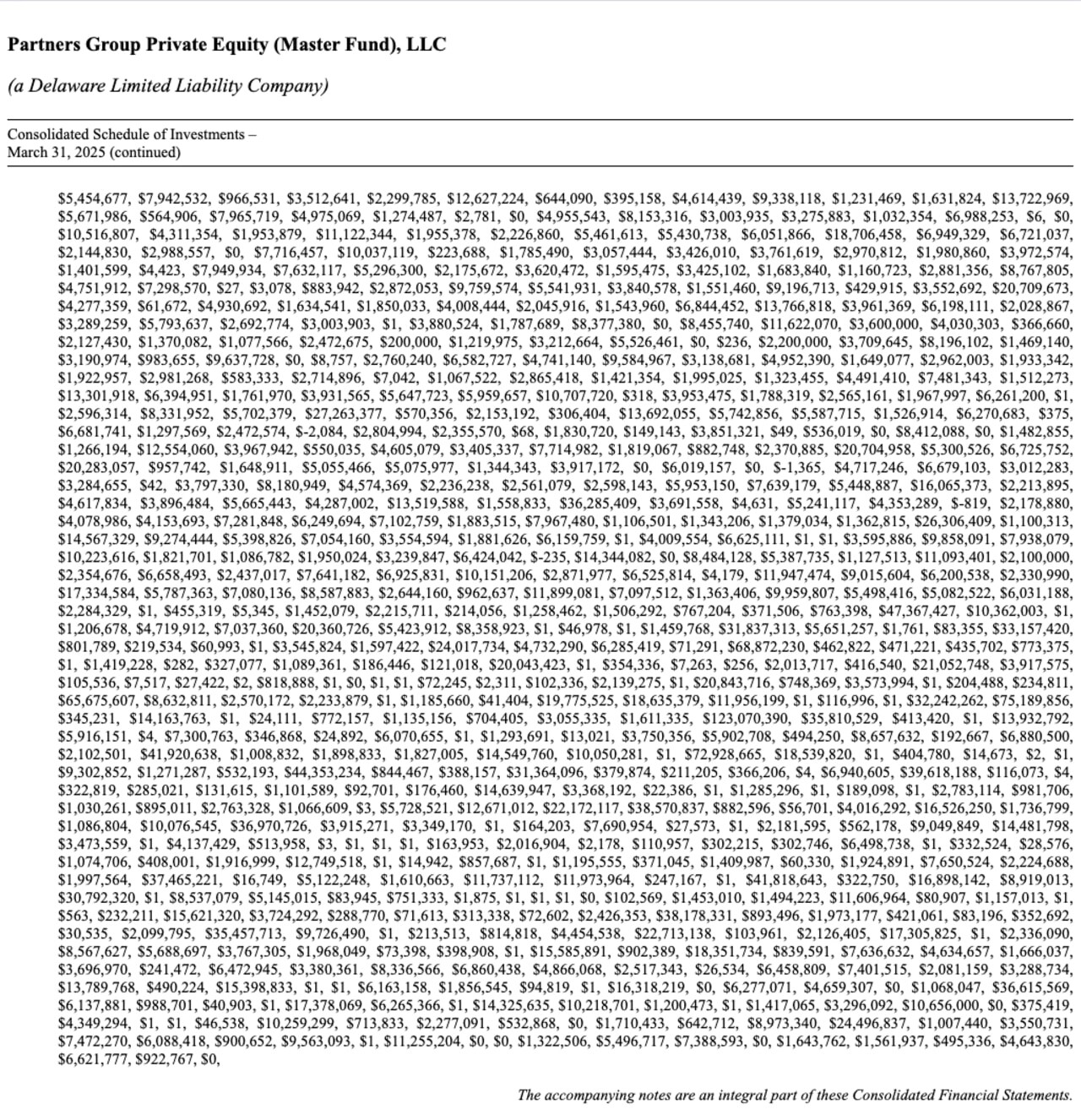
But other funds make comparisons complicated, if not impossible, by listing the cost figures in lengthy footnotes, rather than in the main tables. The only way to determine the size of the markups is to manually match the costs for each investment (in the footnote) with the latest fair values listed on the disclosure table. Even that doesn’t always work.Take, for instance Partners Group Private Equity (Master Fund), which last reported almost $16 billion of net assets. It is the largest SEC-registered private-equity fund, according to Interval Fund Tracker. Individuals investing in the fund must meet certain minimum financial criteria. To exit from the fund, investors submit redemption requests during designated tender periods.
The schedule of investments in the fund’s latest annual report listed 1,089 individual private-equity investments in a table that included the fair value and acquisition date for each. In a footnote to that table, however, it listed 1,095 different cost figures.
That is six more cost figures than there were investments. The footnote spanned three pages, single-spaced.
In other words, there is no way someone reading the annual report could determine which cost figure applied to which investment—and no way to gauge which investments might have fishy markups. A review of previous reports showed the Partners Group fund sometimes had done this before.
Regarding the cost-figure mismatch in the latest annual report, Partners Group spokeswoman Jenny Blinch said that “there were a handful of investments to which the fund made follow-on investments in the same security,” and the cost figures listed for these in the footnote “were disaggregated into the individual transactions.”
After receiving questions about the practice, Blinch also said the fund plans “to start including investment costs in the main table of the schedule of investments, alongside entry dates and current valuations.”
The fund accounted for about 10% of Switzerland-based Partners Group’s assets under management at year-end.
A Wall Street Journal review of disclosures by other similar funds showed they use the same footnote technique. At those funds, however, it was at least possible to match costs to the corresponding investments. That is because the number of cost figures in the footnotes aligns with the number of disclosed investments. These include private-markets funds run by well-known managers such as Hamilton Lane, Franklin Resources, Coller Capital, Pantheon, Pomona and FlowStone.
Ares Private Markets Fund’s annual report shows cost figures in the main disclosure table, not a footnote. It bought stakes in 51 different private-equity funds on the secondary market on March 31, 2025, the last day of its fiscal year. The total cost was $330 million, and the Ares fund marked them up the same day to $377 million. The biggest percentage markup for a single investment was 57%, and the cumulative $47 million of paper gains that day amounted to 12% of the fund’s total unrealized gains for the entire year.
Ares ensured outsiders could at least look up those numbers. Anyone trying the same exercise with the Partners Group fund’s last annual report would be stymied.
Investors would be fair in suspecting that something here doesn’t add up.
Write to Jonathan Weil at jonathan.weil@wsj.com
Track live Stock Market Today updates and check your NSE IPO Allotment Status Today. Stay informed with the latest business news like N Chandrasekaran, petrol and diesel prices, gold and silver rates, income tax updates, and major economic developments across India and globally.


