
Can India establish a viable semiconductor industry? If things go as planned, the country could emerge as a significant player in global supply chains. This could generate high-quality jobs in India, lessen Western dependence on China, and deepen U.S.-India technology relations.
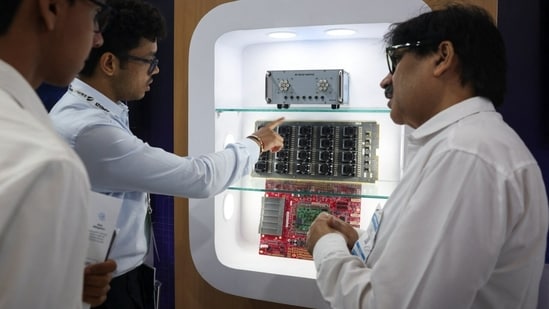
But success is far from guaranteed. Should India’s ambitious semiconductor effort falter, it will likely be remembered as another example of a wasteful government program that squandered taxpayer money on a vanity project.
Still, you can’t fault the Modi
Can India establish a viable semiconductor industry? If things go as planned, the country could emerge as a significant player in global supply chains. This could generate high-quality jobs in India, lessen Western dependence on China, and deepen U.S.-India technology relations.
But success is far from guaranteed. Should India’s ambitious semiconductor effort falter, it will likely be remembered as another example of a wasteful government program that squandered taxpayer money on a vanity project.
Still, you can’t fault the Modi government for lack of ambition. Over the past five years, it has earmarked about $23 billion to support development of a sustainable semiconductor system in India. State governments have topped this with generous incentives of their own.
A report last year by the Center for Strategic and International Studies described India’s effort as an attempt “to compress decades of ecosystem development into just a few years.” Of about a dozen projects approved so far, highlights include a wafer fabrication plant in Gujarat, which is expected to become operational in 2028; an assembly and test facility in the northeastern state of Assam, which is expected to begin commercial production next year; and an assembly and test facility in Gujarat, which began production earlier this year.
In a phone interview, Chris Miller, a professor at Tufts University and author of “Chip War,” says India’s strengths include a large pool of chip designers, strong links to Silicon Valley, and encouragement from the Indian government. He points out that “the electronics industry has been looking for a home for a lot of manufacturing outside China.” India’s size and large domestic market give it an advantage over smaller Asian countries such as Malaysia, Thailand and the Philippines.
There are also reasons for skepticism. For one, previous Indian efforts to establish a semiconductor industry have come to naught. In the 1950s, the heyday of Nehruvian planning, India laid the foundations for a public-sector electronics industry that expanded into semiconductor manufacturing, but the projects sputtered after promising starts.
Attempts this century fared no better. Announced in 2006, an ambitious project near Hyderabad that was supposed to include a $500 million investment by computer chip maker Advanced Micro Devices failed to materialize. Eight years later, two high-profile projects to build fabrication plants in India also failed to get off the ground.
“When the Chips Are Down,” a 2023 book by Indian tech experts Pranay Kotasthane and Abhiram Manchi, calls India’s “poor environment for businesses” the “common thread in these failures.” The authors point out that an uncertain tax and policy environment, poor infrastructure and high trade barriers “made chip fabrication an unattractive proposition in India.”
Might this time be different? Believers in India’s semiconductor dream point toward Prime Minister Narendra Modi’s personal interest in the initiative. He has inaugurated all five editions of the annual Semicon India conference, a relatively recent addition to similar conferences in the U.S., Taiwan, South Korea, Japan and China. Mr. Modi also meets regularly with the leaders of semiconductor companies and has elevated the issue to the highest levels of Indian diplomacy. Mr. Modi picked Ashwini Vaishnaw, a highly regarded technocrat, as minister of Electronics and Information Technology.
Moreover, India’s ambitions are relatively modest. Policymakers recognize that the country is nowhere near the frontier of semiconductor technology. The $11 billion fabrication plant in Gujarat being built by Tata Electronics and Taiwan’s Powerchip Semiconductor Manufacturing Corp. will start out manufacturing relatively simple “legacy” 90-nanometer chips used in cars, mobile phones and power-management equipment. This is far away from the high drama of the race for chip dominance between the U.S. and China.
Most of the other projects approved as part of India’s semiconductor mission involve assembly and testing, which are relatively labor-intensive. Mr. Miller points to India’s success in cellphone assembly in the southern state of Tamil Nadu as a template: “You shouldn’t start with the hardest problem, which is advanced manufacturing.”
For India, a lot rides on this bet. The semiconductor industry is capital-intensive and highly globalized, and it values a level of policy predictability that is the opposite of India’s reputation for capriciousness. If Messrs. Modi and Vaishnaw can change this reputation, they will do India a favor that goes far beyond semiconductors.
For the U.S., India could reduce the world’s dependence on China and add a measure of geographical diversification to an industry concentrated in North America and East Asia. “For the U.S., India has been an important partner,” Mr. Miller says. “But it could be a whole lot more.”
One Subscription.
Get 360° coverage—from daily headlines
to 100 year archives.
Archives
HT App & Website