This is just an unfortunate time to be making fine foldable smartphones. No matter what phone makers do, the final price tag consumers see will always elicit contemplation about value. Phone makers have little control over certain reasons, including supply chain pricing inflation particularly around storage or memory, and component availability constraints (though that’s eased quite a bit). Vivo’s struggles are similar. Their latest foldable, the Vivo X Fold6, is an accomplished product across the three key pillars—performance, ergonomics and camera.
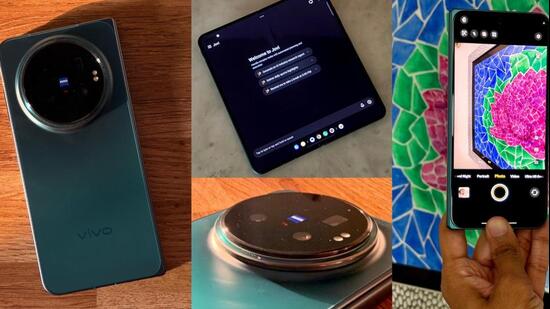
Yet, the price tag of ₹2,19,999 poses a stumbling block. Yet, it is hardly a spoiler alert to say this is by far the best camera in a foldable, with the Zeiss imaging system.
Pricing and competition landscape
This is a complication that the Google Pixel 11 Pro Fold (priced now at ₹1,86,999) and the Samsung Galaxy Z Fold8 Ultra (now selling for ₹1,99,999) also faced at different points in time. But the passage of time has allowed the price tags (as you can notice) to slide below the ₹2,00,000 mark. It is still an incredible amount of money to part with for a foldable phone, but purely for perspective, they suddenly seem to be better value (if value is at all the right word here). There are some discounts on certain credit cards— ₹26,400 on HDFC, Axis Bank and SBI credit cards, and if you hold one of those, use it wisely. Then parity begins to make more sense.
Pricing subjectivity aside, there is a lot to like about the Vivo X Fold6, particularly in this Nebula Teal colour. You’ll certainly not miss the gradient from light to dark, and spend some time noticing the gorgeous light-reflective play this finish manages to achieve. The other choice is a more common and widely acceptable Prism Black. This is a book-style foldable, and Vivo has done a good job of bringing the thickness and overall footprint very close to the benchmark that Samsung has set.
{{/usCountry}}Pricing subjectivity aside, there is a lot to like about the Vivo X Fold6, particularly in this Nebula Teal colour. You’ll certainly not miss the gradient from light to dark, and spend some time noticing the gorgeous light-reflective play this finish manages to achieve. The other choice is a more common and widely acceptable Prism Black. This is a book-style foldable, and Vivo has done a good job of bringing the thickness and overall footprint very close to the benchmark that Samsung has set.
{{/usCountry}}The X Fold6 does feel well balanced, and attention to the little things makes a world of difference. For instance, this is slightly less tall than the Galaxy Z Fold8 Ultra and just that little bit wider—meaning the 6.5-inch cover display is a smidgen more comfortable to use comparatively. And speaking of fine details, the AMOLED cover display as well as the larger 8-inch foldable AMOLED display have the same pixel density (424 pixels per inch), which means app scaling and crispness will be similar if and when you move apps between the two screens. Both screens are bright, and particularly do well in terms of colour richness. The square-er foldable screen
Attention to detail
Vivo has redone the hinge mechanism and there is absolutely no spring reaction to speak of—this means it can be held open at multiple angle steps, and feels absolutely smooth with every fold and unfold. If you intend to use it in a tent mode or a laptop-esque mode for instance, the Vivo X Fold6 will do it more easily than any of the other foldables that have slightly stiffer hinge mechanisms that don’t offer this fluidity. Each method has its advantages, so to speak, and versatility is never a shortcoming.
There is something to be said about the Origin OS 7, which has seen a significant rework in terms of not just the visual elements, but also the fluidity, better use of the larger foldable screen, and an expected infusion of an artificial intelligence (AI) layer with Jovi. There is an element of agentic capabilities in what Jovi can do (this uses their homegrown Blue Heart large model architecture) such as managing tasks across the phone and connected Windows PC or Apple Mac, or natural language search across file manager and notes content.
Vivo’s approach helps, because this neatly leads me on to a productivity feature set that includes the Origin Workbench and multi-split screen flexibility. The Origin Workbench allowing five apps to be open at the same time, with a very intuitive tiling storm on the left side of the screen, means you know exactly where each app is and that’s intuitive too. Getting work done on a powerful smartphone should be a given, but more often than not, it remains a bit of a hit-or-miss depending on the apps you’re using.
The basis of Origin OS gives a stronger foundation for that to be more consistent, and it is—much easier to switch between a spreadsheet, document, web browser and another file saved on the phone or on Google Drive.
A chip, that Vivo specified
It is important to clarify that the chip powering the Vivo X Fold6 is the MediaTek Dimensity 9500 Super Edition, which was launched this summer and jointly developed by MediaTek and Vivo. It evolved from the Dimensity 9500 chip, retains the 3-nanometer process architecture as well as the CPU and graphics core layout. What’s changed, however, are further optimisations for dual-display driver management to ensure switching between displays without any stutter or latency, optimisation for Vivo’s software architecture for multi-window layout with chip-level changes, and thermal tuning for a very slim chassis.
The Vivo X Fold6 is on sale in India in the 12GB memory and 512GB storage variant. All the changes that Vivo has worked on with MediaTek have delivered the sort of experience which doesn’t follow the typical ’Qualcomm Snapdragon chips are better than MediaTek chips in flagship phones’ logic that is often heard. This holds performance without the slightest struggle, and most importantly, it returns excellent stamina from the 6,900mAh battery. In Balanced mode, this will get you through two days of usage as a phone, before it is down to 15% charge.
Use the Boost mode for gaming, and while that does drain charge quicker because it keeps the chip at a higher level of performance, those game-focused optimizations are also worth appreciating.
The Zeiss camera trump card
The Zeiss cameras are likely the biggest reason you’d buy a Vivo X Fold6. The troika has a 200-megapixel wide camera which is the Zeiss main camera using a Samsung HPB sensor, a 50-megapixel telephoto camera using the Sony LYT-602 sensor, and a 50-megapixel ultra-wide camera with the Samsung JN1 sensor. The chain includes the new image processing pipeline that the Dimensity 9500 Super Edition brings to the table, with Vivo’s Imaging Chip V3+, a professional grade stabilisation system and the Zeiss T* coating on the lens to reduce stray light and better colour reproduction.
The main sensor is larger than before, and this brings the foldable at parity with the flagship sibling, the Vivo X300 Ultra, and that in itself is a big step forward for the foldable as a camera phone. As a starting point, the Vivo X Fold6 replicates fantastic colours and excellent dynamic range, while retaining a definite high ceiling for editing these photos. However, it is a bit surprising that certain photos get more aggressive image processing than others, which can do one of these two things—either details look unnaturally sharp, or there is a bit of realism lost from the colours. This is easily fixable in an update.
The Vivo camera app has many features sitting within the interface, often in layered menus and pop-ups. It may seem overwhelming to someone like me, but my eight and a half year old daughter decided within minutes that the Photo mode in the ‘Refined’ colour profile and Portrait in ‘Radiant’ are her preference (not that she is getting any screen time to enjoy). Zoom is where the Vivo X Fold6 shines brightly, if you are okay with some artificial infusion of details to complete the picture. It is interesting to note that fine lines tend to be reproduced naturally at 10x zoom, while there is some jaggedness at 6x zoom. Again, something for an update to iron out. At the other end of the spectrum, close-up photos are almost flawless.
A conversation about the shopping cart
If you are having a conversation about parting with a lot of money for an Android foldable in this day and age, the Samsung Galaxy Z Fold8 Ultra and the Google Pixel 11 Pro Fold will certainly figure prominently. While Samsung may hold a slight edge in terms of overall performance, the Vivo X Fold6’s cameras are in a different league. In fact, even the Pixel foldable will be left catching up in complex photograph scenarios. Vivo has also done really well to catch up on the software front with productivity-focused additions as well as the AI layer, which then becomes a subjective choice.
No foldable is perfect (in fact, no candy bar flagship is perfect either, even after decades of trying), but there is indeed a lot that the Vivo X Fold6 does right. The hinge mechanism adds flexibility without taking anything away from strength, while Vivo has slimmed down the overall foldable profile without compromising dust or water resistance. The foldable screen’s crease is barely noticeable. And not to forget, the superb battery life. But then again, it all boils down to the sticker price, and that’s where the decision really isn’t that simple anymore. Market price will be operative in this decision, not the launch price. Look for those deals.