Honda Motorcycle & Scooter India (HMSI) expects the two-wheeler manufacturer's domestic sales to reach six million or 60 lakh units in this financial year, ending in March 2027. With this, HMSI is aiming for a 4.3% year-on-year (YoY) domestic sales growth in FY27, compared to its domestic dispatches of 5.75 million units recorded in the last financial year.
Tsutsumu Otani, President and CEO of HMSI, the second-largest two-wheeler manufacturer in India, has said that this year the company's sales have been very good. He also expects that, with the festive season, the domestic sales of the OEM in the Indian market are expected to grow further. "This year, the market and Honda's sales have been very good. Now, with the Navratri season starting, it is going quite well. Considering the current pace, Honda's domestic sales volume may be around six million units for the year," Otani told PTI in an interview.
In the first half of FY27, between April and September, HMSI's domestic two-wheeler dispatches rose 13.5% YoY to 3.04 million units with a market share of around 25%. Meanwhile, the domestic sales of the Indian two-wheeler industry rose 17.6% during the period to 12.09 million units, according to data from the Society of Indian Automobile Manufacturers (SIAM).
Around 60% of HMSi's two-wheeler volume comes from the scooter segment, which has been the Japanese automaker's forte for a long time, thanks to models like the Activa. For the broader industry, the contribution from scooters is 40%, with the motorcycle segment dominating sales volumes.
{{/usCountry}}Around 60% of HMSi's two-wheeler volume comes from the scooter segment, which has been the Japanese automaker's forte for a long time, thanks to models like the Activa. For the broader industry, the contribution from scooters is 40%, with the motorcycle segment dominating sales volumes.
{{/usCountry}}Speaking on the segment, Otani said that sales in this category have been growing, in line with a wider global shift from light motorcycles to scooters. He also added that the mix in India would depend on how customers use their vehicles. HMSI CEO also noted that demand is growing across all categories and Honda will focus on both entry-level and premium motorcycles apart from scooters.
Entry-level products expanding despite focus on premium models
While more customers are moving towards premium motorcycles and scooters, the entry-level market is also expanding. Otani said the company can draw on its wide global product range and adapt models to suit Indian buyers.
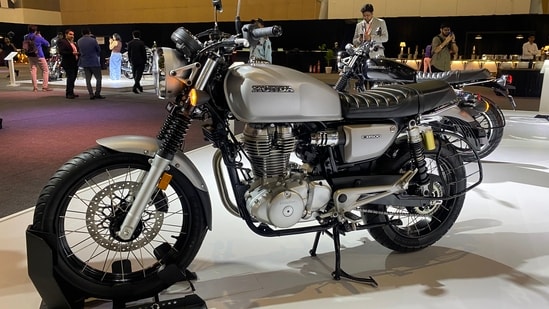
Recently, Honda unveiled 10 two-wheeler models in India. These included the adventure scooter E85 fuel-compliant ADV 160, the QC3 electric scooter, Rebel 300, XR L300, XR300 Rally, CB500 roadster, and the CB350 range of modern classics. With this wide range of products, the OEM is expecting to see a sales surge in the coming months, especially buoyed by the festive demand.
HMSI emphasising on production expansion
HMSI will expand the production capacity to eight million units from the current 6.5 million units by FY28. There are two new production lines coming up at its existing facilities in Tapukara and Vithalapur in Rajasthan. The additional production capacity planned is for both internal combustion engine and electric vehicle models.
In FY26, Honda produced 6.32 million two-wheelers, of which 5.75 million units were dispatched to the domestic market, and 620,275 units were exported to overseas markets.
Honda entered the electric vehicle market in early 2025 with two electric scooters. However, the OEM is yet to see major traction in sales with those models, even as electric vehicle adoption in this segment is growing steadily and other established OEMs are stepping up competition.
HMSI focusing on multi-fuel strategy
Otani indicated that Honda is looking at a multi-fuel strategy that includes petrol, flex-fuel and electric vehicles, rather than focusing on a single powertrain. He said that the powertrain choice depends on India's social infrastructure. "Electric vehicles are being promoted by the government, so that market is increasing. On the other hand, biofuels are also being promoted. We have E20 now, and the next stage may be a higher ethanol blend. Therefore, the powertrain will depend on the evolving social infrastructure. Shifting all vehicles from ICE to EV may be difficult when we consider the required infrastructure. I think EV adoption will accelerate in some areas. In other areas, there may be a shift from petrol to biofuels, at least initially," he said.
When asked about his outlook on the electric two-wheeler market, Otani said it is difficult to predict growth because the second-hand market is still developing and buyers are still working out how to assess an electric vehicle's long-term value.