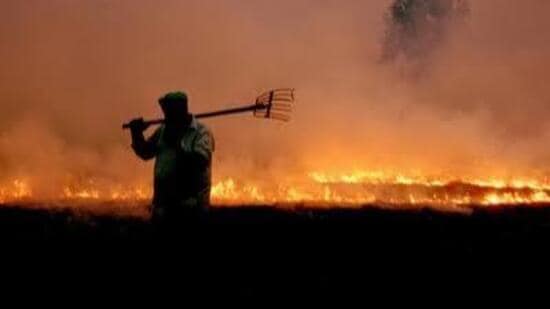
The Haryana government on Thursday said that 52 first information reports (FIRs) have been registered and 21 people arrested for stubble-burning violations during the ongoing paddy harvesting season.
The chairperson of the commission for air quality management (CAQM), Rajesh Verma, reviewed the enforcement measures being implemented by the state government to improve air quality. Haryana chief secretary Anurag Rastogi was also present in the meeting.
Haryana’s director (agriculture) Amit Khatri said that Haryana has distributed 13,200 crop-residue management machines against a target of 9,000.
He said that apart from lodging 52 FIRs and arresting 21 people for crop-residue burning related offences, the environmental compensation of ₹10,000 has also been recovered. “Red entries have also been made in farm records in cases related to stubble burning,” Khatri said in the meeting, according to an official spokesperson.
While the environmental compensation is recovered from the farmer burning the paddy stubble, the red entry in revenue records prohibits the cultivator from selling his crop under the minimum support price (MSP) in the next two crop cycles.
The official spokesperson said that the state is using a mobile application developed by the national remote sensing centre to verify burnt areas at the village level, helping authorities monitor incidents using satellite data.
To promote the use of paddy residue as a resource, district-level agreements have been made with industries to utilise over 27 lakh metric tonnes (LMT) of paddy residue during the current season.
{{/usCountry}}To promote the use of paddy residue as a resource, district-level agreements have been made with industries to utilise over 27 lakh metric tonnes (LMT) of paddy residue during the current season.
{{/usCountry}}It was informed in the meeting that biomass-based power projects had consumed over 7 LMT of paddy straw by September 30, while compressed biogas plants had consumed over 1 LMT.
Verma appreciated the Haryana government for the continuous decline in stubble-burning incidents. He also commended the Jhajjar district administration for developing a model brick kiln in the Badli area that is utilising paddy stubble as fuel.
Brick kilns in eight non-NCR districts are using paddy straw pellets as fuel, while Indira Gandhi Super Thermal Power Station has achieved 73% of its co-firing target.
Shekhar Vidyarthi, chairman, Haryana State Pollution Control Board, said that 20 drones have been deployed in the first phase of surveillance, and another 30 are planned. These measures will help authorities monitor affected areas and identify incidents of stubble burning more effectively.
Meeting with Punjab focuses on plan to curb farm fires
A separate meeting with the Punjab government focused on the implementation of the state action plan aimed at preventing and controlling paddy stubble burning, as directed by CAQM on May 15, an official statement said.
The commission reviewed on-ground enforcement measures, district-level preparedness, and monitoring mechanisms for effective paddy stubble management.
Key topics included the availability, deployment, and effective use of crop residue management (CRM) machinery at both the district and farmer levels.
The commission assessed gaps in machinery utilisation and arrangements for the collection, transportation, and use of paddy straw through in-situ and ex-situ management.
The commission emphasised the need to strengthen the crop-residue supply chain and ensure effective utilisation of available machinery during the peak harvesting period.
The meeting also covered field validation of burnt-area assessment through satellite-based fire alerts, along with District-wise deployment of drones and low-cost sensors for monitoring stubble-burning incidents.
Other points of discussion included compliance with a CAQM directive mandating the use of paddy straw-based biomass pellets and briquettes in brick kilns, along with progress towards targets for biomass co-firing in thermal power plants.