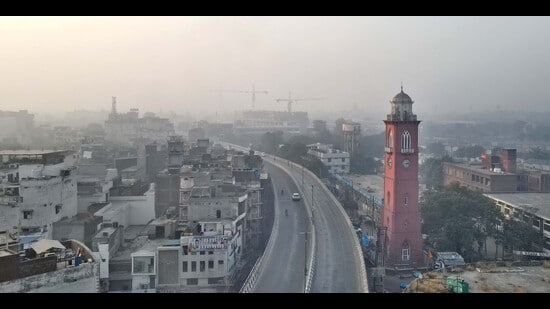
The air quality in Ludhiana deteriorated after Diwali, with the Air Quality Index (AQI) touching 296 (poor category) on Monday, compared to 216 on the corresponding day last week. Adding to the pollution burden are rising stubble-burning incidents, with the district recording 193 farm fires as of November 8, according to Punjab Pollution Control Board (PPCB) data.
Among other major cities, Jalandhar recorded an AQI of 332, falling in the very poor category, while Amritsar registered 266 and Patiala 220, both in the poor category. According to the National Air Quality Data Management System of the Central Pollution Control Board (CPCB), an AQI between zero and 50 is classified as good, 51-100 as satisfactory, 101-200 as moderate, 201-300 as poor, 301-400 as very poor and 401-500 as severe.
The rising number of farm fires in Ludhiana has emerged as another major concern. From 106 incidents on November 6, the count increased to 122 on November 7 and further climbed to 193 by November 8, despite the harvested area remaining unchanged during this period. Of the nearly 2.6 lakh hectares under paddy cultivation in the district, around 89% has been harvested.
According to the PPCB data, authorities have inspected 113 fields in the district so far, with crop burning confirmed at 62 locations. Environmental compensation amounting to ₹2.75 lakh has been imposed in 50 cases, while 11 FIRs have been registered. As many as 38 red entries have also been made against farmers, while 26 warning notices have been issued to nodal or supervisory officers in areas reporting a high number of verified incidents.
{{/usCountry}}According to the PPCB data, authorities have inspected 113 fields in the district so far, with crop burning confirmed at 62 locations. Environmental compensation amounting to ₹2.75 lakh has been imposed in 50 cases, while 11 FIRs have been registered. As many as 38 red entries have also been made against farmers, while 26 warning notices have been issued to nodal or supervisory officers in areas reporting a high number of verified incidents.
{{/usCountry}}The latest figures also mark a significant rise compared to last week, when the district had recorded only 27 farm-fire incidents. The increase has come despite several measures being taken to discourage farmers from burning paddy residue.
A comparison with last year’s figures presents a mixed picture. During the corresponding period last year, when nearly 97% of the paddy area had been harvested, Ludhiana had recorded 135 farm-fire incidents. The authorities had registered 26 FIRs and made 19 red entries at that time. Although the current harvested area is lower, the number of reported incidents has already crossed last year’s corresponding figure.
At the state level, Punjab’s cumulative stubble-burning count crossed 4,400 incidents by November 8.
Gurdeep Singh, chief agriculture officer of the district, said the number of incidents had increased in recent days, but enforcement and monitoring were also being strengthened. “The cases have increased, but the authorities are keeping a check too. FIRs have been lodged as well,” he said.
Singh said awareness campaigns and field-level interventions had helped improve the situation compared to last year, although the recent increase remained a concern. “Now the numbers have increased, but the fields are being inspected and awareness activities are continuing,” he added.
With the post-Diwali pollution spike coinciding with a fresh rise in farm fires, Ludhiana is facing the combined impact of seasonal agricultural emissions and urban pollution, making effective enforcement and sustainable crop-residue management crucial in the coming days.