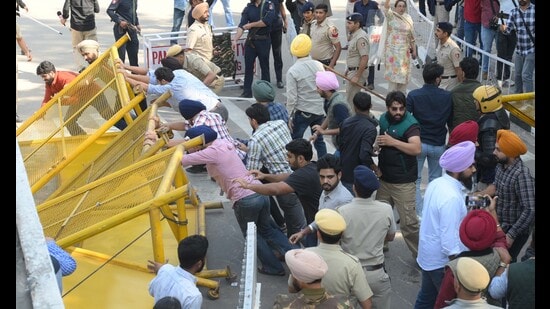
A year-long uncertainty over the Panjab University (PU) senate had already brought students to the edge when the Centre’s October 28 reform notification abruptly shifted the protests into a wider political movement. Though the Centre was ultimately forced to withdraw the reforms, the initial notification had triggered sharp reactions from student groups, former senators, state parties and the larger Punjabi community. With the reforms now off the table, the focus has returned to the original demand – announcement of the senate election schedule. HT examines why the reform proposal ignited such a strong political and community response across Punjab.
Q. What is the senate and syndicate and why are they important to PU’s governance?
At PU, the senate is the highest decision-making authority. It approves major policies, finances, academic matters and long-term planning. The syndicate, on the other hand, functions as the university’s executive government and handles appointments, promotions and day-to-day administration. Former vice-chancellor (V-C) Arun Grover explains that the V-C presides over both bodies as the chief executive but does not control how they are constituted. Of the 91 senate seats, 36 are nominated by the chancellor (the Vice-President of India), while the rest come from elected constituencies such as teachers, principals and registered graduates. A key pillar of this structure is the registered graduate constituency, which serves as the alumni’s voice in the university’s governance. Five years after graduating, any PU alumni can register as a graduate voter and once registered, they can also contest elections from this constituency. The graduate constituency elects 15 members to the senate.
Polling for these seats is extensive – PU sets up multiple booths majorly across Punjab, Haryana, Delhi, Jammu & Kashmir, Himachal Pradesh and Rajasthan, allowing far-flung alumni to participate in the governance of their alma mater. This mix of elected and nominated members is what gives PU its identity as a representative, public university with substantial participation from Punjab.
{{/usCountry}}Polling for these seats is extensive – PU sets up multiple booths majorly across Punjab, Haryana, Delhi, Jammu & Kashmir, Himachal Pradesh and Rajasthan, allowing far-flung alumni to participate in the governance of their alma mater. This mix of elected and nominated members is what gives PU its identity as a representative, public university with substantial participation from Punjab.
{{/usCountry}}Q. What triggered the current push for senate reforms?
The push for structural reforms also has a longer institutional history. According to former V-C Grover, entrenched groups within the senate and syndicate repeatedly blocked routine functioning, staged walkouts, resisted transparency measures, such as videography of meetings, and at times worked to undermine the V-C’s office, creating what he describes as “mayhem in governance.” These disruptions, he says, made it difficult for the administration to carry out even basic academic and administrative work.
A reform committee, set up by chancellor Venkaiah Naidu in 2021 during the tenure of V-C Raj Kumar, eventually recommended structural changes to prevent concentration of power and ensure smoother functioning. But the proposals never translated into action.
Instead, PU entered a deeper crisis last year as the senate’s term ended in October 2024 and no fresh elections were announced, thus creating a governance vacuum at the highest decision-making level. It was into this vacuum that the Centre stepped, issuing the October 28 senate reform notification, which sharply escalated political and campus tensions.
Q. What changes were made in PU’s governance structure with October 28 notification by the Centre?
The October 28 notification attempted a complete restructuring of the senate and the syndicate, replacing the long-standing mix of elected and nominated members with a smaller, largely reconstituted structure. The notification reduced the senate from its existing 91 member body (36 nominated + elected constituencies including teachers, principals, and 15 registered graduates) to a 31-member senate. Its new composition would have been: 18 elected members, six nominated by the chancellor, seven ex-officio members.
The reforms also capped the number of “ordinary fellows” (non ex-officio members) at 24, compared to the earlier framework where the number could go up to 85. One of the most controversial changes was the removal of the graduate constituency, which elects 15 senate members and is widely seen as the alumni’s democratic stake in PU’s governance. The notification deleted the provision allowing graduates to register as voters and instead proposed that only two alumni would be nominated by the chancellor, thus ending direct alumni elections.
The syndicate was also revamped to turn it into a nominated body instead of an elected one. All members were to be either nominated by the V-C or ex-officio. Membership included the higher education secretary (MoE), DPIs of Punjab and Chandigarh, one senator nominated by the chancellor and around 10 rotating nominees from among deans, professors, college principals and senior faculty. The new framework also expanded the syndicate’s powers to delegate executive authority directly to the V-C or sub-committees. Those supporting the October 28 reforms argued that PU’s existing senate had become “too politicised and insufficiently academic-oriented,” making a structural change necessary. A key reason cited was the graduate constituency: voter rolls had become heavily inflated, with thousands of inactive or even deceased voters still listed, making the electoral process vulnerable to manipulation. Conducting the polls across multiple states was also described as logistically draining and costing nearly ₹2 crore each cycle. Former senator Dharendar Tayal said the reforms aimed to create a leaner, cleaner system, “a senate that works with academic purpose rather than political pressure.”
Q. Why did the reform notification trigger protests and political backlash?
For Punjab as a community, this notification collided with two old anxieties: Loss of democratic representation and fear of central takeover. Student groups, fellow senators and political parties saw the removal of elected constituencies as an attempt to sideline Punjab’s voice in a university. Former senator Jagwant Singh says people initially assumed elections were only being delayed. “Once the notification came, people felt something unlawful was being done,” he says. Grover adds that the notification was issued “without the explicit participation of PU stakeholders,” which further deepened mistrust. Many in Punjab interpreted this as a reduction of the state’s democratic stake. Former senator IP Sidhu argues the reforms were shaped by those “who wanted to decrease the democratic component,” and that nominated constituencies, which he says are “never active in functioning”, should have been trimmed instead. However, Tayal offers a sharply different view. He says the notification was misread, arguing that the syndicate would still be largely ex-officio and elected internally, not hand-picked by the Centre. He adds that the Centre’s influence would have reduced from 39% to 26%.
Q. With the controversial notification rescinded, what’s the way forward ?
All former senators agree on one thing: the only way forward is to restore democratic processes properly. But there is disagreement on how fast this should happen. It’s been over a week since V-C Renu Vig announced that the process for senate polls had begun as the election schedule had been sent to the chancellor’s office for his approval. Though, as per those in the know of the matter, there has been no response from the latter. A former senator says this delay is unnecessary because “there is no statutory provision” requiring external approval; the schedule can be notified immediately. Grover, however, argues that reforms must accompany elections, including updating the graduate rolls, limiting senators to one faculty vote and preventing repeated syndicate dominance. Even if the schedule is approved immediately, PU rules require roughly 240 days between issuing the notification and polling for the graduate constituency and about 90 days for the other constituencies-meaning the election process will inevitably stretch over several months once cleared.
In essence, PU’s crisis is not about one withdrawn notification- it is the product of long-standing structural weaknesses, a stalled electoral process and a deep layer of mistrust between Punjab and the Centre. While these governance flaws will require sustained reforms over years, the immediate unrest on campus has a far clearer trigger. ‘The Panjab University Bachao Morcha’ continues to intensify, and its final, non-negotiable demand is the announcement of the senate election schedule. For now, the protests are expected to de-escalate only when this schedule is formally notified, even if the larger structural issues will remain to be addressed after the elections.