
 E-Paper



Freshly infiltrated groups behind terror spike in Rajouri-Poonch
Security experts say the recent spike in terror activities don’t appear to be due to spillover from South Kashmir as there are not many terrorists are left in the Valley now

 Prefer HTon Google


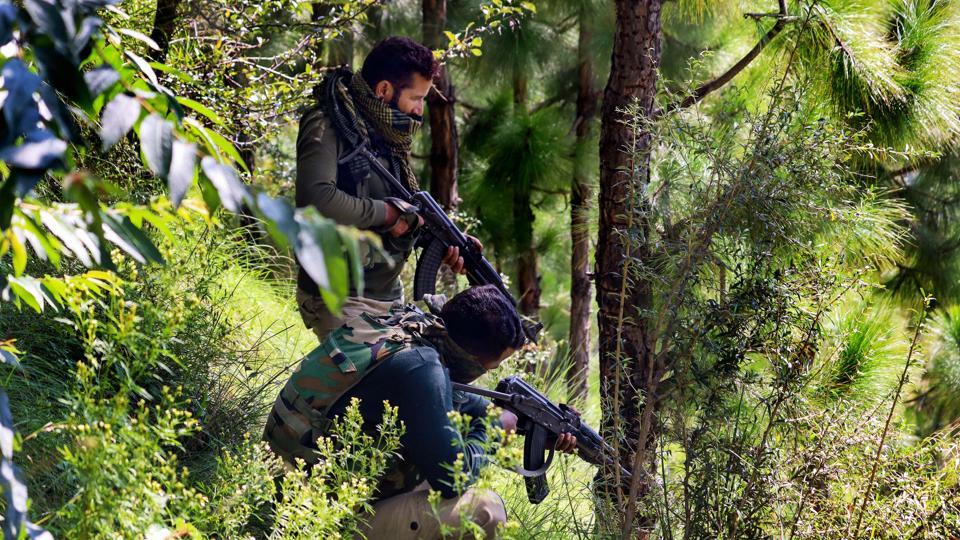
While the Army lost nine soldiers, including two junior commissioned officers, within four days in October, the protracted Poonch encounter in the dense jungles of Nar Khas entered the 23rd day on Tuesday.
Former DGP SP Vaid, the man who contained Pak-sponsored terrorism during its peak, attributed the spike in terror activities in the twin border districts of Rajouri and Poonch, south of Pir Panjal, to freshly infiltrated terrorists.
“Most likely, they are infiltrating groups. It (spike in terror attacks in Rajouri-Poonch) doesn’t appear to be a spillover from South Kashmir because not many terrorists are left in the Valley now. In the last two years, several terrorists have been eliminated in Kashmir and their numbers have been constantly depleting. Spillover takes place when their numbers go up considerably and their masters, sitting across the border, intend to engage security forces and involve Jammu,” said the former DGP.
‘Focus back on Kashmir after fall of Afghan govt’
Vaid said that after Afghanistan’s capture by the Taliban, Pakistan’s Inter-Services Intelligence (ISI) seems to have shifted its focus back on Kashmir.
“Most probably, the ISI is trying to get terrorists spared from Afghanistan, and take them to launch pads along the Line of Control (LoC) to infiltrate them from Rajouri, Poonch, Uri, Tangdhar and Gurez,” the former DGP said.
He said the ISI always tries to involve Rajouri, Poonch, Doda and Kishtwar areas.
“Rajouri and Poonch have remained preferred routes for infiltration as they get less snow and the terrain is easier than Kashmir. People in this region are overwhelmingly nationalist and against terrorism but Hurriyat and JeI have tried to radicalise them in the past,” he said.
No spillover from Valley: Army
Sources within the army establishment, however, said, “As of now, there are no clear cut answers on why there is a spike in terrorism south of Pir Panjal.”
“Infiltration pattern does not indicate exponential increase. Two to three militants from south Kashmir were able to sneak into the region, probably via Pir Ki Gali, but there is no big spillover from south Kashmir,” they added.
The source said that though nine soldiers have died in two encounters, calling the region a hotspot of terror may not be correct at this stage.
According to DGP Dilbag Singh, five to seven militants are believed to be hiding in the forests between Surankote and Mendhar tehsils of Poonch.
“Two groups had come from across the LoC through Rajouri-Poonch area and they are embedded somewhere in the jungle. Going by their sighting at three places and the crossfire between them and us at two places, it seems their number is between five and seven,” he told a TV channel in Srinagar recently.
On August 10, Dilbag Singh had said, “After a brief lull following the renewed truce deal between the two DGMOs on February 25, infiltration into Jammu and Kashmir resumed.” He added, “Terror camps across the border are still intact.”
Route taken by infiltrators
An intelligence official, requesting anonymity, said, “Sangiot and Balakote in Mendhar is an infiltration route. Once in, the terrorists cross Bhimber Gali and enter Nar Khas and Bhata Dhurian forests from where they can go to Thannamandi or to Bufliaz to Pir Ki Gali and head towards Shopian.”
“It seems to that the fresh infiltration has caused disturbance in Rajouri and Poonch,” he added.
“Till May, there was no infiltration in the region but we also know that during the season of maize crop and before the onset of winters, terrorists try to use these routes to infiltrate,” he said.
The first major encounter took place in the region on August 6, a day after the second anniversary of the abrogation of Article 370, when two terrorists were killed in the Pangai forest of Thanamandi area of Rajouri.
Another encounter took place in the same area on August 19. Two soldiers, including a JCO, were killed in an encounter.
On September 13, a terrorist was killed in Manjakote area of Rajouri.
“These encounters suggest that the terrorists had successfully infiltrated from across the LoC,” he said.
Tufail Hussain, 36, a farmer from Shahpur, a village along the LoC in Poonch, said, “We have been living a peaceful life following a renewed truce deal on February 25 but things, it seems, have started taking an ugly turn. I don’t know whether they are coming from South Kashmir or have crossed the LoC but we are really scared.”
“We request Prime Minister Narendra Modi to take strong action against terrorism,” he added.
Munaf Malik, former Hizbul Mujahideen commander, said, “Militancy has increased and the situation is deteriorating in the region. There could be multiple factors behind this, but I believe that resentment has increased among the people because of the rising unemployment. People are also annoyed over abrogation of Article 370.”


