Fallen leaves provide a breathtaking backdrop to the autumn hues in the Kashmir valley but prove to be a nightmare for the civic authorities in Srinagar, the summer capital.
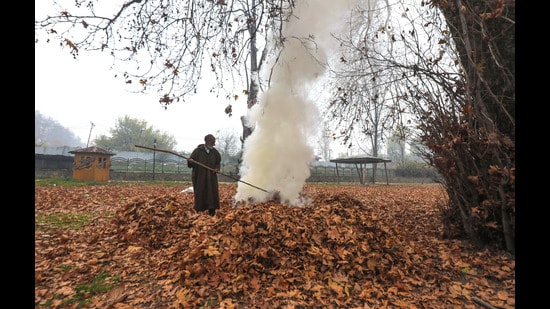
As autumn arrives, large quantities of leaves from gigantic chinar, poplar and willow trees blanket the landscape across the Valley. During rains or snowfall, these leaves often choke drains and increase air pollution when locals burn them for fuel.
This year, the Srinagar municipal corporation (SMC) has decided to adopt scientific methods to manage fallen leaves and is set to intensify its autumn sanitation to prevent indiscriminate dumping and open burning.
The corporation aims to segregate the leaves from other non-biodegradable waste to promote composting and sustainable use of such refuse in horticulture and agriculture.
The SMC officials said that the seasonal initiative seeks to address the accumulation of leaf litter across roads, footpaths, parks and institutional premises, which, if left unattended, can obstruct drainage channels, affect urban cleanliness and contribute to air pollution when burnt.
“Autumn waste management requires a planned and coordinated response. Fallen leaves and other biodegradable waste should not be treated merely as refuse but as a resource that can be put to productive use through segregation and composting. Our focus is on ensuring cleaner neighbourhoods while promoting environmentally responsible practices,” said SMC commissioner Basharat Qayoom.
The Commissioner stressed the need to move beyond routine collection and disposal towards a systematic approach that prioritises resource recovery. The proposed measures include dedicated leaf-litter collection, segregation at source, composting and the use of processed organic matter for horticultural purposes.
{{/usCountry}}The Commissioner stressed the need to move beyond routine collection and disposal towards a systematic approach that prioritises resource recovery. The proposed measures include dedicated leaf-litter collection, segregation at source, composting and the use of processed organic matter for horticultural purposes.
{{/usCountry}}Ward-level sanitation teams will be tasked with identifying leaf-fall hotspots and vulnerable drainage points. Additional sanitation rounds will be undertaken in areas requiring intensified attention. Particular emphasis will be placed on preventing leaves and other waste from entering drains and water bodies, including the Jhelum, Dal Lake and Nigeen Lake.
“Keeping drains free from leaves and waste is essential to maintaining effective drainage and preventing avoidable blockages. All concerned officers must ensure timely clearance of vulnerable points, with particular attention to areas prone to waterlogging and locations adjoining our water bodies,” Qayoom said.
The corporation will also strengthen monitoring through ward-wise sanitation plans, field inspections and periodic reporting by the concerned supervisory officers. Government institutions, commercial establishments, residential communities and other bulk generators of horticultural waste will be encouraged to adopt on-site or cluster-level composting wherever feasible.
Open burning of leaves and municipal waste will be discouraged through public awareness and addressed under applicable legal provisions. Citizens will be encouraged to keep leaf litter separate from mixed waste and hand it over through authorised collection arrangements.
“The success of these measures depends not only on the efforts of sanitation teams but also on the cooperation of citizens, institutions and market associations. Segregating leaf litter, avoiding open burning and ensuring that waste does not enter drains or water bodies are simple yet significant steps towards a cleaner and healthier Srinagar, “ Qayoom said.