The near-extinct Markhor, a majestic wild goat known for its distinctive corkscrew-shaped horns, is showing signs of slow recovery in Jammu and Kashmir, with its population rising marginally to an estimated 227 in the latest survey conducted by the Wildlife Trust of India (WTI) and the J&K wildlife department.
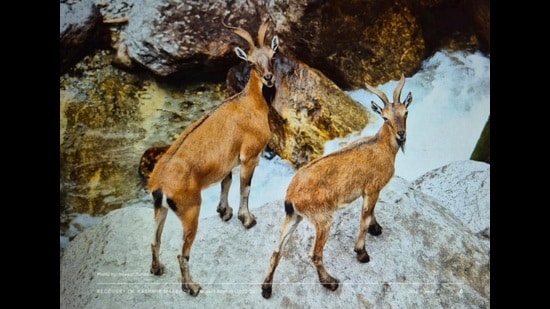
The rugged forests of Kazinag National Park, close to the Line of Control, with dense deodar, pine and fir forests and elevated cliffs, continue to be a refuge of this majestic mammal. The species is also found in Hirpora Wildlife Sanctuary on the historic Mughal Road. However, Kazinag National Park, spread over 160sq km, remains its main habitat in J&K.
The park came into existence after two wildlife sanctuaries — Limber and Lachipora — were clubbed with the Naganari Conservation Reserve with the support of the Wildlife Trust of India in 2007.
“The 2026 estimate put the Markhor population at 227 ± 13.9 individuals, up slightly from 221 ± 12.5 individuals in 2023,” according to the survey report. The findings suggest a healthy and slowly growing Markhor population in Kazinag, with a high recruitment rate of 69 kids per 100 adult females— an indicator of successful breeding and juvenile survival.
The Markhor, or Capra falconeri, is the world’s largest wild goat and is native to Central Asia. The flare-horned subspecies, Capra falconeri cashmiriensis, known as the Pir Panjal or Kashmir Markhor, is found only in Jammu and Kashmir in India.
{{/usCountry}}The Markhor, or Capra falconeri, is the world’s largest wild goat and is native to Central Asia. The flare-horned subspecies, Capra falconeri cashmiriensis, known as the Pir Panjal or Kashmir Markhor, is found only in Jammu and Kashmir in India.
{{/usCountry}}Its habitat, however, remains vulnerable to livestock grazing and developmental activities, including roads, mining, high-tension power lines, and border fencing.
The species has historically been considered to be in decline, underscoring the need for sustained conservation efforts.
The latest survey recorded 600 direct sightings in 2026 — 131 in summer, 158 in autumn, 127 in winter, and 184 in spring — across four seasons in the Kazinag range through repeated monitoring of 12 permanent trails.
The report said the first-ever thermal drone survey was also conducted in the Hirpora Wildlife Sanctuary with due permission from the department of wildlife protection, J&K, the Indian Army, and Air Traffic Control (ATC), Srinagar.
Markhor is listed under Schedule I of the Wildlife (Protection) Act, 1972. The species is classified as ‘Near Threatened’ on the IUCN Red List
Since Kazinag was declared a national park, the upward trend in the Markhor population has been accompanied by an increase in sightings of other species, including musk deer, goral and tragopan.
Earlier surveys conducted by the Wildlife Trust of India (WTI) in 2009 and 2011 had put the Indian Markhor population at 150-170, while the 2023 survey had estimated the number at 221.
WTI’s Markhor Recovery Project, launched in 2005, has been working with the department of wildlife protection, J&K, to secure the long-term survival of the Kashmir Markhor.
Over the past four years, WTI, in partnership with the DWP, J&K and with financial support from the Astral Foundation, has focused on monitoring Markhor population growth, securing critical Markhor habitats, particularly in the Pir Panjal range, reducing livestock grazing pressure, strengthening patrolling by trained and equipped frontline staff and local community members, strengthening the capacity of law enforcement agencies, and reducing communities’ dependency on forest resources while supporting alternate livelihoods in villages around Kazinag.
In addition, the programme aims to raise awareness of Markhor conservation.