
 E-Paper



Lockdown: Cases down in Chandigarh, Panchkula, but Mohali bucks the trend
While extending the curbs on Monday, the Chandigarh administration had reasoned that it does not want to undo the “gains of the lockdown”, ie, the plateauing of cases

 Prefer HTon Google


The number of Covid-19 cases and positivity rate dropped in the second week of lockdown in Chandigarh and Panchkula, but went up in Mohali district.
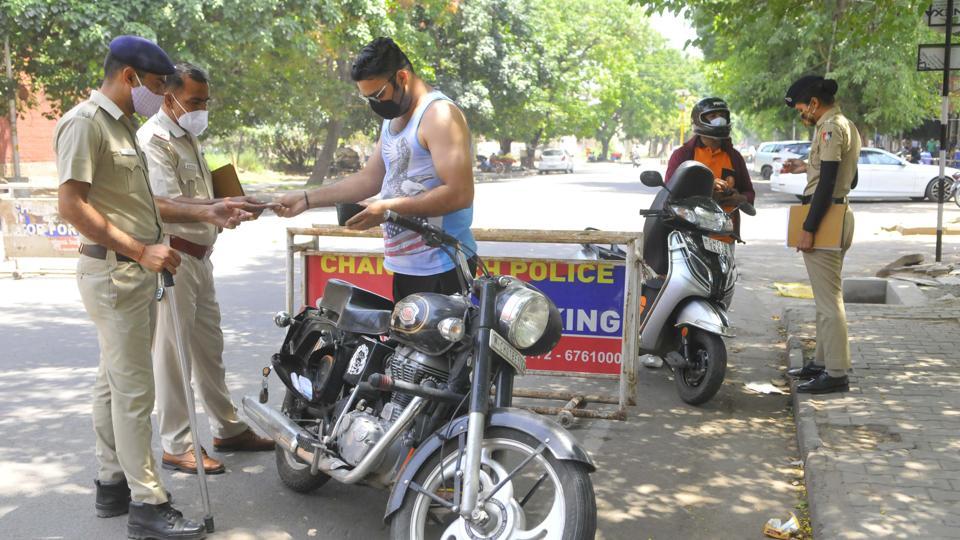
The Punjab and Haryana governments had imposed statewide curbs from May 3 while Chandigarh followed suit a day later. The lockdown has been further extended for a week in Chandigarh and Panchkula while it will remain in force till the month end in Mohali.
While extending the curbs on Monday, the Chandigarh administration had reasoned that it does not want to undo the “gains of the lockdown”, ie, the plateauing of cases.
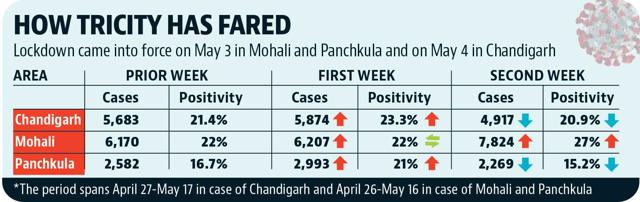
In Chandigarh, the number of cases had gone up by 3.3% in the first week of the lockdown (May 4-10) as compared to the week prior (April 27-May 3), but saw a significant drop of 16% in the second week (May 11-17).
Even the weekly positivity rate saw a marginal drop during this period, but still remains above 20%. It means that of every five persons being sampled, at least one is testing positive for the virus.
Positivity rate is the true indicator of the growth or decline in the spread of an infection, as it is proportion of people testing positive among all those sampled. On the other hand, the absolute number of positive cases is influenced by the number of tests conducted, and fails to give the true picture.
For example, the drop in the number of positive cases in the second week of the lockdown is accompanied by a drop in testing numbers too.
In week prior to the lockdown (April 27-May 3), 26,581 tests were conducted and 5,683 people tested positive, leading to a positivity rate of 21.4%. In the first week of lockdown, tests went down to 25,217 and case load went up to 5,874, with which positivity rate also saw an uptick to 23.3%. In the second week, tests further fell to 23,556, but even cases came down to 4,917, leading to a drop in positivity rate to 20.9%.
In Panchkula, too, the trend has been similar to that in Chandigarh, with cases going down by 24% in the second week and positivity rate dropping to 15%, lowest across the tricity.
However, Mohali, which has been the worst hit by the pandemic’s second wave in the tricity, has bucked the trend. The cases, in fact, surged by 26% in the second week and positivity rate, too, shot up from 22% to 27%.
Mohali deputy commissioner Girish Dayalan said the second wave was expected to peak during this period, and the lockdown has helped the administration in breaking the chain of infection. “We are hopeful that in the coming days, both the number of cases and deaths will come down,” he said.
‘Takes at least 10 days to start seeing impact’
Meanwhile, the case fatality rate, ie, the proportion of people succumbing to the virus among all those tested positive for it, marginally declined from 1.07% (April 27-May 3) to 0.97% in the first week of the lockdown (May 4-10) in Chandigarh, before going up to 1.13% in the second week (May 11-17).
In Panchkula, too, it declined from 1.31% (April 26-May 2) to 0.9% (May 3-9) before surging to 1.41% (May 10-16). In Mohali, the trend was once again the opposite, as the case fatality rate went up from 1% to 1.3%, before dropping to 1.07% during the same period as in Panchkula.
Dr Rajesh Kumar, former head of the department of community medicine and public health, PGIMER, said: “The impact of a lockdown takes at least 10 days to be felt. There is a lag of a week before the infection manifests itself. So, a person infected today will test positive in about a week. In case of deaths, the lag is of around two weeks.”
The central government has recently advised states and UTs with over 10% positivity rate to continue with “stringent containments” even if they are witnessing a decline or plateau in order to sustain the trend.
Meanwhile, UT adviser Manoj Parida said the lockdown may not be the solution, but gives a breather for the health infrastructure to be built up.
“It helps in breaking the chain, and has started to show results. However, the long-term solution is for people to strictly follow Covid protocol and get vaccinated,” he said.


