Ramlila in the tricity does not end at the city’s boundaries. Each year, people travel back from abroad or make long journeys from other states to be part of the tradition.
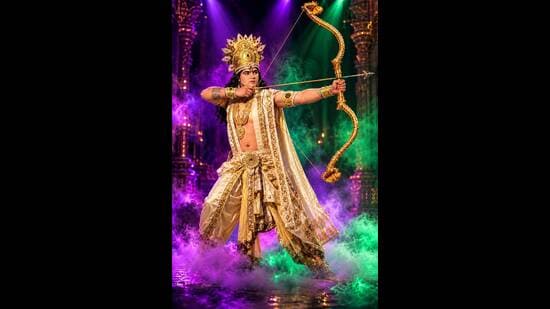
For some, the journey home means stepping into a character they have played for years. For others, it is about carrying forward a family tradition that began generations ago. And then there are those who find their place behind the scenes, away from the applause, ensuring the show goes on.
The distances may run into thousands of kilometres, but the pull of Ramlila remains strong enough to bring them back.
Commitment to the role
For Shivani, a former journalist now living in Dubai, United Arab Emirates (UAE), that connection has meant arranging her life around the annual performance rather than treating it as an occasional return to India. Since 2019, she has played Mata Sita in the Ramlila organised by the Shri Ramlila and Dussehra Committee in Phase 1, Mohali. This year, too, she has travelled from the UAE to reprise the role.
Her association with the production began in 2017, when she was a college student and the committee was selecting women performers for the first time. She auditioned and initially played Kaikeyi and Shurpanakha, before being cast as Sita two years later.
{{/usCountry}}Her association with the production began in 2017, when she was a college student and the committee was selecting women performers for the first time. She auditioned and initially played Kaikeyi and Shurpanakha, before being cast as Sita two years later.
{{/usCountry}}The character gradually became more than a part to be rehearsed and performed during Navratri. For Shivani, playing Sita is an opportunity to reflect on patience, self-respect, dignity and the responsibilities associated with the character.
In 2025, when she had plans to move abroad during Navratri, she chose to perform in the Ramlila before leaving. This year, she has again returned specifically for the production, planning to head back to the UAE after the performances conclude.
A childhood role becomes a family legacy
At Chandigarh’s Parade Ground in Sector 17, Mohit Datta’s association with the Shree Ramlila Committee goes back to when he was barely old enough to remember his first appearance. Datta played Junior Ram in 2000, at the age of one. Today, 27 years into his association with the committee, he has returned to Chandigarh after moving to Canada for higher studies in 2023 to play Lakshman again.
His connection to Ramlila predates his own time on stage. His maternal grandfather, the late Suresh Chander Bakshi, directed the production for nearly six decades. An actor and scriptwriter, Bakshi played several characters, including Lakshman, Bharat, Kevat, Kaikeyi and Shravan Kumar.
Datta’s own journey through the production has involved several roles. After playing a member of Ravana’s army, he portrayed Angadh from 2011 to 2019. Between 2020 and 2022, he played Lakshman and Shravan Kumar.
Moving to Canada did not mean stepping away from the committee. He continued contributing as a script editor, refining dialogues and recordings and helping manage its social media.
Even others in the committee have a long family tradition. Committee director Rajinder Bagga and his son Gaurav Bagga, who plays Ram, represent the third generation of their family associated with the role.
Bollywood’s RAW agent is RAM on local stage
For Suraj Bhardwaj, the route to Ramlila began with a desire to learn acting. He joined a theatre group at 19 and performed in stage plays at Tagore Theatre in Chandigarh before moving into films, television and web series. His credits include Lovely Da Dhaba, Rang Punjab, and television serials such as Rajj and Yeh Jhuki Jhuki Si Nazar.
In Dhurandhar, he played RAW agent Pratik Srivastav. On the Ramlila stage, however, his current role is Lord Ram in the production organised by the Uttarakhand Janseva and Cultural Forum in Sector 28, Chandigarh. The two worlds may differ in their settings and audiences, but his journey illustrates how Ramlila can serve as a continuing space for performers whose professional careers take them into other areas of the entertainment industry.
The man behind the tallest Ravana
A former state-level kabaddi player from Barara village in Haryana’s Ambala district, Tejinder Chauhan has spent decades making Ravana effigies, turning an early attempt to win his father’s approval into a pursuit that has brought him recognition beyond his home state.
His interest began in the mid-1980s, when he made a 20-foot effigy of the demon king. His father, Ami Singh Chauhan, was a headmaster who placed great emphasis on education. Tejinder, however, preferred playing sports and spending time with friends. The disagreements at home deepened his resentment towards studies, and he left school after Class 10.
A keen kabaddi player, he recalls a period when he became involved in fights in his village and elsewhere. Complaints reached his family, and the turning point came when he overheard his father lamenting the family’s loss of reputation.
The remark prompted him to reconsider his direction in life. When he sought advice, his father asked him to do something meaningful for society and culture.
With Ramlila no longer being staged in Barara, Chauhan took on the task of reviving it. Villagers were initially reluctant to support him because of his past, but the effort to rebuild the tradition eventually became the foundation of his life’s work.
Over the years, his Ravana effigies grew dramatically in height, turning him into a familiar name in the world of record-breaking Dussehra displays. His work has included a 210-foot effigy in Panchkula in 2018, while accounts of his record-breaking creations have also cited a 215-foot effigy in Rajasthan.
Service beyond the spotlight
Not everyone who travels to be part of Ramlila wants to perform before an audience. At Panjab University, 65-year-old Maninder Singh makes the annual journey from Ghazipur in Uttar Pradesh to serve the people involved in the Ramlila. His contribution takes place away from the spotlight, without the visibility that comes with playing Ram, Sita or Ravana. His presence is a reminder that a large cultural production depends on more than performers and directors. It also relies on people willing to give their time and effort to those bringing the story to life.