During this year’s monsoon season (June 1 to September 30), Punjab received 5% less rainfall of the long-period average (LPA) volumes recorded over a particular interval averaged over a long period.
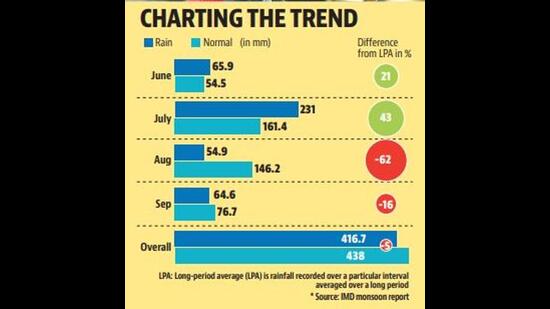
Punjab received 416.7 mm of rainfall against its LPA of 438.8mm, which amounts to 5% less than the normal.
In the northwest region, Punjab has received the lowest rainfall. Himachal Pradesh received 19% excess rainfall; Uttarakhand 4%; Haryana, Chandigarh and Delhi received 1 % deficit rainfall; and Jammu Kashmir and Ladakh, which is considered as one division, received 5% excess rainfall of the LPA.
Of the three regions of the Punjab state, the Malwa region remained the driest.
The monsoon has already withdrawn from the entire Punjab state, on Saturday.
Among the total 23 districts in Punjab, nine have received normal rainfall, four received excess rainfall, and two districts received large excess. As per the Indian Meteorological Department (IMD), the country’s nodal weather agency, seven districts were rain deficit in the state. Fazilka received the lowest rainfall in the state during the monsoon season by recording 64% less rainfall from the LPA.
In the Malwa belt, Fazilka, Barnala, Sangrur, Mansa, Moga, Bathinda, and Muktsar have been the most affected districts.
{{/usCountry}}In the Malwa belt, Fazilka, Barnala, Sangrur, Mansa, Moga, Bathinda, and Muktsar have been the most affected districts.
{{/usCountry}}Tarn Taran received the highest rainfall (over 80%) in the state during this monsoon season. It is followed by Ferozepur with over 60% and Amritsar with over 33% precipitation.
In the four months of the monsoon season, Punjab received the highest rainfall during July with the state recording 231.3 mm of rainfall against its normal rainfall of 161.4 mm which is 43% excess than normal. It was during this month when floods wreaked havoc in the state.
As per the IMD, Punjab received the lowest rainfall in August when the state recorded 54.9 mm of rainfall against its normal value of 146.2 mm and was 62% (largely deficient) less than the LPA.