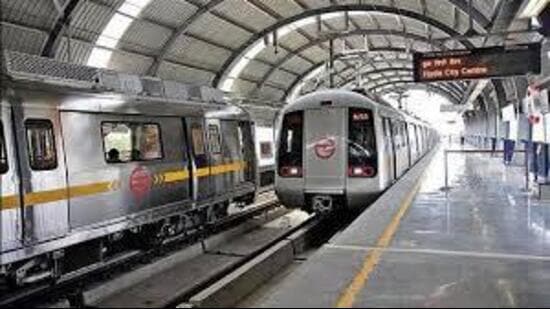
With the Rail India Technical and Economic Services (RITES) recommending a two-coach Metro system for the tricity, as many as 3,376 trees will be axed to construct the corridors on the elevated tracks.
The Union ministry of housing and urban affairs (MoHUA) had already approved running the Metro lines in heritage sectors (1 to 30) fully underground.
The draft alternatives analysis report (AAR) states that an estimated 3,376 trees along the project corridors will be removed during the implementation of the elevated tracks.
Once the draft for the AAR is finalised, a detailed project will be prepared and sent to the ministry for final approval.
The report also highlights the environmental impact, noting that there will be noise and vibration pollution associated with the Metro project. Noise generated from the Metro is expected to be 66.4 decibels, considering two coaches for both systems and design speeds of 90 km/h for the Metro.
The report stated that the maximum sectional speed will be 95 km/h for the Metro, subject to further restrictions by the radius of horizontal curves, cant, and cant deficiency. The Metro has a higher passenger carrying capacity of 15,000 to 100,000 and will be able to cater to peak-hour passenger demand well beyond 2056.
The comprehensive mobility plan (CMP) for Chandigarh tricity was prepared in 2023 by the Chandigarh administration for a horizon year of 2052. The comprehensive mobility plan, 2023, recommended an integrated multi-modal mass transport system plan, indicating different mass transport systems (MRTS and dedicated bus corridors) on various corridors to cater to traffic up to the year 2052.
{{/usCountry}}The comprehensive mobility plan (CMP) for Chandigarh tricity was prepared in 2023 by the Chandigarh administration for a horizon year of 2052. The comprehensive mobility plan, 2023, recommended an integrated multi-modal mass transport system plan, indicating different mass transport systems (MRTS and dedicated bus corridors) on various corridors to cater to traffic up to the year 2052.
{{/usCountry}}Traffic characteristics at present in city
The report states that about 80% of trips are vehicular, while 20% are walking trips. Trips performed by two-wheelers account for about 34%. It is observed that buses are the major public transport mode, catering to about 5.3% of the total trips, whereas trips performed by cars are 9.3%. About 2.63 million motorised internal trips are made by various modes. The per capita trip rate, including walking trips, is 1.5, excluding walk trips is 1.2, and for motorised trips it is about 1.07. Approximately 50% of vehicular and 10% of walking trips are performed for work and business purposes. Among education trips, 35.5% are vehicular and 38% are walking trips. For shopping and recreation, about 11% of trips are vehicular and 41% are walking trips.