
Preserving Punjab’s historical, religious and cultural heritage while preparing youth for future challenges is the need of the hour, Punjab governor Gulab Chand Kataria said on Wednesday, calling for Amritsar’s 450-year journey to be tied to forward-looking development.
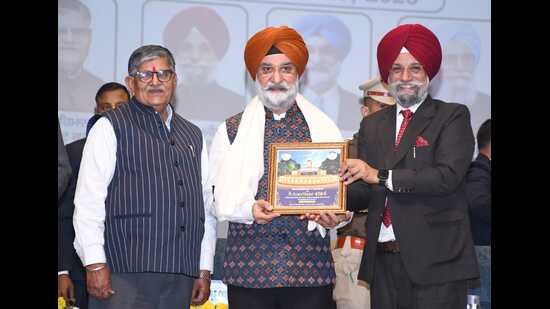
Kataria made the remarks while inaugurating the two-day international conclave “Amritsar 450” at Guru Nanak Dev University (GNDU), organised to mark the 450th Foundation Year of Amritsar city under the theme “Remembering the Past, Understanding the Present and Envisioning the Future”.
Highlighting the teachings of Sikh Gurus, the tradition of langar and the martyrdom of Sahibzadas, Kataria said Punjab’s history reflected courage, conviction and social responsibility, giving the state a distinct global identity.
Flagging rising drug abuse among youth, he urged governments, educational institutions and society to act collectively.
He also stressed new initiatives in education, research, agriculture and industry, pointing to agricultural diversification, food processing, water conservation, alternative energy, environmental protection and technological innovation. India’s strides in medical science, space research, defence technology and vaccine manufacturing, he added, were creating fresh avenues for young people.
Vice chancellor Karamjeet Singh said the university was launching three initiatives to chart the city’s next phase: the “Amritsar 2052 Vision Document” for development over the next 25 years, a digital oral history repository of 450 videos capturing heritage and elderly residents’ memories, and closer links between education, skills and employment.
{{/usCountry}}Vice chancellor Karamjeet Singh said the university was launching three initiatives to chart the city’s next phase: the “Amritsar 2052 Vision Document” for development over the next 25 years, a digital oral history repository of 450 videos capturing heritage and elderly residents’ memories, and closer links between education, skills and employment.
{{/usCountry}}Delhi Lieutenant Governor Taranjit Singh Sandhu noted that the city, founded by Guru Ramdas in 1577, had long been a hub of spirituality, education and culture. He called for protecting heritage structures, old neighbourhoods and traditions while upgrading urban infrastructure and linking tourism with economic growth.
Eminent scholar Gurinder Singh Mann said imitating Western methodologies had limited value for Sikh historiography, urging an original approach grounded in Gurbani, Sikh philosophy and historical sources.
During the inaugural session, Kataria released a book on Sikhism authored by Karamjeet Singh in Punjabi, Hindi and English.
Day 1 also featured a panel discussion at the Convention Centre moderated by Nirmal Singh Joura with Avtar Singh, RS Ghuman, Inderjit Kaur, Jagjit Singh Dardi, Gunbir Singh and Himani Arora. A college principals’ meet was attended by Karamjeet Singh, SS Behl, Saroj Bala and Vasudha Sambyal.
Another session on “The Spiritual and Sacred Heritage of Amritsar” saw views from Rajwant Singh, Amarjit Singh Grewal, Inderjit Singh Gogoani, SS Sohal, Sulakhan Singh and Gurmeet Singh Sidhu. The day ended with the light-and-sound show “Dastaan-e-Amritsar” at Dashmesh Auditorium.
Amarjit Singh, director of the Sikh Studies Chair, outlined the conclave, Harvinder Singh Saini, dean of academic affairs, proposed the vote of thanks, and registrar KS Chahal was also present.