
 E-Paper



PRTC, Punjab Roadways contractual staff go on strike, commuters hassled
Workers blocked the bus stand gates, clashed with police officers who tried to open them and even climbed a nearby water tank to register their dissent.

 Prefer HTon Google


A ruckus erupted at the Ludhiana Bus Stand on Friday morning as contractual workers of Punjab Roadways, Punbus, and Pepsu Road Transport Corporation (PRTC)staged a protest, shutting down operations for nearly three hours and leaving hundreds of commuters stranded.
The agitation followed the alleged detention of several senior union leaders late Thursday night and early Friday morning. Workers blocked the bus stand gates, clashed with police officers who tried to open them and even climbed a nearby water tank to register their dissent.
The protest caused significant disruption across the district. Buses were off the road from 5 am, causing major delays for office-goers, students and daily commuters.
The agitation was organised against the opening of tenders for the kilometre scheme, which allows private contractors to operate buses with only the conductor retained from the Roadways workforce. The tenders were scheduled to be opened on Friday, just hours after the union leaders were detained.
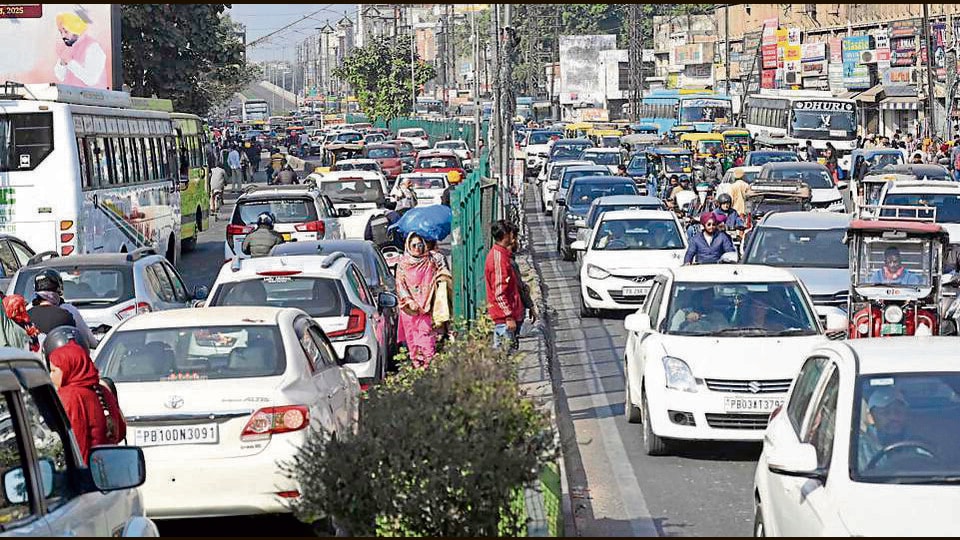
The shutdown also led to traffic congestion on the main road outside the bus stand, as private bus operators had to park on the road to allow commuters to board.
Union response
Jagtar Singh, joint secretary of the union in Ludhiana, said, “Punjab Roadways had scheduled the tendering of its luxury Volvo and HVAC buses today. To oppose this, we had planned to hold rallies across the state. Nearly 100 union members were taken into custody, including our general secretary Shamsher Singh Dhillon and vice-president Harkesh Kumar Vicky.”
“To protest this unjust action, we immediately decided to shut down bus operations of both Punjab Roadways and PRTC. When our remaining members attempted sit-ins at depots in Patiala and Bathinda, the police forcefully detained them. Some of our members in Patiala and Sangrur even sustained injuries during the action. We have
completely shut down bus services from 5 am today, and the strike will continue indefinitely. No Punjab Roadways or PRTC buses will operate until our detained members are released and our demands are met,” he added.
Some of the union members and leaders were detained from across the state to pre-empt protests, the union said.
In a press release, the union said, “The chief minister of Punjab had given a written assurance in a meeting on 1 July 2024 to resolve the demands within a month. Instead of resolving them, the government and police administration detained leaders and workers to disperse a peaceful struggle.”
Navraj Batish, general manager of Punjab Roadways, Ludhiana, said authorities are engaging with the agitated workers. “Those who had climbed the water tank have come down. We are trying to get as many buses back on the road as soon as possible. Talks with union members are ongoing to restore normal operations,” he added.
Commuters struggle
The agitation left hundreds of commuters stranded, forcing them to rely on overcrowded private buses.
“I commute to the city every day for work from Moga. Today (Friday), as the Roadways/PRTC buses were not running, it was very hard to find a bus. I managed to get on a private bus, which was overcrowded,” said a lecturer.
Businessman Atul Mongia said, “I had to reach Chandigarh at 9 am, but all government buses were off the road and private buses were full. I missed my appointment and now will have to reschedule.”
“I had to go to Chandigarh to see my sick brother-in-law. I went to the bus stand at 7 am. I found no buses. I had to arrange a taxi, which cost way more than the bus fare,” said Ishank Sharma, a local resident.
The impact of the stir was compounded by the composition of the fleet. Ludhiana Depot has 94 Punjab Roadways buses, of which around 90% are run by contractual staff. Only about 10 buses, operated by regular PRTC workers, were running on Friday.
Similarly, PRTC has 135 buses at its depot, most run by contractual employees, and only 10–20% were plying on the road.


