Despite years of research and evaluation, the low chill apple varieties introduced in Punjab by the department of fruit science at Punjab Agricultural University (PAU), have not proven to be commercially viable for large-scale cultivation. While Dorsett Golden and Anna apples have shown promising fruiting capabilities, their smaller size and limited colour development due to high temperatures during Punjab’s summer months hinder their market potential.
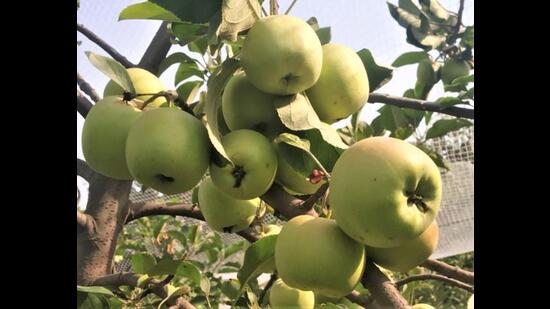
Apple cultivation in India faces challenges due to the country’s predominantly tropical climate. However, Punjab’s milder winter climate made it an ideal location for testing low chill apple varieties. The introduction and evaluation of 29 apple varieties, including Dorsett Golden and Anna, commenced in 2012. These varieties exhibited good fruiting across Punjab and were recommended for cultivation in kitchen gardens or small-scale plantations in specific zones of the region.
Dorsett Golden, a low chilling and early maturing variety, features round-conical fruits with a greenish-yellow hue. The average fruit size ranges from 55 to 65mm in diameter, with a total soluble solid (TSS) content of 13.0% and acidity of 0.3%. It is available during the first fortnight of June, yielding an average of 30 kg per plant.
Similarly, Anna, another low chilling and early maturing variety, presents oblong-conical fruits with a greenish-yellow colour and a slight red blush on some fruits. Its fruit size is also smaller, ranging from 55 to 65mm in diameter, with a TSS of 12.7% and acidity of 0.38%. Anna apples are available from the fourth week of May to the second week of June, yielding an average of 32 kg per plant.
{{/usCountry}}Similarly, Anna, another low chilling and early maturing variety, presents oblong-conical fruits with a greenish-yellow colour and a slight red blush on some fruits. Its fruit size is also smaller, ranging from 55 to 65mm in diameter, with a TSS of 12.7% and acidity of 0.38%. Anna apples are available from the fourth week of May to the second week of June, yielding an average of 32 kg per plant.
{{/usCountry}}While these varieties exhibit good eating quality, the high summer temperatures in Punjab limit their fruit size and colour development, negatively impacting their market value. Market trends prioritize apples with vibrant colour development and substantial fruit size, fetching higher prices. Consequently, the low chill apple varieties face challenges in meeting these criteria.
PAU professor Anirudh Thakur emphasized the need for hand thinning of the fruits during the second to third week of March to improve fruit size and quality. “Shading the plants with 50% shade net during May-June can also enhance fruit size and quality. Although low chill apples can be processed into high-quality juice with good storage life, their commercial viability in Punjab remains uncertain” he said.
Nirmal K Jain, a Ludhiana-based businessman who has planted low chill apple varieties on his farm, shared positive insights about their production and said, “I believe that these varieties offer a cost-effective alternative to cold storage apples and provide fresh and more nutritious options for consumers. Additionally, the indigenously grown variety will serve as a good choice for crop diversification in Punjab.”
However, the limited area under low chill apple cultivation in Punjab currently allows growers to command better prices. Considering the smaller size and low colour development, commercial cultivation of these apple varieties in Punjab seems challenging. While they may not be suitable for large-scale plantations, their acceptable eating quality makes them suitable for kitchen gardens or small-scale plantations.