Security agencies in Punjab are facing a new and increasingly sophisticated cross-border threat as Pakistan-based smuggling networks are now relying on cutting-edge high-capacity drones that use satellite communications and advanced navigation systems to push consignments of drugs, arms and ammunition into the state.
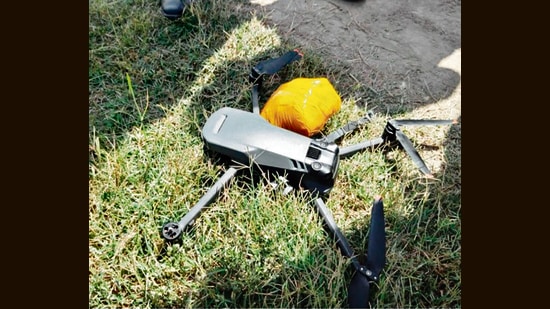
Unlike conventional GPS or radio frequency-controlled drones, these satellite-linked are able to evade conventional anti-drone systems that rely on jamming radio frequencies or GPS signals, allowing them to operate over much longer distances.
Investigators believe Pakistan-based handlers are using these drones to drop consignments of heroin, sophisticated weapons, ammunition, grenades and cash at pre-designated locations in Punjab.
Local operatives linked to smuggling and terror networks are then tasked with retrieving the consignments using encrypted messaging applications and precise coordinates.
The first such threat came to fore on May 24, when Punjab Police’s counter intelligence dismantled a drug smuggling network in Ferozepur district. Four accused were arrested and police recovered a satellite-enabled communication drone, along with 28.12 kg heroin and ₹9.5 lakh in suspected drug proceeds.
According to an Anti-Narcotics Task Force (ANTF) official, security agencies have also recovered satellite communication devices, including equipment using Starlink-based services, during recent anti-narcotics and anti-terror operations, indicating that trans-border smugglers are increasingly adopting advanced technology to evade surveillance and interception.
{{/usCountry}}According to an Anti-Narcotics Task Force (ANTF) official, security agencies have also recovered satellite communication devices, including equipment using Starlink-based services, during recent anti-narcotics and anti-terror operations, indicating that trans-border smugglers are increasingly adopting advanced technology to evade surveillance and interception.
{{/usCountry}}“These drones are very hard to track. They make four to five sorties each night. As they use satellite communication links, our anti-drone systems find it difficult to track them, a major concern for the Border Security Force and Punjab Police,” said the official quoted above.
While Punjab Police does not have the exact data of recovery of satellite drones, insiders say various reports by their intelligence wing and the Border Security Force have time and again been raising the issue with higher authorities.
Officials say the shift to satellite-enabled drones reflects the evolving nexus between Pakistan-based smugglers and terror outfits after intensified action against conventional cross-border smuggling routes.
The use of advanced drones has enabled handlers to attempt deeper incursions into Indian territory while reducing the risk of interception.
“The huge profit involved in the trade of heroin smuggling has given way to a thriving drone industry in the border region in Pakistan. People get ₹20,000 to ₹30,000 per kg of load to drop consignment from across the border,” said a senior official from State Special Operation Cell (SSOC).
Agencies believe the proceeds from the drug trade continue to finance terror activities and support the logistics of Pakistan-backed terror modules operating in the region.
Punjab has witnessed a steady rise in drone intrusions over the past few years, with security forces recovering hundreds of such devices and multiple consignments of heroin, assault rifles, pistols, explosives and ammunition dropped from across the border.
In the 15 months between March 1, 2025, and June 11, 2026, as many as 403 drones of various ranges and capabilities have been seized.
Why satellite-linked drones are harder to stop
Conventional drones usually depend on radio signals and GPS, making them vulnerable to jamming. Satellite-linked drones, however, communicate through satellite networks, allowing operators to control them over much longer distances and maintain connectivity even in remote areas lacking mobile coverage.
The technology enables real-time navigation and monitoring through live video and real-time commands while escaping traditional anti-drone measures that rely on disrupting radio-frequency or GPS signals, making it harder to detect, track or disrupt their movement.