Seventy-four-year-old advocate Satish Sharma and his family spent their life savings building their house in Shimla’s Sanjauli area. Today, they are spending sleepless nights watching fresh cracks creep across the floors and walls in the vicinity.
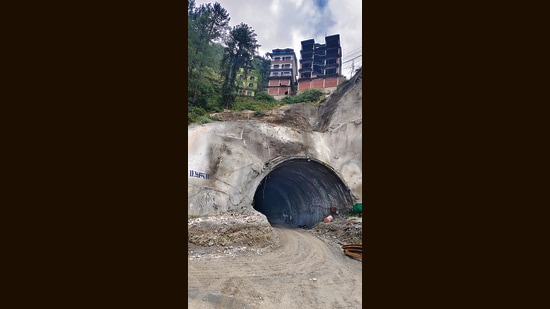
At least 16 buildings in the vicinity have developed similar structural damage, triggering panic among nearly 1,000 local families. The culprit, residents say, is the National Highways Authority of India’s (NHAI) underground twin-tunnel project being carved beneath one of the state capital’s most densely populated residential belts.
“Though the work has been halted temporarily, we are still afraid of sleeping in the house,” said Sharma, a member of the Twin Tunnel Affected Joint Struggle Committee. “We are clear. The proposed twin tunnel is not acceptable. We will not let this turn into another Joshimath,” he said, referring to the January 2023 disaster in Uttarakhand, where heavy underground tunneling triggered land subsidence, affecting over 800 structures and forcing evacuation. Residents fear Sanjauli’s fragile, heavily built slopes could face the same fate.
The struggle committee is also joined by Lekh Ram Koundal, 68, a retired government employee whose family home in Shimla’s Chamyana was damaged and rendered unsafe on June 30, 2025, during earlier four-lane highway excavations.
{{/usCountry}}The struggle committee is also joined by Lekh Ram Koundal, 68, a retired government employee whose family home in Shimla’s Chamyana was damaged and rendered unsafe on June 30, 2025, during earlier four-lane highway excavations.
{{/usCountry}}“We were among the first few victims of the four-lane project,” Koundal said, adding: “Our building was damaged and we were rendered homeless. We had to shift to a rented accommodation with only the clothes we were wearing.”
Despite three structural assessments—and a fourth now underway by court order—Koundal’s family continues to wait for compensation.
Change in plan
Backed by the Shimla Nagrik Sabha, the struggle committee and local councillor Vineet Sharma have called for a protest on October 16 to demand an immediate end to the tunneling.
“The point where construction is now heading poses a direct threat to about 300 buildings,” the councillor said. “We have demanded that no work be executed until a geological study is done and residents are convinced their homes are safe.”
Residents also question why NHAI abandoned its initial surface alignment in favour of underground drilling.
Initially planned as an open-cut four-lane surface highway under the Shimla bypass blueprint, the project aimed to bypass traffic bottlenecks between Bhattakufar and Dhalli. However, early slope instabilities and steep terrain challenges led NHAI to revise the alignment in favour of underground twin tunnels to avoid land acquisition and slope cutting.
Residents argue this change occurred without fresh public consent, local geological impact assessments, or disclosure of cost escalations.
“The land was already acquired after a survey and affected people were compensated. Why was that survey ignored in the name of a twin tunnel?” asked local resident Rajinder Chauhan. “If the plan changed, the technical basis, safety risks, and additional government expenditure must be made public,” he said.
Anshul Chauhan, a local engineer, said: “People only learned about the tunnels a month ago when problems started. The strata here are fragile. The NHAI installed monitoring equipment, but only after the damage was already done.”
Experts say the overburden above the tunnel crown consists of highly sheared slate, phyllite, and loose overburden material typical of Shimla’s slopes, susceptible to vibrations from excavation and subsurface water seepage changes. They say continued blasting or mechanical heading without pre-grouting could trigger subsidence, structural collapse, or hill-slope failure like what happened in Chamyana last year.
IIT-Roorkee roped in
Following district administration orders to suspend drilling, NHAI announced it will conduct a comprehensive building condition survey covering all 500 houses within the project’s zone of influence.
“We are working on confidence-building and will do everything to weed out doubts and fears,” said Anand Dahiya, NHAI project director, Shimla. “We are getting a building survey done, and only after the report will we resume work.”
The survey will document each structure’s baseline condition using photography and videography. Structurally weak buildings will be slated for reinforcement or repair.
Dahiya added that a team from the Indian Institute of Technology (IIT)-Roorkee has completed a preliminary visual inspection under directions from the district collector to analyse root causes and recommend safety precautions before any pending excavation resumes.