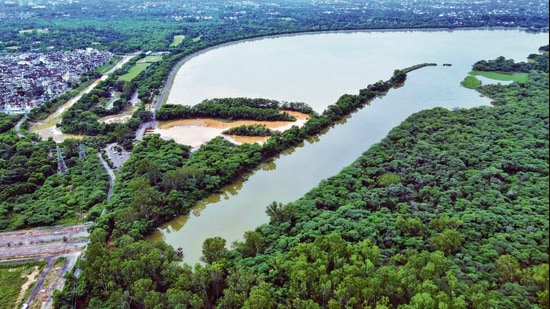
Sukhna Wetland has officially been declared a Ramsar site – an international recognition which will help strengthen conservation efforts besides putting it on the global map.
Instituted under the Ramsar Convention on Wetlands, an intergovernmental treaty signed in Ramsar, Iran, in 1971, the tag promotes the conservation and wise use of wetlands and preserving its biodiversity.
UT administrator Gulab Chand Kataria welcomed the development, stating that it will boost conservation efforts.
Spread over 565 acres, Sukhna wetland is surrounded by a catchment area of more than 10,000 acres that includes a wildlife sanctuary.
Declared a national wetland in 1988, Sukhna serves as a habitat for a range of floral and faunal species, particularly waterbirds and migratory birds travelling along the Central Asian Flyway.
Among the notable species supported by the ecosystem are the vulnerable common pochard (Aythya ferina) and the endangered Pallas’s fish eagle (Haliaeetus leucoryphus). Its shallow littoral habitats also support the endangered black pond turtle (Geoclemys hamiltonii).
The tag comes after UT’s sustained efforts, which had gathered momentum last year. In July this year, the Centre confirmed that the wetland was among four sites whose proposals had been submitted to the Ramsar Secretariat for consideration. The other sites were Glaw Lake in Arunachal Pradesh, the Gosabara-Mokarsagar Wetland Complex in Gujarat and Sauj Jheel in Uttar Pradesh. Until last year, India had 100 Ramsar sites. This year, three more sites were added to the list. With Glaw Lake receiving the tag in August, and now Sukhna and Sauj Jheel in Uttar Pradesh joining it, the figure has gone up to 106.